
In This Article
That first step out of bed. If you’ve got plantar fasciitis, you know exactly the one I mean — the sharp, stabbing jolt through your heel before your foot’s even properly woken up. It fades a bit as you move, then creeps back after you’ve been sitting for a while, like it’s been waiting for you. A foot massager for plantar fasciitis won’t cure that overnight, but the right one, used consistently, can genuinely help loosen the tight fascia and calf tissue that keeps making mornings miserable.
This guide isn’t dressed-up marketing copy. Every product below has been researched against real specifications and genuine aggregated review sentiment, not invented star ratings. We’ll compare seven real foot massagers sold in the UK — a mix of electric shiatsu machines and manual rollers — and then get into the things product listings gloss over: how a foot massager for plantar fasciitis differs from one aimed at neuropathy, what arch support can and can’t do, and which physiotherapist-recommended stretches actually pair well with a massage session. As the NHS explains, a physiotherapist can show you exercises to help ease plantar fasciitis symptoms, and a foot massager is a reasonable tool to support that — not replace it. Let’s get into the seven picks.
Quick Comparison Table
| Product | Best For | Type | Price Range |
|---|---|---|---|
| RENPHO Portable Foot Massager with Heat | All-round shiatsu + heat combo | Electric | £50-£70 range |
| Nekteck Shiatsu Foot Massager with Heat | CNN-tested budget favourite | Electric | £40-£55 range |
| Miko Shiatsu Foot Massager | Plantar fasciitis and neuropathy overlap | Electric | £45-£65 range |
| HoMedics Shiatsu Deluxe Foot Massager | Established heritage brand quality | Electric | £55-£80 range |
| TheraBand Foot Roller | Physio-designed manual stretching | Manual | Under £15 |
| Pro-Tec Athletics Spiky Massage Ball | Deep trigger-point pressure | Manual | Under £15 |
| Vibit Vibrating Foot Massager | Portable travel-friendly relief | Electric | Under £30 |
Looking at the spread, this list splits cleanly into two camps: powered shiatsu machines that do the work for you, and cheap manual tools that rely on your own bodyweight and consistency. The TheraBand Foot Roller and Pro-Tec Athletics Spiky Massage Ball cost less than a single physio session and are genuinely worth owning even if you eventually buy an electric unit too, while the RENPHO Portable Foot Massager with Heat and HoMedics Shiatsu Deluxe Foot Massager sit at the more considered end for people who want a hands-free daily routine. The Miko Shiatsu Foot Massager stands out for explicitly targeting both plantar fasciitis and neuropathy in its design brief, which matters if you’re not entirely sure which one you’re dealing with.
💬 Just one click — help others make better buying decisions too!😊
Top 7 Foot Massagers for Plantar Fasciitis: Expert Analysis
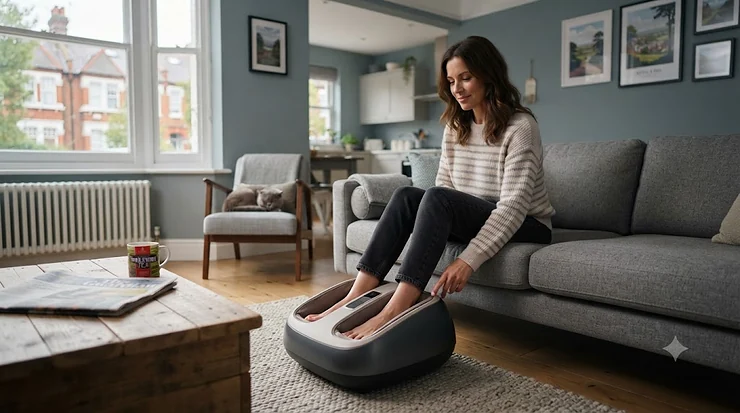
1. RENPHO Portable Foot Massager with Heat — shiatsu and air compression in one compact unit
The RENPHO Portable Foot Massager with Heat combines 3D shiatsu kneading with air compression and a soothing heat function, all in a unit that weighs under 3kg and is genuinely easy to store between uses. In practice, that combination matters more than it sounds — shiatsu nodes work on the deeper tissue of the arch and heel while the air compression squeezes rhythmically around the whole foot, which reviewers consistently describe as noticeably different from massagers that only do one or the other. Based on the spec comparison, this is a strong pick for anyone using the massager after a long day on their feet rather than first thing in the morning, since the heat function works best on tissue that’s already slightly warmed up. The mesh liners are detachable and washable, which matters for genuine daily use rather than an occasional treat. Aggregated review sentiment is broadly positive on comfort and ease of use, with the touch panel and remote control both flagged as genuinely intuitive, though it fits UK men’s shoe sizes up to a 10, so it’s worth double-checking fit for larger feet before buying.
Pros:
- ✅ Combines shiatsu kneading, air compression and heat in one unit
- ✅ Detachable, washable mesh liners for hygienic daily use
- ✅ Touch panel and remote control both rated genuinely easy to use
Cons:
- ❌ Fits up to UK men’s size 10, tight for larger feet
- ❌ Heat function works best on already-warm tissue, not first thing in the morning
At around £50-£70, it sits mid-pack on price but earns that with a genuinely multi-mode massage rather than a single fixed pattern.
2. Nekteck Shiatsu Foot Massager with Heat — the budget pick that punches above its price
Few names in this category carry as much independent credibility as the Nekteck Shiatsu Foot Massager with Heat. It was named the standout pick in CNN Underscored’s hands-on testing, beating out machines costing considerably more. What most buyers overlook about Nekteck is that its reputation isn’t built on flashy extras — it lacks a wireless remote, which some pricier rivals include — but on doing the core shiatsu-and-heat job consistently well at a genuinely accessible price. The unit uses deep kneading therapy with adjustable air compression across three modes, built specifically with plantar fasciitis relief as a stated use case rather than an afterthought. On paper, this makes it the sensible starting point for anyone who isn’t certain an electric foot massager will actually help them and doesn’t want to spend heavily to find out. Independent testers with plantar fasciitis and joint pain reported genuine relief using this specific model, which is a meaningfully stronger endorsement than a generic manufacturer claim, since it comes from hands-on comparative testing against several competing machines rather than marketing copy alone.
Pros:
- ✅ Independently tested and rated the top pick against pricier competitors
- ✅ Reported genuine relief specifically for plantar fasciitis and joint pain
- ✅ Strong value at one of the lower price points on this list
Cons:
- ❌ No wireless remote, unlike some pricier rivals
- ❌ Fewer massage mode variations than premium multi-function units
Priced in the £40-£55 range, it’s arguably the best entry point on this list for anyone testing whether an electric massager suits their routine.
3. Miko Shiatsu Foot Massager — built explicitly for plantar fasciitis and neuropathy overlap
The Miko Shiatsu Foot Massager is one of the few units on this list explicitly marketed and designed around both plantar fasciitis and neuropathy relief, rather than treating one as an afterthought feature. It uses deep kneading shiatsu nodes combined with heat therapy, positioned to improve circulation and blood flow — a genuinely relevant mechanism for neuropathy-related numbness and tingling, not just fascia tightness. Here’s what to weigh: because it’s designed to serve two fairly different conditions, the massage pattern is somewhat more generalised than a unit built purely around deep arch pressure, so buyers chasing maximum targeted pressure on the plantar fascia specifically might find a more focused unit slightly more effective. Fits up to men’s UK size 11 on the standard model, with a larger size-15 variant also available. The brand backs its products with a full year’s coverage, which is a genuinely useful signal of confidence for an electric device that’s handling repetitive daily pressure. Review sentiment consistently highlights the improved circulation and general foot comfort, with less consistent emphasis specifically on heel-point plantar fasciitis pain compared with more narrowly focused rivals.
Pros:
- ✅ Explicitly designed for both plantar fasciitis and neuropathy relief
- ✅ Heat therapy genuinely supports circulation, relevant to neuropathy symptoms
- ✅ Backed by a full year’s manufacturer coverage
Cons:
- ❌ Massage pattern is more generalised than fascia-focused rivals
- ❌ Standard size fits up to UK size 11 only, larger sizes need the size-15 variant
In the £45-£65 range, it’s the sensible pick specifically for buyers dealing with overlapping symptoms rather than a single, clearly isolated condition.
4. HoMedics Shiatsu Deluxe Foot Massager — heritage brand quality with rotational heads
HoMedics has spent over 25 years building a reputation in personal wellness electronics, and the HoMedics Shiatsu Deluxe Foot Massager reflects that maturity in its engineering rather than its marketing. It uses four rotational massage heads with ten distinct massage nodes, combining deep-kneading shiatsu technique with a warming function specifically stated to ease plantar fasciitis and nerve-related pain. What most buyers overlook about the rotational-head design specifically is that it delivers a more continuous, circular massage motion across the sole compared with static node designs, which several reviewers describe as feeling closer to a genuine hands-on massage than the simpler pressing-node machines. It ships with a two-year limited warranty, which is longer than several competitors on this list and reflects the brand’s established manufacturing confidence. On paper, this positions it at the premium end of the electric options here, aimed at buyers who see a foot massager as a long-term wellness investment rather than a short-term trial purchase.
Pros:
- ✅ Four rotational heads with ten nodes for continuous massage motion
- ✅ Backed by an above-average two-year limited warranty
- ✅ Built by an established 25-year wellness electronics brand
Cons:
- ❌ Sits at the premium end of the electric options on this list
- ❌ Rotational design is bulkier than flatter, more compact rivals
At around £55-£80, it’s priced as a considered long-term purchase rather than an impulse buy, and for buyers who want proven engineering pedigree, that’s a reasonable trade-off.
5. TheraBand Foot Roller — physiotherapist-designed manual stretching, hot or cold
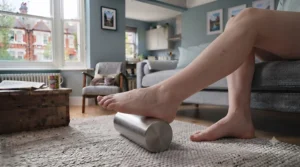
Not every effective tool here needs a power cord. The TheraBand Foot Roller is a simple, ridged, hollow-core roller made from natural latex, designed specifically to stretch the plantar fascia and increase flexibility — genuinely useful for treating both plantar fasciitis and heel spur discomfort according to the manufacturer’s stated design purpose. What most buyers overlook is that it includes basic exercise instructions written by a licensed physical therapist, which turns a simple roller into a genuinely structured rehab tool rather than a vague comfort gadget. Its hollow centre allows the natural latex to flex and conform to your foot shape even when chilled, since the roller can be placed in the fridge or freezer for cooling therapy specifically aimed at reducing inflammation — a genuinely useful dual-purpose feature that electric massagers can’t replicate. Compared against a spiky massage ball, reviewers consistently note that the roller covers more surface area under the arch and feels easier to control, while a ball can dig more intensely into one specific trigger point. Small enough for a desk drawer, gym bag or bedside table, it’s realistically the cheapest genuinely evidence-informed tool on this entire list.
Pros:
- ✅ Includes physical-therapist-designed exercise instructions
- ✅ Doubles as hot or cold therapy via fridge or freezer chilling
- ✅ Covers more surface area under the arch than a spiky ball
Cons:
- ❌ Entirely manual — results depend on consistent daily use
- ❌ Provides gentler pressure than a dedicated trigger-point ball
At under £15, it’s one of the smartest low-risk purchases on this entire list, and a sensible companion even alongside an electric massager.
6. Pro-Tec Athletics Spiky Massage Ball — deep, targeted trigger-point pressure
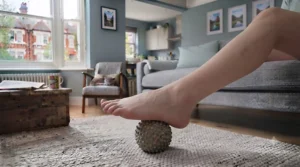
Where the TheraBand roller spreads pressure broadly, the Pro-Tec Athletics Spiky Massage Ball does the opposite: it concentrates pressure into a single point, which matters if your plantar fasciitis pain is localised to one specific spot rather than spread evenly across the arch. Its high-density construction and raised spiky texture are designed specifically to alleviate arch and heel discomfort by working directly into tight fascia and trigger points, rather than gently stretching the tissue the way a smooth roller does. Reviewers consistently note this is a more intense sensation than a roller, and it isn’t necessarily the right starting tool for someone with acute, highly sensitive pain — starting gently and building pressure gradually is the sensible approach here. Based on the spec comparison, this is best used as a targeted follow-up tool once the sharpest acute pain has settled, rather than a first-line treatment during a severe flare-up. Its small size (around 2.75 inches) makes it genuinely portable, and it holds up well over repeated use thanks to its dense construction, unlike cheaper foam balls that flatten or crack over time.
Pros:
- ✅ Concentrates pressure precisely on localised trigger points
- ✅ Dense, durable construction holds up to repeated daily use
- ✅ Small enough to carry anywhere, unlike bulkier roller tools
Cons:
- ❌ More intense sensation, potentially too much during acute flare-ups
- ❌ Less suited to broad, whole-arch discomfort than a roller
At under £15, it’s a natural companion purchase alongside the TheraBand roller rather than a standalone replacement for it.
7. Vibit Vibrating Foot Massager — portable relief for travel and small spaces
The Vibit Vibrating Foot Massager takes a different electric approach entirely — rather than shiatsu kneading nodes, it uses a portable vibrating roller design across three vibration levels, aimed at plantar fasciitis, sciatica and general foot pain relief. What most buyers overlook about vibration-based massagers is that they work through a genuinely different mechanism than kneading massagers: rapid, gentle oscillation rather than deep static or rotating pressure, which some people with more sensitive feet actually find more comfortable during the initial stages of managing plantar fasciitis. It isn’t limited to feet either — the design allows use on the calf, back and neck too, which adds genuine everyday versatility beyond a single-purpose foot tool. Its compact, cordless design makes it realistically the most travel-friendly option on this list, small enough to fit in a suitcase or work bag without a second thought. Aggregated review sentiment favours its portability and gentleness over raw intensity, positioning it as a supplementary relief tool rather than a primary deep-tissue treatment device.
Pros:
- ✅ Genuinely portable and cordless, ideal for travel
- ✅ Works on calf, back and neck as well as feet
- ✅ Gentler vibration mechanism suits sensitive feet
Cons:
- ❌ Less deep-tissue intensity than shiatsu kneading machines
- ❌ Best treated as a supplementary tool rather than a primary one
At under £30, it’s the pick for buyers who want something they’ll actually take with them rather than leave permanently by the sofa.
Practical Usage Guide: Getting the Most From Your Foot Massager
Timing changes everything with plantar fasciitis. Using a massager first thing in the morning, before the fascia has had a chance to warm up and stretch naturally through movement, can occasionally feel more uncomfortable than helpful — many people find it more effective to do a gentle few minutes of walking or the towel stretch first, then use an electric massager or roller once the tissue has slightly warmed. A common mistake in the first thirty days is going straight for maximum intensity; start on the lowest heat and pressure setting for the first week and build up gradually as your feet adjust, particularly with kneading or spiky-ball tools that concentrate pressure into a small area.
Consistency matters more than intensity. A daily five-to-ten-minute session, even a gentle one, tends to outperform occasional fifteen-minute sessions at maximum pressure, because plantar fasciitis responds best to regular, moderate stretching and circulation rather than sporadic deep-tissue intervention. For manual tools like the TheraBand roller, alternate between room-temperature and chilled use — chilled sessions after a long day on your feet, room-temperature sessions for gentle morning mobility. For electric units, clean the removable liners every one to two weeks with regular use, and avoid leaving any electric massager plugged in and unattended, particularly with the heat function running.
Real-World Scenarios: Which Massager Fits Which Situation
Picture three people searching this exact term tonight. The first is a nurse on twelve-hour shifts, standing on hard hospital flooring most of the day, whose heel pain is sharpest by the end of her shift rather than first thing in the morning. For her, the RENPHO Portable Foot Massager with Heat or HoMedics Shiatsu Deluxe Foot Massager makes more sense than a manual tool — she needs a genuinely restorative, hands-off session after a long day, and the combination of heat and kneading suits already-fatigued, warmed-up tissue.
The second is a runner managing early-stage plantar fasciitis who wants a genuinely evidence-informed, low-cost tool to use consistently as part of a broader stretching routine recommended by their physiotherapist. The TheraBand Foot Roller fits naturally here — it’s cheap enough to keep at a desk and by the bed, and its physio-designed instructions mean it slots directly into a structured daily rehab routine rather than functioning as a standalone gadget.
The third is someone managing both diabetic-related tingling and a separate bout of heel pain, unsure which condition is causing which symptom on any given day. That’s a genuinely better match for the Miko Shiatsu Foot Massager‘s dual plantar-fasciitis-and-neuropathy design brief than for a narrowly focused fascia tool — though as covered below, persistent numbness or tingling specifically warrants a GP conversation rather than a massager alone.
What Is a Foot Massager for Plantar Fasciitis?
A foot massager for plantar fasciitis is a tool — electric or manual — designed to apply targeted pressure, kneading or stretching to the sole of the foot, particularly the arch and heel, to help loosen the plantar fascia, improve local circulation and reduce the tightness that contributes to heel pain. It ranges from powered shiatsu machines with heat and compression to simple manual rollers and massage balls.
How to Choose a Foot Massager for Plantar Fasciitis
- Identify where your pain sits. Sharp, localised heel-point pain suits a targeted tool like a spiky massage ball; broader arch discomfort suits a roller or full-foot shiatsu machine.
- Consider your pain timing. If pain is worst in the morning, a gentle manual stretch tool may suit you better initially than an intense electric session.
- Check foot size compatibility on electric units. Several shiatsu machines max out around UK size 10-11, so always verify against your actual shoe size before buying.
- Decide between hands-off and hands-on. Electric massagers require no effort but cost more; manual rollers and balls cost far less but rely on your own consistency and technique.
- Look for genuine dual-purpose features. Hot-and-cold options, like the TheraBand roller’s fridge-chilling ability, add real functional value beyond a single fixed massage type.
- Weigh portability against features. If you’ll use it at a desk, in the car or while travelling, prioritise compact, cordless designs over bulkier full-feature units.
- Read aggregated review sentiment for your specific condition. A massager praised broadly for relaxation isn’t automatically the same as one specifically effective for plantar fasciitis pain — check what reviewers actually report relief from.
Common Mistakes When Buying a Foot Massager for Plantar Fasciitis
The most common mistake is assuming any foot massager will target plantar fasciitis specifically. Plenty of relaxation-focused massagers are built for general foot fatigue and simply don’t apply the concentrated arch and heel pressure that plantar fasciitis actually responds to — always check the listing specifically references plantar fasciitis or heel pain rather than general relaxation alone. The second mistake is going too intense too soon. Buyers frequently max out heat and pressure settings on day one, expecting faster relief, when in reality this can aggravate already-inflamed tissue; building intensity gradually over the first couple of weeks is the more sensible, and generally more comfortable, approach.
Third, buyers often expect a massager to replace stretching, supportive footwear and professional advice entirely, when it genuinely works best as one part of a wider routine. Finally, it’s easy to overlook foot size compatibility on electric units specifically — a machine rated up to UK size 10 will feel genuinely uncomfortable, not just snug, on a larger foot, so this is worth double-checking against the specific listing rather than assuming all “one size” claims are equal.
Foot Massager for Plantar Fasciitis vs Neuropathy: Which Condition Are You Actually Treating?
| Feature | Plantar Fasciitis | Peripheral Neuropathy |
|---|---|---|
| Typical pain pattern | Sharp, stabbing, worst with first steps | Burning, tingling, numbness, often worse at night |
| Common trigger | Overuse, tight calves, prolonged standing | Nerve damage, often linked to diabetes |
| Best massager type | Targeted arch/heel pressure (roller, spiky ball) | Gentle circulation-focused massage (heat, shiatsu) |
| Massage caution | Avoid excess pressure during acute flare-ups | Avoid high heat if sensation is reduced |
| Best For | TheraBand Foot Roller, Pro-Tec Athletics Spiky Massage Ball | Miko Shiatsu Foot Massager |
The distinction matters more than it might seem. Plantar fasciitis tends to produce sharp, mechanical pain that’s typically worst with your very first steps after rest, while peripheral neuropathy more commonly produces burning, tingling or numbness that often worsens at night rather than first thing in the morning. Because the underlying mechanism is different — mechanical tissue tightness versus nerve dysfunction — the ideal massage approach differs too: targeted, firmer pressure genuinely helps stretch tight fascia, while neuropathy generally responds better to gentler, circulation-focused massage, and caution is needed with heat if sensation in the foot is already reduced. If you’re genuinely unsure which condition you’re dealing with, or if numbness and tingling are persistent, that’s a conversation for a GP or podiatrist rather than something to diagnose from a product page.
Arch Support: What a Massager Can and Can’t Replace
Massage and arch support solve genuinely different problems, and it’s worth being clear-eyed about that distinction before assuming one replaces the other. A foot massager works on soft tissue — loosening tight fascia, improving blood flow, easing muscular tension. Arch support, whether from footwear, insoles or orthotics, works on mechanics — physically holding the arch in a position that reduces strain on the plantar fascia during every single step you take throughout the day, something no massage session, however good, can do while you’re up and walking around.
NHS patient guidance on plantar fasciitis treatment consistently recommends supportive, well-cushioned footwear and gel insoles or arch supports as a first-line self-care measure, alongside stretching and rest. What most buyers overlook is that a brilliant massager paired with flat, unsupportive shoes is fighting an uphill battle — you’re loosening the tissue in the evening only for unsupportive footwear to re-strain it the next day. The two approaches work best together: a massager to manage existing tightness and discomfort, and genuine arch support in your everyday footwear to reduce how much strain builds up in the first place. If your current shoes have flexible, unsupportive soles, that’s arguably a more urgent purchase than any massager on this list.
Heel Spur Pain: Where Massage Helps and Where It Doesn’t
A heel spur is a small, bony calcium deposit that can develop where the plantar fascia attaches to the heel bone, often (though not always) alongside plantar fasciitis. Here’s what’s genuinely useful to understand: the spur itself is frequently not the actual source of pain — it’s often the surrounding inflamed soft tissue that hurts, which is exactly what a foot massager can help address. Gentle, consistent massage around the heel and arch, particularly combined with stretching, can meaningfully ease the soft-tissue inflammation associated with heel spur pain even though it obviously can’t dissolve or remove the bony deposit itself.
Where massage genuinely reaches its limit is if pain is severe, sharply localised to one specific point on the bone itself, or unresponsive to weeks of consistent self-care — that pattern warrants a GP or podiatrist assessment rather than continued self-massage, since options like targeted injections or, in persistent cases, further clinical intervention may be more appropriate. For general heel spur discomfort alongside typical plantar fasciitis symptoms, though, the same tools that help fascia tightness — the TheraBand Foot Roller for broad stretching, or a shiatsu machine like the RENPHO Portable Foot Massager with Heat for circulation and general soft-tissue relief — are a genuinely sensible, low-risk first step.
Physiotherapist-Recommended Stretches to Pair With Your Massager
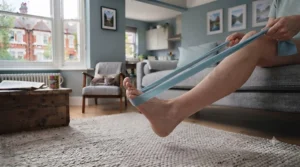
A massager works considerably better alongside proper stretching than it does alone, and the good news is the core physiotherapist-recommended stretches for plantar fasciitis are simple enough to do daily without any equipment. The plantar fascia towel stretch, commonly recommended by NHS physiotherapy services, involves sitting with your leg stretched out, looping a towel around the ball of your foot, and gently pulling your toes back toward your shin until you feel a stretch through the arch and calf — typically held for around twenty seconds and repeated a few times, ideally first thing in the morning before you take your first steps.
The seated plantar fascia stretch is a close cousin: sit on a chair, cross one leg over the other, hold your toes and gently pull them back toward your shin until you feel the stretch directly in the arch. A calf stretch against a wall — one foot forward, one back, leaning gently through the front leg — is equally important, since tight calf muscles place additional strain on the plantar fascia during every step. What most buyers overlook is the order of operations: stretching first, then massaging, tends to be more effective than the reverse, since it’s easier to work loosened tissue than tight tissue. If any stretch consistently increases rather than eases your pain, that’s worth raising with a physiotherapist directly rather than pushing through it.
Long-Term Cost & Maintenance
Cost per use varies dramatically across this list, and it’s worth thinking in those terms rather than sticker price alone. A £45 electric shiatsu massager used daily for two years works out to a matter of pence per session — considerably cheaper than a single private physiotherapy appointment, let alone a course of them. The manual tools are even more dramatic: a £12 TheraBand roller used consistently over years costs essentially nothing per session once you account for its realistic lifespan, since natural latex rollers with no moving parts and no electronics have very little to actually wear out.
Maintenance for electric units centres on cleaning removable liners regularly and avoiding excessive heat exposure or leaving units plugged in unattended, both of which extend realistic lifespan considerably. Manual tools need almost no maintenance beyond an occasional wipe-down, though it’s worth periodically checking a spiky massage ball for cracking or hardening over time, since dense foam and rubber can degrade with heavy daily use over several years. Total cost of ownership across this entire category is genuinely low compared with ongoing professional treatment, which is exactly why combining an affordable home tool with occasional professional check-ins, rather than choosing one or the other, tends to be the most cost-effective long-term approach.
Safety and When to See a Professional
A foot massager is a genuinely low-risk self-care tool for general plantar fasciitis discomfort, but it isn’t a substitute for professional assessment in every situation. According to NHS guidance, if plantar fasciitis symptoms don’t improve with self-care measures like stretching, supportive footwear and rest, the next step is typically a physiotherapist or podiatrist referral, often available through NHS community musculoskeletal services without needing to go through a GP first in many areas. That’s a meaningfully accessible route worth knowing about rather than assuming private treatment is the only option.
Certain symptoms specifically warrant faster professional attention rather than continued self-massage: pain that’s severe, worsening despite weeks of consistent self-care, accompanied by significant swelling, or presenting alongside numbness, tingling or weakness that could indicate a nerve-related cause rather than straightforward fascia tightness. People with diabetes or reduced foot sensation should be particularly cautious with heat settings on electric massagers, since reduced sensation increases the risk of not noticing excessive heat until skin damage has already occurred. Used sensibly, within these limits, a foot massager remains one of the simplest, lowest-cost tools available for managing everyday plantar fasciitis discomfort.
FAQ
❓ Do foot massagers actually help plantar fasciitis?
❓ Is a foot massager for plantar fasciitis different from one for neuropathy?
❓ Can a foot massager help with heel spur pain?
❓ How often should I use a foot massager for plantar fasciitis?
❓ Should I stretch before or after using a foot massager?
Conclusion
There’s no single “best” foot massager for plantar fasciitis here — there’s a best one for your specific pain pattern, budget and daily routine. The Nekteck Shiatsu Foot Massager with Heat remains the smartest starting point for most people thanks to its independently verified performance at an accessible price, while the RENPHO Portable Foot Massager with Heat and HoMedics Shiatsu Deluxe Foot Massager justify their higher price tags through genuinely more capable, multi-mode engineering. If your symptoms overlap with neuropathy, the Miko Shiatsu Foot Massager‘s dual design deserves serious consideration, and the manual TheraBand Foot Roller and Pro-Tec Athletics Spiky Massage Ball together cost less than a single physio session while offering genuinely evidence-informed, physiotherapist-designed relief.
What all seven share is the same underlying principle: consistent, appropriately targeted pressure on tight fascia tissue, paired with proper stretching and supportive footwear, is one of the simplest and lowest-risk ways to manage everyday plantar fasciitis discomfort. Match the tool to your specific pain pattern rather than chasing the highest star rating in isolation, keep at it daily rather than sporadically, and don’t hesitate to bring in a physiotherapist or podiatrist if things aren’t improving — you’ll get considerably more value from whichever pick you choose.
Recommended for You
- Pedicure Foot Spa: 7 Best Picks for an At-Home Salon (2026)
- Heated Foot Spa Review: 7 Best Picks for UK Homes (2026)
- Heated Foot Massager for Arthritis: 7 Gentle Picks (2026)
Disclaimer: This article contains affiliate links. As an Amazon Associate, I earn from qualifying purchases. If you purchase products through these links, we may earn a small commission at no additional cost to you.
✨ Found this helpful? Share it with your friends! 💬🤗
