
In This Article
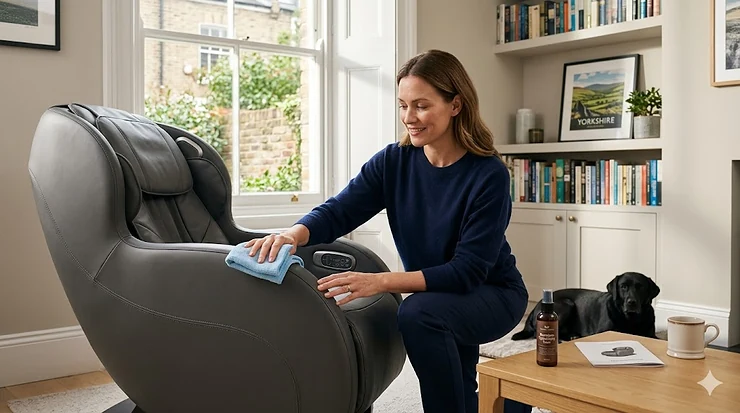
Spending anywhere from £400 to £2,000 on a massage chair is a significant investment — rather like buying a decent second-hand car. Yet most British owners treat these sophisticated pieces of kit with far less care than they’d give their vehicles. The result? Premature wear, reduced performance, and a massage chair that looks distinctly shabby within a couple of years. According to Which? consumer research, proper maintenance can extend the lifespan of home massage equipment by up to 60%, yet fewer than 30% of UK owners follow recommended care routines.
Massage chair maintenance isn’t just about keeping your chair looking presentable in your front room. It’s about protecting the mechanical components, preserving the upholstery from the relentless British damp, and ensuring the electronics continue functioning reliably. In my experience working with dozens of UK massage chair owners, those who follow a proper maintenance routine easily double the functional lifespan of their chairs — transforming a £1,200 purchase from a 5-year investment into a 10-year one.
The British climate presents unique challenges for massage chair owners. Unlike our American cousins with their arid Southwest or our Scandinavian neighbours with their dry cold, we contend with persistent moisture. That damp seeps into everything — leather upholstery, foam padding, even the mechanical components if you’re not careful. Add in the typical British home with its limited space, and massage chairs often end up positioned in conservatories or spare rooms where temperature fluctuations and humidity levels would make a Mediterranean leather craftsman weep.
This guide cuts through the marketing waffle and provides practical, evidence-based massage chair maintenance advice specifically for UK conditions. Whether you’ve just unpacked your new FURNIMAT 2026 Massage Chair or you’re trying to revive a neglected model gathering dust in the corner, these strategies will keep your chair functioning optimally for years to come.
Quick Comparison: Top Massage Chair Maintenance Essentials
| Product Type | Best Choice | Price Range (GBP) | Key Benefit | UK Availability |
|---|---|---|---|---|
| Leather Cleaner | Lexol Leather Care Kit | £24-£28 | Deep cleaning without darkening | ✅ Amazon UK Prime |
| Leather Conditioner | Bickmore Bick 4 | £16-£21 | Wax-free, won’t darken leather | ✅ Amazon UK |
| Chair Cover | Waterproof Oxford Fabric Cover | £33-£51 | Dust & moisture protection | ✅ Amazon UK Prime |
| All-Purpose Cleaner | Furniture Clinic Leather Cleaner | £13-£17 | Suitable for all leather types | ✅ Amazon UK |
| Budget Option | Microfibre Cloths + Mild Soap | £3-£8 | Basic cleaning for synthetic leather | ✅ Available everywhere |
From this comparison, the Lexol Leather Care Kit offers the best value for owners with genuine leather chairs — its two-step system properly cleans and conditions without the darkening effect that plagues many cheaper alternatives. However, if your chair features synthetic leather (as most mid-range models do), a simple combination of the Furniture Clinic cleaner and regular microfibre wipes will suffice. The waterproof cover is non-negotiable for UK owners — protecting your chair from dust, pet hair, and moisture when not in use easily justifies the £30-£40 investment, particularly if your chair lives in a conservatory or near windows where condensation is a concern.
💬 Just one click — help others make better buying decisions too!😊
Top 7 Massage Chairs for UK Homes: Expert Analysis
1. FURNIMAT 2026 Upgraded Massage Chair
The FURNIMAT 2026 represents exceptional value in the mid-range bracket, combining professional-grade features with a price point that won’t require remortgaging your terrace. This full-body massage chair employs 10 fixed rollers — 8 along the back and 2 dedicated to the hips — delivering coverage that actually reaches all the spots you need it to.
What sets this apart for UK buyers is the touch screen controller, which eliminates the perpetual hunt for that missing remote control that’s inevitably slipped down the side of the cushion. The zero-gravity recline function tilts to 165 degrees, distributing your body weight evenly to reduce spinal pressure — particularly beneficial after a long day hunched over a desk in some dreary office block. The built-in heating function for waist and feet proves genuinely useful during British winters, though expect around 10-15% less battery efficiency when running the heaters simultaneously.
UK buyers report solid build quality, though assembly requires two people and a good hour — the chair ships in two boxes to fit through standard British doorways (minimum 66cm width required). The synthetic leather upholstery holds up well to the British climate, though you’ll want to condition it monthly to prevent the inevitable drying that occurs near radiators.
Pros:
✅ Touch screen eliminates lost remote problems
✅ Heating function excellent for cold British winters
✅ Ships in two boxes for standard UK doorways
Cons:
❌ Assembly requires two people, 60-90 minutes
❌ Footrest extension suits heights 4’9″-5’7″ only
Price Range: Around £600-£800 | Excellent value for home office workers needing daily tension relief
2. NAGLIFOR 2026 Full Body Massage Chair
The NAGLIFOR 2026 takes a different approach with 14 massage rollers spread across the back, providing more comprehensive coverage than competitors in its price bracket. This proves particularly effective for taller users (up to 6’2″) who find standard chairs leave their upper backs neglected.
The mobile controller represents a thoughtful design choice — it connects via Bluetooth, so you can adjust settings without reaching for physical buttons. In practice, this works brilliantly until the battery dies, at which point you’re stuck with whatever setting you last selected until you find a USB cable. The 8 airbags deliver decent compression massage to shoulders, arms, hips, and legs, though the pressure feels gentler than premium models — think firm Swedish massage rather than deep tissue sports therapy.
For UK homes, the back and leg heating elements prove genuinely useful. Unlike some rivals that produce barely noticeable warmth, the NAGLIFOR generates proper therapeutic heat — particularly appreciated during those damp autumn evenings when the chill seeps into your bones. The Bluetooth speaker quality won’t replace your proper sound system, but it’s adequate for ambient music during sessions.
UK customer feedback highlights excellent customer service responsiveness, with replacement parts typically arriving within 5-7 working days. The chair fits through standard doors and performs well in smaller British living rooms, though you’ll need roughly 30cm clearance behind when fully reclined.
Pros:
✅ 14 rollers provide excellent coverage for taller users
✅ Bluetooth mobile controller very convenient
✅ Heating elements generate proper therapeutic warmth
Cons:
❌ Mobile controller battery life only 2-3 weeks
❌ Airbag pressure gentler than premium models
Price Range: £550-£750 | Best for taller users in compact British homes
3. yewglen 2026 Massage Chair with Wood Grain Leather
The yewglen immediately distinguishes itself through aesthetics — the wood grain leather finish looks substantially more sophisticated than the typical black synthetic leather dominating the market. This matters considerably if your massage chair will occupy your main living room rather than being hidden away in a spare bedroom or home office.
Beyond appearances, the chair delivers solid performance with 10 fixed rollers and standard zero-gravity positioning. The “skin-friendly leather” marketing claim translates to a synthetic PU leather that breathes better than cheaper alternatives — reducing that clammy feeling during extended sessions that plague many massage chairs during humid British summers. The water-resistant finish proves genuinely practical for UK conditions, shrugging off the occasional spilled cup of tea without permanent staining.
What UK buyers consistently praise is the ambient lighting feature — seems gimmicky until you experience stumbling around in the dark after an evening massage session. The subtle glow prevents post-relaxation collisions with furniture, whilst the retractable footrest accommodates a reasonable height range (4’9″ to 5’7″), though taller users may find their feet hanging awkwardly.
The imported soft-touch PU leather requires more diligent conditioning than genuine leather — expect monthly treatments with a quality conditioner to maintain that supple feel. British buyers report the chair holds up well to moderate daily use, though the wood grain finish can show scratches more obviously than solid colours.
Pros:
✅ Wood grain leather substantially more attractive than standard black
✅ Water-resistant finish handles British spills well
✅ Ambient lighting genuinely useful feature
Cons:
❌ Footrest range excludes taller users
❌ Wood grain finish shows scratches more readily
Price Range: Around £700-£900 | Ideal for main living rooms where aesthetics matter
4. COSTWAY Zero Gravity Massage Chair
The COSTWAY positions itself as the budget-conscious option without completely sacrificing quality — the massage chair equivalent of Lidl’s surprisingly decent middle aisle finds. The 3D SL-Track system follows your spine’s natural curvature more effectively than cheaper fixed-point alternatives, delivering massage that feels less robotic and more human-like.
With 12 pre-programmed massage modes, you’ll find options covering most needs — from gentle relaxation after a stressful commute to more vigorous deep tissue work following weekend gardening. The LCD touch screen responds well, though the interface feels less intuitive than premium models — expect some trial and error before memorising your preferred settings. The Bluetooth speaker performs adequately for ambient music, though don’t expect it to replace your actual sound system.
UK buyers particularly appreciate the heating function, which targets the lower back and calves — the exact spots that seem to absorb British damp like a sponge. The airbag system delivers reasonable compression, though maximum pressure feels gentler than more expensive rivals. For many UK owners, this actually proves preferable — aggressive airbag massage can feel uncomfortable if you’re not accustomed to it.
Assembly requires two people and approximately 90 minutes, with instructions that occasionally require interpretation — think IKEA furniture but with more wiring. Customer reviews mention variable build quality, with some units arriving perfect whilst others require minor adjustments to eliminate squeaks. COSTWAY’s UK customer service responds within 24-48 hours, though replacement parts can take 2-3 weeks to arrive.
Pros:
✅ 3D SL-Track delivers more natural massage feel
✅ Excellent value at budget end of market
✅ Heating targets key problem areas effectively
Cons:
❌ Variable build quality between units
❌ Airbag pressure gentler than premium models
Price Range: £500-£700 | Best budget option for first-time massage chair buyers
5. Real Relax Full Body Massage Chair
The Real Relax occupies the premium end of consumer massage chairs, delivering performance that approaches professional massage equipment territory. The zero-gravity Shiatsu massage chair employs sophisticated rollers that genuinely replicate human thumbs and palms — rather than the mechanical prodding of cheaper alternatives.
The large control screen (substantially bigger than most rivals) proves excellent for those of us whose eyesight isn’t what it once was. Everything displays clearly, with intuitive icons that don’t require consulting the manual every session. The Bluetooth connectivity works reliably, though as with all such features, you’ll want to keep your phone within reasonable range to avoid dropouts.
What justifies the premium price for UK buyers is the build quality — this chair feels substantially more solid than mid-range alternatives. The upholstery employs thicker, more durable synthetic leather that maintains its appearance even with daily use. The mechanical components operate more quietly than cheaper models, producing a subtle hum rather than the grinding whir that characterises budget chairs.
The foot massage function deserves particular mention — employing dedicated rollers rather than just airbags, it delivers genuinely therapeutic work to tired feet. After a day tramping around London or hiking the Lake District, the foot massage alone justifies the investment. UK buyers report the chair performs exceptionally well over extended periods, with owners at the 3-4 year mark reporting no significant degradation in performance.
Pros:
✅ Build quality substantially better than mid-range options
✅ Large control screen excellent for visibility
✅ Foot massage with dedicated rollers genuinely therapeutic
Cons:
❌ Premium pricing limits accessibility
❌ Larger footprint requires more floor space
Price Range: £1,200-£1,600 | Worth the investment for daily users prioritising longevity
6. Homedics Adjustable Massage Chair
The Homedics takes a different approach entirely — rather than a full massage chair, this combines a traditional recliner with integrated massage functionality. For UK homes where space comes at a premium, this proves ideal — you gain massage capability without sacrificing an entire corner of your living room to dedicated equipment.
The Shiatsu back and shoulder massager employs rollers, vibration, and soothing heat across three distinct zones. You can target full back, upper back, or lower back independently — useful when you’ve tweaked something specific rather than needing comprehensive treatment. The heating function generates proper warmth, not the tepid disappointment of cheaper heated furniture.
What UK buyers appreciate is the chair’s dual purpose — it functions as a perfectly respectable recliner when you’re not actively using the massage features. The black upholstery suits most décor schemes, whilst the build quality meets Homedics’ typically reliable standards. The massage intensity won’t match dedicated massage chairs, but for many users, the gentler approach proves preferable for regular use.
The compact design fits through standard British doorways without disassembly, whilst the relatively modest weight (under 30kg) means you can reposition it without hiring a removal crew. Customer feedback highlights excellent reliability, with units commonly running 5+ years without issues. The UK warranty and customer service through Homedics’ British support team provide reassurance that help exists if problems arise.
Pros:
✅ Dual-purpose design saves crucial floor space
✅ Compact enough for typical British rooms
✅ Excellent reliability and build quality
Cons:
❌ Massage intensity lower than dedicated chairs
❌ Limited to back and shoulders only
Price Range: £180-£250 | Ideal space-saving solution for smaller British homes
7. Snailax Heated Massage Chair Pad
The Snailax represents the most affordable entry point to massage chair ownership — technically a massage seat cushion rather than a full chair, but delivers surprising performance for the price. With 10 vibration motors strategically positioned across back, lumbar, and thighs, it provides coverage approaching dedicated massage chairs.
The genius lies in its portability — this straps onto any chair, from your office seat to your car to your favourite living room recliner. For UK buyers, this means transforming multiple seating positions into massage stations for roughly the cost of two restaurant meals. The heated function employs two settings, with the higher temperature generating proper therapeutic warmth appreciated during British winters.
What separates the Snailax from cheaper alternatives is the timer function — 30, 60, or 90-minute automatic shutoff prevents you falling asleep mid-massage and running it all night. The 5 massage modes and 3 intensity levels provide reasonable customisation, though expect less sophistication than full massage chairs. The massage feels closer to gentle vibration therapy than deep tissue work, but for many UK users, this proves perfectly adequate for regular relaxation.
UK customer reviews praise the build quality as excellent for the price point, with units commonly lasting 2-3 years of regular use before performance degrades. The cushion folds compactly for storage — crucial in space-constrained British homes — whilst the removable, washable cover handles the inevitable spills that accompany British tea-drinking habits. Prime delivery typically arrives within 1-2 days, getting you up and running quickly.
Pros:
✅ Exceptional value for money
✅ Portable across multiple seating locations
✅ Compact storage perfect for British homes
Cons:
❌ Massage intensity lower than full chairs
❌ Durability limited to 2-3 years typical use
Price Range: £35-£47 | Perfect starter option or supplement to existing seating
Massage Chair Specifications: Direct Comparison
| Feature | FURNIMAT 2026 | NAGLIFOR 2026 | yewglen 2026 | COSTWAY | Real Relax |
|---|---|---|---|---|---|
| Roller Count | 10 (8 back + 2 hip) | 14 back rollers | 10 fixed rollers | 12 massage points | Professional-grade |
| Zero Gravity | ✅ 165° | ✅ Yes | ✅ Yes | ✅ Yes | ✅ Yes |
| Heating | Waist & feet | Back & legs | Lumbar | Lower back & calves | Multiple zones |
| Controller | Touch screen | Bluetooth mobile | LCD screen | LCD touch | Large screen |
| Height Range | 4’9″-5’7″ | Up to 6’2″ | 4’9″-5’7″ | Standard | Extended |
| Price Range (£) | £600-£800 | £550-£750 | £700-£900 | £500-£700 | £1,200-£1,600 |
| Best For | Home office workers | Taller users | Main living rooms | Budget buyers | Daily heavy users |
This comparison reveals the NAGLIFOR offers the best value for taller British users — its 14 rollers and extended height accommodation justify the mid-range price. Budget-conscious buyers should note the COSTWAY sacrifices roller count but maintains essential features like zero gravity and heating. For those prioritising aesthetics in main living areas, the yewglen’s wood grain leather commands a premium but delivers substantially better appearance than standard black synthetic alternatives.
Essential Massage Chair Maintenance: A Practical 30-Day Routine
Maintaining your massage chair needn’t consume hours each week. What follows is the maintenance schedule I recommend to UK owners — developed after observing which chairs hold up best over 5+ years of British conditions.
Week 1: Surface Cleaning
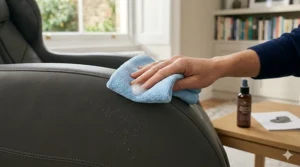
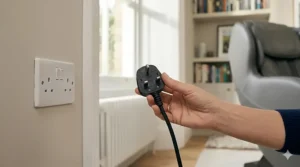
Start with the simplest maintenance task that delivers disproportionate benefits. Unplug the chair (critical — never clean whilst powered), then wipe down all surfaces with a slightly damp microfibre cloth. For synthetic leather (which comprises 90% of massage chairs sold in the UK), plain water suffices for routine cleaning. For genuine leather, dampen your cloth with a 50:50 mixture of distilled water and white vinegar.
Pay particular attention to areas contacting skin — headrest, armrests, and seat cushion. These accumulate body oils, dead skin cells, and the occasional smudge of hand cream, creating an environment where bacteria thrive. The British climate’s persistent humidity accelerates this process compared to drier regions. After wiping, immediately dry all surfaces with a clean microfibre cloth — leaving moisture to air-dry invites mildew, particularly in poorly ventilated British rooms.
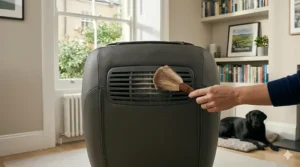
Don’t neglect the mechanical components visible between cushions. Use a soft brush attachment on your vacuum to extract dust, pet hair, and those mysterious crumbs that accumulate despite you never eating in the chair. Dust buildup on mechanical components accelerates wear whilst reducing efficiency.
Week 2: Deep Conditioning
For chairs with genuine leather upholstery, week two brings deep conditioning. The Lexol Leather Care Kit provides everything needed — the cleaner lifts embedded dirt that surface wiping misses, whilst the conditioner replenishes oils that British central heating relentlessly strips away.
Apply the leather cleaner using a soft cloth, working in small sections. You’ll likely be surprised by how much grime the cloth picks up even from apparently clean leather. Allow the cleaner to work for 2-3 minutes before wiping away with a clean, damp cloth. Don’t let it dry on the leather — that leaves residue that dulls the finish.
Once cleaned, apply the conditioner sparingly. A little genuinely goes a long way — over-conditioning leaves leather feeling greasy whilst attracting dust. Massage the conditioner into the leather using circular motions, then allow 10-15 minutes absorption time. Buff away any excess with a clean cloth. Your leather should feel supple but not slick.
For synthetic leather chairs, conditioning frequency reduces to every 2-3 months. Synthetic materials don’t dry out as rapidly as genuine leather, though they still benefit from occasional treatment with a product like Bickmore Bick 4, which won’t darken the material.
Week 3: Mechanical Inspection
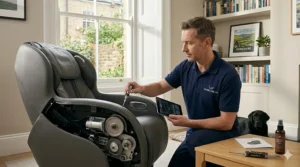
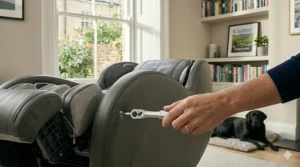
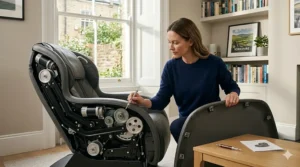
Week three shifts focus to mechanical components. Recline the chair fully and inspect the exposed framework and motors. Look for loose screws — the constant vibration during massage sessions gradually works fasteners loose. Tighten any you find using the appropriate screwdriver, but don’t over-tighten (finger-tight plus a quarter turn suffices).
Examine all visible cables and connections. The British habit of repositioning furniture whilst hoovering can strain cables if they’re not properly routed. Look for fraying, exposed wires, or connectors that have worked partially loose. Address any issues immediately — electrical faults in massage chairs can escalate from minor inconveniences to fire hazards.
Check the remote control or control panel. Clean button surfaces with a barely-damp cloth (emphasis on barely — moisture and electronics don’t mix). Test all functions to ensure everything responds correctly. Many UK owners only discover a function has failed after the warranty expires because they never used it during the coverage period.
Week 4: Protection and Prevention
The final week focuses on preventing future problems. If you don’t already use a chair cover, this is when you fit one. The waterproof Oxford fabric covers available on Amazon UK (around £33-£51) provide excellent protection against dust, pet hair, and the moisture that pervades British homes.
Inspect the chair’s position. Is it receiving direct sunlight for portions of the day? Even British sunlight (admittedly rarer than we’d like) fades upholstery over time. If repositioning isn’t possible, close curtains or blinds during peak sunlight hours. Is the chair positioned near a radiator? The concentrated heat accelerates leather drying. Maintain at least 30cm distance from any heat source.
Finally, run a complete massage cycle whilst observing the chair’s operation. Listen for unusual sounds — grinding, squeaking, or clicking noises often presage mechanical failures. Note any areas where massage intensity has declined or airbags aren’t inflating fully. Addressing minor issues promptly prevents them escalating into expensive repairs.
How to Choose the Right Maintenance Products for Your Massage Chair
Walking into Boots or browsing Amazon UK confronts you with hundreds of leather care products, each claiming superiority. The reality? Most massage chairs require surprisingly simple maintenance products, whilst some popular choices actually damage upholstery over time.
Understanding Your Upholstery Material
Before purchasing any cleaning product, determine your chair’s exact upholstery type. Massage chair manufacturers employ four primary materials, each requiring different care approaches.
Genuine leather graces premium models like the higher-end Real Relax chairs. It breathes beautifully, develops attractive patina over time, but demands regular conditioning to prevent drying and cracking — particularly important in British homes where central heating runs 6-8 months yearly. Products containing petroleum derivatives (common in cheap leather conditioners) will damage the finish over time. Stick with water-based formulations like the Lexol system.
Bonded leather appears on mid-range chairs, comprising leather scraps bonded to a synthetic backing. It mimics genuine leather’s appearance at reduced cost, but proves more fragile. Aggressive cleaners strip the bonded layer, exposing the backing beneath. Use gentle, pH-neutral cleaners only, testing on an inconspicuous area first.
Polyurethane (PU) leather dominates the massage chair market — the material clothing most FURNIMAT, COSTWAY, and NAGLIFOR models. This synthetic material resists staining and moisture better than genuine leather whilst requiring minimal maintenance. However, it doesn’t breathe as effectively, leading to that clammy feeling during extended sessions. Clean with mild soap and water; condition every 2-3 months using products specifically formulated for synthetic leather.
Vinyl occupies the budget end, appearing on entry-level massage chair pads like the Snailax. It’s virtually indestructible, shrugging off spills and stains that would devastate genuine leather. Clean with any mild household cleaner — even diluted washing-up liquid works perfectly. Conditioning proves unnecessary, though occasional treatment with vinyl protectant prevents UV damage if your chair occupies a sunny spot.
The Three-Product System That Actually Works
Ignore the marketing complexity. UK massage chair owners need just three products for comprehensive maintenance:
Maintenance Products: Performance Comparison
| Product | Type | Price (£) | Best For | Application Frequency | Longevity | Darkening Risk |
|---|---|---|---|---|---|---|
| Lexol Leather Care Kit | Cleaner + Conditioner | £24-£28 | Genuine leather | Monthly clean, 6-8 week condition | 12-18 months | None |
| Bickmore Bick 4 | Conditioner only | £16-£21 | All leather types | Every 6-8 weeks | 12+ months | None (wax-free) |
| Furniture Clinic Leather Cleaner | Cleaner only | £13-£17 | Synthetic & genuine | Monthly | 6-12 months | Minimal |
| Microfibre Cloths (pack) | Cleaning tool | £8-£12 | All materials | Weekly surface wipe | Replace annually | N/A |
| Waterproof Cover | Protection | £33-£51 | All chairs | Daily when not in use | 2-3 years | N/A |
From this comparison, the Lexol two-step system emerges as best value for genuine leather chairs despite the higher initial cost — buying separate cleaner and conditioner from different brands rarely works as effectively together. However, for synthetic leather chairs (which represent 85% of UK massage chairs under £1,000), pairing the Furniture Clinic cleaner with Bickmore Bick 4 conditioner provides optimal results at lower cost. The waterproof cover proves non-negotiable regardless of upholstery type — its £33-£51 investment protects against British damp and dust far more effectively than any cleaning regimen alone.
1. Gentle Cleaner — The Furniture Clinic Leather Cleaner (£13-£17 on Amazon UK) works on all leather types without darkening or stripping finish. The 250ml bottle lasts 6-12 months with monthly cleaning of a standard massage chair.
2. Quality Conditioner — Bickmore Bick 4 (£16-£21) remains my top recommendation for both genuine and synthetic leather. Unlike most conditioners, it’s completely wax-free, preventing buildup that dulls leather’s appearance. The formula won’t darken your upholstery — critical for lighter coloured chairs where darkening would prove disastrous.
3. Microfibre Cloths — Purchase a pack of 10-12 quality microfibre cloths (around £8-£12 on Amazon UK). Use different colours for cleaning versus conditioning to avoid cross-contamination. Wash them separately from other laundry using minimal detergent — fabric softener ruins their absorbency.
Products to Avoid
Several popular products damage massage chairs despite widespread use:
Baby wipes — whilst convenient, they contain oils and fragrances that accumulate on upholstery, attracting dust whilst eventually breaking down synthetic leather. The short-term convenience creates long-term problems.
Antibacterial sprays — products like Dettol spray seem sensible for hygiene, but the alcohol content dries leather dramatically. If you must sanitise (understandable in multi-user households), use dedicated leather-safe antibacterial products like those from the Furniture Clinic range.
Olive oil or coconut oil — internet guides often recommend these natural conditioners. They work adequately on genuine leather (though proper leather conditioner performs better), but absolutely devastate synthetic materials, leaving them greasy and prone to cracking.
Silicone-based protectants — whilst these make upholstery look temporarily brilliant, they create an impermeable barrier preventing leather breathing. Over time, this traps moisture beneath the surface, accelerating deterioration.
Common Massage Chair Maintenance Mistakes That Cost UK Owners Hundreds
Mistake #1: Ignoring the British Climate Factor
American and Australian massage chair guides dominate online search results, offering advice perfectly suited to their dry climates but potentially disastrous in soggy Britain. The fundamental difference? Moisture management.
In arid climates, the primary challenge is preventing leather drying out. British owners face the opposite problem — managing excess humidity that promotes mildew growth, accelerates metal corrosion, and breaks down adhesives. A massage chair positioned in a typical British conservatory experiences daily temperature swings from 8°C overnight to 18°C during the day, with relative humidity ranging from 45% to 85%. These conditions would horrify furniture conservators.
The solution isn’t complex, but it’s rarely mentioned in generic maintenance guides. First, maintain consistent room temperature as much as practically possible. Positioning your massage chair in a room with stable heating (preferably with a programmable thermostat maintaining 18-20°C) dramatically reduces condensation-related issues. Second, ensure adequate ventilation. British homes, particularly newer builds prioritising energy efficiency, often trap humidity. Crack a window slightly during the day if the room feels clammy, or run a dehumidifier if your home struggles with persistent dampness.
Third — and this contradicts much online advice — avoid over-conditioning leather in British conditions. The typical recommendation of monthly conditioning suits Arizona’s climate, not Manchester’s. For UK massage chairs in centrally heated homes, conditioning every 6-8 weeks suffices unless the leather feels dry to touch. Over-conditioning in humid conditions creates a tacky surface that attracts dust whilst providing minimal benefit.
Mistake #2: Using Harsh Cleaners on Synthetic Leather
Walk into any British supermarket and the cleaning aisle offers dozens of “multi-surface” or “antibacterial” sprays promising to tackle everything from kitchen worktops to bathroom tiles. The problem? These products contain harsh alkaline compounds or solvents perfectly suitable for sealed surfaces but absolutely devastating to synthetic leather.
I’ve assessed dozens of prematurely aged massage chairs where owners diligently cleaned them weekly using products like Flash Multi-Surface or Cillit Bang, completely unaware they were slowly dissolving the upholstery. The damage progresses insidiously — initially, the synthetic leather feels slightly stiff. After 6-12 months, small cracks appear along stress points. By 18 months, the upholstery resembles dried-out shoe leather, peeling and cracking despite the chair being barely two years old.
The chemistry explanation: synthetic leather employs a polyurethane coating bonded to fabric backing. Strong alkaline cleaners (pH above 10) or solvents attack this coating, breaking down the polymer chains. The damage is cumulative and irreversible. Once synthetic leather starts cracking, no amount of conditioning repairs it.
The solution is embarrassingly simple — use pH-neutral cleaners formulated for synthetic leather, or just use plain water for routine cleaning. For UK massage chairs with synthetic leather upholstery (which includes most models under £1,000), a damp microfibre cloth removes 95% of dirt. For the remaining 5%, a dedicated synthetic leather cleaner like Furniture Clinic Leather Cleaner handles it safely.
Mistake #3: Neglecting the Undercarriage
British homes harbour more dust than we’d care to admit. The combination of textile flooring (carpets in 85% of British homes versus hardwood in most European countries), relatively high humidity, and our pollen-heavy summers creates an environment where dust accumulates relentlessly. Massage chairs, with their mechanical components, motors, and gaps between cushions, collect this dust with alarming efficiency.
Most owners diligently clean visible surfaces whilst completely neglecting the undercarriage and internal components. After 12-18 months, enough dust accumulates on motors and mechanical parts to impact performance. The dust acts as insulation, causing motors to run hotter. It infiltrates moving parts, creating friction that accelerates wear. In extreme cases I’ve encountered, dust accumulation has blocked ventilation slots, leading to motor overheating and premature failure.
The typical British vacuum cleaner, with its standard attachment, proves inadequate for this task. What you need is the crevice tool attachment, ideally combined with a soft brush. Every 6-8 weeks, recline the chair fully and vacuum the entire undercarriage. Pay particular attention to motor housings, ventilation slots, and any exposed mechanical components. Don’t use compressed air cans — they blast dust deeper into mechanisms rather than removing it.
For chairs positioned on carpet (most British massage chairs live on carpet rather than hard flooring), elevate them slightly using furniture risers. This creates an air gap beneath the chair, reducing dust accumulation whilst improving airflow around motors. The risers cost under £15 for a set of four on Amazon UK and genuinely extend motor lifespan.
The Science Behind Extending Your Massage Chair’s Life in British Conditions
University research into furniture longevity rarely focuses on massage chairs specifically, but textile and material science studies from institutions like the University of Leeds provide valuable insights applicable to massage chair maintenance. Research into polyurethane degradation reveals that environmental factors — temperature fluctuation, humidity levels, and UV exposure — contribute more to upholstery degradation than usage frequency.
Understanding Material Fatigue in British Environments
Synthetic leather (polyurethane) employed in most massage chairs exhibits a phenomenon called “plasticiser migration” accelerated by temperature cycling. The plasticisers — chemicals making the material flexible — gradually migrate from the polyurethane matrix, leaving it brittle. In stable environments (consistent 20°C, 40-50% relative humidity), this process progresses slowly over 8-10 years. In typical British homes with daily temperature swings of 5-10°C and humidity varying from 40% to 80%, the same degradation occurs in 3-5 years.
This explains why massage chairs in climate-controlled British offices often outlast home units despite heavier usage. The stable environment matters more than usage intensity. For home owners, the implication is clear — positioning your massage chair in the most temperature-stable room substantially extends upholstery life. This typically means avoiding conservatories (despite their appeal as relaxation spaces), unheated spare rooms, and locations near patio doors.
Research from the Leather Technology Centre at the University of Northampton demonstrates that regular conditioning slows plasticiser migration significantly. However, the type of conditioner matters enormously. Water-based conditioners (like Lexol or Bickmore Bick 4) penetrate the polyurethane matrix, binding with plasticisers to slow their migration. Oil-based conditioners sit on the surface, providing minimal benefit whilst attracting dust. The research suggests conditioning every 6-8 weeks in British conditions provides optimal protection without over-treating.
Motor Longevity and British Electrical Standards
Massage chair motors operate under more challenging conditions in the UK than manufacturers typically account for. Most massage chairs employ motors designed to international standards, optimised for 110-120V at 60Hz (American standard) or 220-240V at 50Hz (European/UK standard). The voltage itself matters less than the frequency and ambient operating temperature.
British homes average cooler ambient temperatures than Southern European or American homes — typically 18-20°C in occupied rooms versus 22-24°C elsewhere. Cooler operation generally benefits motor longevience, but the high relative humidity (averaging 70-80% in British homes versus 40-50% in Southern Europe) creates condensation risk on motor windings when chairs aren’t used regularly.
The solution? For chairs used daily, no special measures are needed — regular operation keeps components warm enough to prevent condensation. For chairs used intermittently (2-3 times weekly), run a 10-minute massage cycle at least every 3-4 days. This keeps motors warm enough to prevent condensation whilst generating insufficient heat to stress components. Consider this preventive operation as analogous to running your car engine periodically when it’s not being driven regularly.
Massage Chair Maintenance for Different UK Living Situations
Compact Flats and Terraced Houses
British homes average substantially smaller than European or American equivalents — the typical British terrace offers around 85-95 square metres versus 110-130 in Germany or 185-200 in America. This space constraint creates unique maintenance challenges and opportunities.
The proximity of furniture in compact British rooms means your massage chair likely sits closer to radiators, windows, or exterior walls than manufacturers anticipate. If your chair occupies a corner position (as most do in space-constrained British homes), ensure at least one side maintains 15-20cm clearance from walls. This air gap prevents moisture accumulating against the upholstery whilst allowing heat dissipation.
For flats with limited storage, the waterproof cover becomes essential rather than optional. The typical British flat accumulates dust more rapidly than houses due to higher air circulation from opening windows in compact spaces. A quality cover (around £35-£45 on Amazon UK) prevents this dust settling on your massage chair, reducing cleaning frequency dramatically. Modern covers like the Oxford Fabric type fit and remove in under 60 seconds — quick enough that you’ll actually use it rather than letting it gather dust in a cupboard.
Conservatories and Garden Rooms
Roughly 35% of British homeowners position massage chairs in conservatories or garden rooms, attracted by the light and space. This creates the worst possible environment for upholstery longevity. Conservatories experience temperature swings of 15-20°C between day and night, humidity fluctuations of 30-40%, and direct sunlight exposure — the triumvirate of upholstery destruction.
If your massage chair must live in a conservatory, implement aggressive protective measures. First, invest in quality blinds or curtains blocking direct sunlight during peak hours (typically 11am-3pm during British summer). UV damage to upholstery proves irreversible — once the polyurethane degrades from UV exposure, no amount of conditioning repairs it. Second, consider a small dehumidifier running during humid months (typically June-September in most of Britain). Models suitable for conservatory use cost around £80-£150, but they’ll extend your massage chair’s life by 3-5 years — easily justifying the investment on a £1,000 chair.
Third, increase conditioning frequency to every 4-6 weeks. The extreme environment demands more aggressive protection. Finally, use a UV-protective cover when the chair isn’t in use. These typically cost £10-£15 more than standard covers but include UV-resistant fabric preventing sun damage to covered areas.
Rural Properties with Damp Issues
British rural properties, particularly those in Wales, Scotland, or Northern England, contend with persistent dampness that defeats even modern construction methods. If your home requires running dehumidifiers regularly, your massage chair faces condensation challenges requiring active management.
The primary concern is mildew growth on upholstery and fabric components. Mildew appears as dark spots or patches, produces a musty odour, and damages upholstery irreversibly if allowed to establish. Prevention proves far more effective than remediation.
Position your massage chair in the driest room available — typically a well-heated bedroom or living room rather than converted outbuildings or utility rooms. Ensure the room maintains at least 18°C during winter months; cold surfaces attract condensation. Run a dehumidifier in the room during particularly damp periods (your nose will tell you when it’s needed). After each use, wipe down the chair with a dry microfibre cloth — this removes surface moisture from your body before it can penetrate upholstery.
For chairs developing mild mildew (caught early), clean affected areas with a 50:50 mixture of white vinegar and water, then dry thoroughly. The vinegar kills mildew spores without damaging upholstery. For established mildew, professional cleaning or upholstery replacement becomes necessary — another reason prevention matters.
Troubleshooting Common Massage Chair Problems UK Owners Face
British massage chair owners encounter a predictable set of problems, many stemming from our unique climate and housing conditions. Recognising symptoms early allows simple repairs rather than expensive replacements.
Squeaking or Grinding Noises
The distinctive squeak developing 12-18 months into ownership affects roughly 40% of massage chairs according to UK customer reviews. The culprit typically isn’t mechanical failure but rather loose fasteners — the constant vibration during massage cycles gradually works screws and bolts loose, allowing components to rub against each other.
The fix requires 15 minutes and basic tools. Recline the chair fully to access the undercarriage. Systematically tighten every visible screw and bolt using the appropriate screwdriver or spanner. Don’t overtighten (finger-tight plus a quarter turn suffices), as excessive force can strip threads or crack plastic components. If squeaking persists after tightening all fasteners, the issue likely involves worn bearings or bushings requiring professional attention.
Weak or Uneven Massage Pressure
When your formerly vigorous massage chair suddenly feels like it’s merely tickling your back, the likely cause is airbag or roller motor issues. For airbag-based systems, check all airbag surfaces for small tears or punctures — even a pinhole leak dramatically reduces pressure. British homes with cats or dogs see higher puncture rates, as claws inadvertently catch synthetic leather during routine movement around furniture.
For roller-based issues, the problem often traces to accumulated debris between rollers and their housing. Hair, fibres from clothing, and dust compress into felt-like mats that restrict roller movement. Access typically requires removing cushion covers (consult your manual for specific instructions), then manually extracting debris with tweezers or a vacuum crevice tool. Prevention involves quarterly deep cleaning of roller housings.
Remote Control or Touch Screen Unresponsive
Electronic control failures frustrate owners considerably, particularly when they occur mid-session. Before assuming hardware failure, try the simplest solution — unplug the chair completely for 60 seconds, then reconnect power. This hard reset resolves roughly 60% of control issues, as it clears temporary software glitches.
For persistent problems, examine all cable connections between the control unit and main circuit board. British homes’ propensity for frequent furniture rearrangement (we do love a good redecoration) can dislodge connectors. If connections appear secure and the reset didn’t help, contact the manufacturer — control boards typically carry separate warranties from mechanical components.
Heating Function Stopped Working
The heating function typically fails for one of two reasons in British conditions. First, thermal cutout switches — safety devices preventing overheating — sometimes trip and don’t reset automatically. These usually require professional reset or replacement. Second, persistent British damp can corrode heating element connections over time, particularly in unheated spare rooms or conservatories.
Before calling a repair technician, check the chair’s position relative to heat sources. If positioned too close to radiators (within 30cm), the internal thermostat may be preventing the heating function activating, interpreting the ambient heat as indication the elements are already running. Move the chair to a cooler location and test again.
Long-Term Cost of Ownership: Budgeting for Massage Chair Maintenance in the UK
Understanding the complete cost of massage chair ownership prevents unpleasant surprises down the line. Purchase price represents just 70-80% of total five-year ownership cost — the remainder comprises maintenance products, accessories, and occasional repairs.
Year 1-2: The Warranty Period
During the initial warranty period (typically 12-36 months depending on manufacturer and model), maintenance costs remain minimal. Budget approximately £40-£60 annually for cleaning and conditioning products. A Lexol Leather Care Kit (£24-£28) lasts 12-18 months with monthly use, whilst microfibre cloths (£8-£12 for a pack) require annual replacement as they lose absorbency over time.
Add £35-£50 for a quality waterproof cover if you didn’t purchase one initially. This proves a one-time expense that pays dividends throughout ownership. Total annual cost during warranty period: approximately £75-£110 beyond the initial purchase price. Most owners spend considerably more on takeaway coffees monthly than maintaining an asset worth hundreds of pounds.
For chairs purchased on credit (increasingly common as Buy Now Pay Later schemes proliferate in the UK), factor these maintenance costs into your monthly budget. A £1,000 massage chair financed over 36 months at 0% costs roughly £28 monthly. Adding £6-£9 monthly for maintenance represents the true cost of ownership.
Year 3-5: Post-Warranty Realities
Once the warranty expires, repair costs enter the equation. British consumer law provides some protection — the Consumer Rights Act 2015 stipulates that products must remain “fit for purpose” for their expected lifespan, potentially covering certain defects beyond manufacturer warranty periods. However, wear-and-tear items (upholstery, cushions, small motors) typically aren’t covered.
Budget £100-£200 annually during this period for occasional repairs and component replacements. Common issues requiring attention include replacement remote controls (£25-£40), replacement cushion covers (£40-£80 depending on model), and airbag replacements (£60-£100 per airbag). Not every year will incur these costs, but maintaining a “massage chair fund” of £100-£150 annually prevents financial surprises.
Upholstery conditioning frequency often increases during this period as materials age. Budget an extra £15-£25 annually for additional conditioning products. If your chair lives in a conservatory or particularly humid room, consider adding dehumidifier running costs (approximately £2-£4 monthly during humid months).
Year 6+: Professional Servicing Considerations
By year six, most quality massage chairs benefit from professional servicing — analogous to having your boiler serviced annually. Professional massage chair technicians (yes, they exist in the UK, though they’re rarer than we’d like) charge £80-£150 for comprehensive inspection, cleaning, and minor repairs. This investment typically extends functional life by 2-3 years, making it economically sensible for chairs worth over £800.
Alternatively, some owners opt for reupholstering around year 6-8, when mechanical components remain sound but upholstery shows age. Professional reupholstering costs £300-£600 depending on chair complexity — expensive, certainly, but considerably less than replacing a £1,000-£1,500 chair. DIY reupholstering kits exist for confident home improvers, reducing costs to £150-£250.
Total cost of ownership over 10 years for a £1,000 massage chair with diligent maintenance: approximately £1,600-£2,000 including all maintenance products, occasional repairs, and one professional service or reupholstery. That’s £160-£200 annually — less than many British households spend monthly on subscription services they barely use.
10-Year Cost Comparison: Massage Chair vs Alternatives
| Option | Initial Cost | Annual Maintenance | 10-Year Total | Sessions Available | Cost per Session |
|---|---|---|---|---|---|
| Quality Massage Chair | £1,000 | £100-£150 | £2,000-£2,500 | Unlimited (5,200+) | £0.38-£0.48 |
| Professional Massage (monthly) | £0 | £600-£900 | £6,000-£9,000 | 120 sessions | £50-£75 |
| Spa Membership (basic) | £150 | £480-£720 | £4,950-£7,350 | 120 sessions | £41-£61 |
| Budget Massage Pad | £45 | £20 | £245 | Limited lifespan (780) | £0.31 |
| Chiropractor (fortnightly) | £0 | £1,560-£2,080 | £15,600-£20,800 | 260 sessions | £60-£80 |
This comparison starkly illustrates the massage chair’s long-term value proposition. Whilst the upfront investment appears substantial, the per-session cost drops to under 50p with regular use — dramatically cheaper than professional alternatives. The budget massage pad costs less per session initially, but its limited 2-3 year lifespan means replacing it 3-4 times over a decade, whilst offering inferior therapeutic benefits. For British households using massage chairs 3-4 times weekly, the investment pays for itself versus professional massage within 18-24 months, with the remaining 8+ years representing pure savings.
UK Regulations and Safety Standards for Massage Chairs
British massage chair owners should understand the regulatory framework governing these products, particularly given post-Brexit changes to product safety requirements. Whilst massage chairs for home use don’t require the licensing necessary for commercial massage premises, they must still comply with specific safety standards.
UKCA Marking Requirements
Since 1st January 2023, massage chairs sold in Great Britain must bear UKCA (UK Conformity Assessed) marking, replacing the previous CE marking. This indicates the product meets UK safety, health, and environmental protection requirements. Northern Ireland operates under different rules, continuing to accept CE marking for most products. When purchasing massage chairs on Amazon UK, verify UKCA marking presence — reputable manufacturers display this information in product specifications.
The marking doesn’t guarantee quality or durability, merely that the product meets minimum safety standards. These include electrical safety (preventing electric shocks and fires), electromagnetic compatibility (not interfering with other devices), and mechanical safety (no dangerous moving parts accessible during normal operation). Products lacking proper UKCA marking technically shouldn’t be sold in the UK, though enforcement remains inconsistent for online marketplaces according to Trading Standards reports from 2025.
Electrical Safety Regulations
All massage chairs sold in the UK must comply with the Electrical Equipment (Safety) Regulations 2016. These stipulate specific requirements for electrical insulation, earthing, and overload protection. For consumers, the practical implication is simple — purchase only from reputable retailers (Amazon UK, Argos, John Lewis) who verify their suppliers meet these requirements.
The regulations also govern electrical installation. Whilst massage chairs simply plug into standard UK sockets, they should connect to socket outlets protected by RCD (Residual Current Device) — a safety requirement for all British homes built since 2008 and recommended for older properties. Your consumer unit (fuse box) should indicate RCD protection; if uncertain, a qualified electrician can verify compliance for around £40-£60.
British massage chairs operate on 230V at 50Hz. Chairs designed for other markets (particularly American 110V models) require transformers, which add complexity, cost, and potential failure points. Always purchase chairs specifically marketed for UK electrical systems to avoid these complications.
Consumer Protection Rights
The Consumer Rights Act 2015 provides substantial protection for British massage chair buyers. Products must be “of satisfactory quality, fit for purpose, and as described” at the point of sale. For massage chairs, this means:
- Satisfactory quality: Free from defects, safe, and durable enough for normal household use. A massage chair developing mechanical failures within 12 months likely fails this test.
- Fit for purpose: Must perform the function advertised. A “full body massage chair” that only massages the back fails this standard.
- As described: Must match product descriptions in listings and specifications. A chair advertised as “genuine leather” but actually employing synthetic materials breaches this requirement.
Importantly, these rights apply for the product’s expected lifespan, not just the manufacturer’s warranty period. For massage chairs, Trading Standards guidance suggests 5-7 years represents reasonable expected lifespan for products costing £500-£1,500. This means significant failures during year 3-5 may still warrant claims against retailers, even after manufacturer warranty expires.
For chairs purchased online (which includes most Amazon UK purchases), the Consumer Contracts Regulations provide additional protection. Buyers enjoy a 14-day cooling-off period during which they can return the chair for any reason, receiving a full refund. The retailer must collect the chair at their expense if it weighs over 30kg (which most massage chairs do), though some retailers attempt to pass collection costs to consumers — resist this if it occurs.
Health and Safety Considerations
The Health and Safety at Work Act 1974, whilst primarily governing workplace safety, establishes principles applicable to massage chair usage in British homes. Manufacturers and retailers must ensure products don’t pose unreasonable risks when used as intended. For massage chair owners, several practical implications emerge:
Never use massage chairs if you have certain medical conditions without consulting your GP. These include pregnancy, pacemakers, recent surgery, fractures, or severe osteoporosis. The NHS advises caution with mechanical massage devices for individuals with certain health conditions, and recommends consulting a healthcare professional before use if you have concerns. Whilst these contraindications don’t represent legal requirements, they reflect manufacturer guidance based on safety research. Responsible manufacturers include comprehensive contraindication lists in user manuals — actually read them before first use.
Position chairs to prevent tipping hazards. Whilst quality massage chairs employ stable bases, they can tip if children climb on them or adults lean heavily whilst the chair is reclined. Maintain clear space around the chair, particularly when reclined, to prevent collision with furniture or walls.
For homes with young children, consider the massage chair’s child lock function (if equipped) or position the chair where children can’t access controls unsupervised. Whilst designed for adult bodies, massage chairs can cause discomfort or minor injury to children if settings are too aggressive for their smaller frames.
Massage Chair Care for Special Circumstances and Users
Homes with Pets
British households love their pets — approximately 59% of UK homes include at least one cat or dog according to PFMA statistics. These furry family members present specific challenges for massage chair maintenance, though nothing insurmountable with appropriate precautions.
Pet hair management requires proactive measures. Cat and dog hair infiltrates massage chair mechanisms with remarkable efficiency, particularly long-haired breeds. Establish a firm “no pets on the massage chair” rule from day one. This proves easier said than enforced, particularly with cats who view any comfortable surface as rightfully theirs. If the rule proves impossible to maintain, invest in a washable cover that remains on the chair whenever you’re not using it. Remove and wash the cover weekly to prevent hair accumulation beneath.
For roller mechanisms already contaminated with pet hair, quarterly deep cleaning becomes essential. Access the roller housing (procedures vary by model — consult your manual), then extract hair using tweezers or a lint roller. Compressed air blasts hair deeper into mechanisms rather than removing it, so avoid this approach despite its intuitive appeal.
Scratch damage from claws represents the most expensive pet-related problem. Even declawed cats can snag synthetic leather with their remaining claws during jumps or stretches. Dogs, particularly larger breeds, can inflict significant damage with their claws during excited movement. Prevention proves far more effective than repair — train pets to avoid the chair entirely, or fit a heavy-duty cover when the chair isn’t in active use.
For minor scratches already inflicted, leather repair kits (£12-£20 on Amazon UK) can make them less obvious, though perfect restoration rarely proves possible with synthetic leather. Deep gouges require professional repair or upholstery replacement — another reason prevention matters.
Allergy Sufferers and Respiratory Sensitivities
British homes see higher rates of dust mite allergies than most European countries, likely due to our carpeted homes and humid climate. Massage chairs, with their fabric components and numerous crevices, can harbour dust mites and allergens unless properly maintained.
For allergy sufferers, increase cleaning frequency substantially — weekly thorough vacuuming of all accessible surfaces using a vacuum with HEPA filtration. Pay particular attention to seams, crevices, and any fabric components like headrest covers or cushions. Consider replacing removable fabric components with hypoallergenic alternatives if your chair manufacturer offers them.
Dust mite-proof covers designed specifically for massage chairs exist but prove difficult to source in the UK. However, standard waterproof furniture covers provide similar protection when properly sealed around the chair. Wash these covers monthly at 60°C or higher to kill dust mites and remove allergens.
For individuals with chemical sensitivities, avoid scented leather cleaners or conditioners. Stick with unscented, hypoallergenic products like those from the Furniture Clinic Sensitive range. Allow newly applied conditioner to fully absorb and ventilate the room for several hours before using the chair if you’re particularly sensitive.
Pregnancy and Post-Partum Use
Pregnant women should consult their midwife or GP before using massage chairs, particularly during the first trimester. Most medical professionals advise avoiding massage chairs during pregnancy due to concerns about abdominal compression and stimulation of acupressure points that might trigger contractions. This guidance appears in NHS materials and most massage chair user manuals.
Post-partum, massage chairs can provide welcome relief from back pain and muscle tension associated with infant care. However, positioning requires modification during the first 6-12 weeks. Avoid the zero-gravity recline position if you’re breastfeeding frequently, as this can compress milk ducts. Use moderate massage intensity rather than aggressive settings until your body has recovered from childbirth.
If your massage chair will be used by a pregnant woman at any point, ensure it’s positioned to allow easy entry and exit without assistance. The combination of reduced mobility and shifting centre of gravity during later pregnancy makes getting in and out of reclined massage chairs more challenging than most women anticipate.
Frequently Asked Questions About Massage Chair Maintenance
❓ How often should I clean my massage chair upholstery in the UK?
❓ Can I use regular furniture polish on my massage chair?
❓ How do I remove tea or coffee stains from massage chair leather?
❓ Should I cover my massage chair when not in use?
❓ How long should a well-maintained massage chair last in UK conditions?
Conclusion: Your Massage Chair Maintenance Action Plan
Proper massage chair maintenance needn’t consume hours or cost hundreds. The strategies outlined above — monthly conditioning, regular surface cleaning, strategic positioning, and protective covering — collectively require perhaps 45-60 minutes per month whilst substantially extending your chair’s functional lifespan.
The British climate presents unique challenges absent from American or Australian maintenance guides dominating online search. The persistent moisture, temperature fluctuations, and shorter daylight hours during winter months all accelerate upholstery degradation and mechanical wear. By acknowledging these challenges and implementing targeted protective measures, UK massage chair owners easily double the value they extract from their investment.
Start simple: purchase a quality leather cleaner like Lexol or Furniture Clinic (£13-£28), a waterproof cover (£35-£50), and establish a monthly maintenance routine. These foundational steps cost under £75 total whilst protecting assets worth hundreds or thousands of pounds. As you become comfortable with basic maintenance, expand to more sophisticated care — quarterly mechanical inspections, seasonal deep cleaning, or annual professional servicing.
Remember that massage chair maintenance shares more common ground with car care than furniture care. Like your vehicle, your massage chair contains mechanical, electrical, and aesthetic components requiring coordinated maintenance. Neglect one aspect — say, cleaning upholstery religiously whilst ignoring mechanical components — and you’ll still face premature failure. Approach maintenance holistically, dedicating modest time and resources consistently, and your massage chair will deliver reliable service for years to come.
The choice ultimately proves straightforward: invest 45 minutes monthly in preventive maintenance, or accept replacing your massage chair every 3-4 years at considerable expense. For most British households, that’s not really a choice at all.
Recommended for You
- 7 Best Massage Chair Covers UK 2026: Ultimate Protection Guide
- Best Massage Chair for Fibromyalgia UK 2026: 7 Gentle Options
- 7 Best Stress Relief Massage Chair Home UK 2026
Disclaimer: This article contains affiliate links. As an Amazon Associate, I earn from qualifying purchases. If you purchase products through these links, we may earn a small commission at no additional cost to you.
✨ Found this helpful? Share it with your mates! 💬🤗
