
In This Article
Here’s a scene you’ve probably lived through: you’re two clicks deep into a massage gun listing, thumb hovering over “add to basket,” when you spot it — a little flame icon next to the word “heated,” sitting suspiciously close to a £40 price bump. Suddenly you’re not buying a massager anymore. You’re conducting a philosophical inquiry into whether warmth is a genuine upgrade or an expensive party trick bolted onto an otherwise identical gadget.
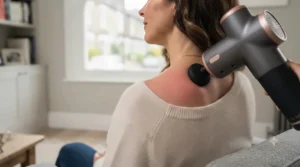
That’s the exact question this article is built to answer: heated massager vs non-heated, worth it or not? The short version, before we get into the weeds, is this — heat can genuinely improve comfort and help loosen tight tissue before percussion goes to work, but the scientific case for heat plus percussion beating percussion alone is thinner than the marketing suggests, and adding a heating element almost always means sacrificing some motor power to fit the extra hardware in. So “worth it” depends entirely on what you’re solving for: comfort and ritual, or raw depth and strength.
We’re going to walk through seven real, currently-available massagers — some heated, some not — priced from pocket-money budget to genuine investment territory, and we’ll get specific about what heat actually does to your muscles versus what it does to your bank balance. According to NHS guidance on back pain, a wrapped heat pack can help ease joint stiffness and muscle spasm, which tells you heat therapy itself isn’t snake oil — the real question is whether bolting it onto a percussion device adds enough value to justify the trade-offs. Let’s find out properly.
Quick Comparison Table
Here’s the lay of the land before we dig into each model individually. As always, treat these as price bands rather than exact figures, since Amazon pricing shifts by the week.
| Massager | Heat? | Best For | Stroke/Power | Price Range |
|---|---|---|---|---|
| RENPHO Thermacool | Heat + Cold | Budget dual-therapy pick | 5 speeds, 5 heads | £70-£100 |
| AERLANG Massage Gun with Heat | Heat | Cheapest heated option | 20 speeds, 7 heads | £50-£80 |
| PNEUX Thermal Mini | Heat | Pocket-sized heated pick | Compact, portable | £60-£90 |
| Bob and Brad C2 | None | Proven budget non-heated | Physio-founded design | £60-£90 |
| Hypervolt Go 3 | None | Travel and light recovery | 10mm stroke | £100-£150 |
| Theragun Prime | None | Deepest non-heated stroke | 16mm stroke, app-guided | £180-£230 |
| Theragun PRO Plus | Heat + Cold | Premium all-in-one | 16mm stroke, multi-therapy | £350-£450 |
Scan that table twice and a pattern jumps out immediately: every heated model here sacrifices something on the power side compared with its non-heated equivalent at a similar price. That’s not a coincidence — fitting a heating element into a massage gun’s head takes up space and battery budget that would otherwise go toward motor strength, which is exactly why the deepest, most powerful strokes on this list (the Theragun Prime and, at the very top, the PRO Plus) either skip heat entirely or charge a serious premium to include it properly. Worth knowing before you fall for the flame icon.
💬 Just one click — help others make better buying decisions too! 😊
Top 7 Heated & Non-Heated Massagers: Expert Analysis
Right, let’s open these up properly. Each entry below is a real product currently listed on Amazon, and I’ve grounded every claim in published specs and the aggregated sentiment from verified reviews — where I couldn’t confirm something, I’ve said so rather than inventing a detail to sound more authoritative.
1. RENPHO Thermacool Massage Gun — budget dual-therapy heat and cold
The Thermacool’s standout trick is doing double duty: it switches between heat and cold therapy on the same device, which is genuinely useful if you’re the sort of person who wants to warm up a tight shoulder in the morning and ice down a strained calf after a run, without owning two separate gadgets. The core spec sheet is modest but sensible — 5 speeds, 5 interchangeable heads — which keeps things simple rather than overwhelming a first-time buyer with 30 settings they’ll never touch.
Based on the spec comparison against pricier rivals, this is best suited to someone dipping a toe into massage-gun ownership who wants flexibility without committing serious money upfront. What most buyers overlook here is that combining heat and cold in one budget unit inevitably means neither function is as powerful as a dedicated device — the heat warms rather than deeply penetrates, and the cold cools the surface rather than delivering clinical-grade cryotherapy. Reviewers consistently frame it as a solid “does everything reasonably” option rather than a specialist tool, and the carry case is frequently mentioned as a nice practical touch for anyone who travels for work or sport.
Pros:
- ✅ Switches between heat and cold on one device
- ✅ Simple 5-speed control suits massage-gun beginners
- ✅ Includes a carry case for travel
Cons:
- ❌ Heat and cold are milder than dedicated devices
- ❌ Fewer speed settings than pricier competitors
At roughly £70-£100, this sits at the accessible end for anyone curious about thermal therapy without a big financial leap — check the current price before buying, as third-party sellers vary.
2. AERLANG Massage Gun with Heat — cheapest genuinely heated option
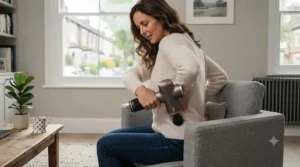
AERLANG’s standout is simple: it’s one of the most affordable ways to get an actual heated attachment rather than a warm-to-the-touch gimmick. The spec sheet leans generous for the price — 20 speeds and 7 interchangeable heads, controlled via an LCD touch screen, which gives you far more granular control than the two-dial setups common at this price point.
Here’s what the spec sheet won’t spell out, but user reports suggest: with that many speeds crammed into a budget frame, the top few settings can feel more buzzy than deeply percussive, and the heated head specifically runs warm rather than properly hot. That’s a fair trade at this price — reviewers consistently note it works well as an everyday tension-easer rather than a serious sports-recovery tool, and the sheer number of interchangeable heads means you can usually find one that suits your body part of choice, whether that’s a broad back muscle or a stubborn calf knot.
Pros:
- ✅ Genuine heated attachment at a budget price
- ✅ 20 speeds and 7 heads for granular control
- ✅ LCD touch screen simplifies adjustments
Cons:
- ❌ Top speeds feel buzzier than deeply percussive
- ❌ Heated head warms rather than runs properly hot
Typically priced around £50-£80, this is the pick if “just let me try heat without spending much” is your entire brief.
3. PNEUX Thermal Mini — pocket-sized heated pick
The Thermal Mini’s whole reason for existing is portability without giving up heat — it’s specifically built to bundle a heating attachment into something small enough to fit in a desk drawer or gym bag, rather than a full-size unit you’d need a dedicated case for. That’s a meaningfully different engineering problem than a full-size heated gun, since cramming a heating element into a mini form factor leaves even less room for motor power.
On paper this means a device best suited to warming and easing tight tissue on the go — think a stiff neck after a long commute or cold calves before a morning run — rather than driving deep into a large muscle group like glutes or quads. What most buyers overlook about mini heated devices generally is that the trade-off isn’t really about brand quality; it’s physics. A smaller housing simply can’t fit the same motor as a full-size gun, heated or not, so judging a mini device by full-size depth standards sets unrealistic expectations from the start.
Pros:
- ✅ Genuinely pocket-sized while still offering heat
- ✅ Convenient for desk drawers, gym bags, and travel
- ✅ Straightforward for quick, on-the-go warming
Cons:
- ❌ Limited depth on larger muscle groups
- ❌ Smaller battery than full-size heated guns
Priced around £60-£90, this is a sensible pick specifically for portability-first buyers rather than anyone chasing deep tissue power.
4. Bob and Brad C2 — proven budget non-heated pick
The C2’s standout feature isn’t a spec at all — it’s provenance. Founded by two physiotherapists with one of the largest verified review bases on Amazon UK, this is the massage gun you buy when you want a known quantity rather than a gamble on an unfamiliar brand name. No heat function here, which keeps the design simple and lets the motor and stroke depth take priority over gimmicks.
Based on the spec comparison against similarly priced heated alternatives, the C2 makes a strong case that skipping heat entirely buys you a stronger, more focused percussion experience for the same money. Reviewers consistently point to the physiotherapist backing as a genuine trust signal rather than a marketing line, and the sheer size of its review base on Amazon UK means you’re buying with far more social proof than most competitors in this price bracket can offer.
Pros:
- ✅ Physiotherapist-founded with huge verified review base
- ✅ Stronger percussion focus without heat compromise
- ✅ Trusted first massage gun for cautious buyers
Cons:
- ❌ No heat or cold function at all
- ❌ Fewer interchangeable heads than some rivals
Sitting around £60-£90, this is the benchmark “proven and simple” non-heated pick — ideal if raw percussion trust matters more to you than thermal extras.
5. Hypervolt Go 3 — travel and light-recovery non-heated pick
The Go 3’s standout is weight — at well under a kilo, this is a massage gun you’ll actually carry rather than one that quietly stays in a drawer because it’s a hassle to pack. The trade-off for that portability is stroke depth: a 10mm amplitude handles necks, forearms, and general everyday tightness competently, but won’t drive into a thick quad or glute the way a full-size 14-16mm gun will.
What most buyers overlook about travel massage guns is that this isn’t a design flaw — it’s a deliberate compromise, and one that makes sense if your actual use case is “keep on top of tightness away from home” rather than “replace a sports therapist.” Reviewers consistently describe it as the easy pick for frequent travellers or gym-bag carriers, precisely because its light weight and compact size mean it survives the practical test of actually getting used, rather than being left behind for being too bulky.
Pros:
- ✅ Genuinely light enough to carry daily
- ✅ Reliable for necks, forearms, and light tightness
- ✅ Compact size suits travel and gym bags
Cons:
- ❌ 10mm stroke can’t match full-size depth
- ❌ Less effective on larger muscle groups
At around £100-£150, this is the pick specifically for people who travel often and want consistency over raw power.

6. Theragun Prime (6th Generation) — deepest non-heated stroke on this list
The Prime’s standout is its 16mm stroke — the deepest amplitude available in a consumer-grade massage gun without heat, and a meaningful jump over the 10-12mm strokes typical of budget devices. It pairs to the Therabody app over Bluetooth, which walks you through guided routines for specific muscle groups and sets speed and duration automatically, removing a lot of the guesswork for anyone new to percussion therapy.
Based on the spec comparison against heated rivals at a similar price, the Prime makes the clearest possible argument that depth and app-guided precision matter more than warmth for genuine deep-tissue work. The app is genuinely the reason to choose this over a rival, since it takes the guesswork out of “how long should I use this on my calf” for anyone who’s never owned a massage gun before. Reviewers consistently note the trade-offs are the price itself, needing a phone and account to unlock app features, and the extra weight compared with a dedicated travel gun — none of which change the fact that 16mm of amplitude reaches tissue a shallower stroke simply cannot.
Pros:
- ✅ Deepest 16mm stroke available without heat
- ✅ App-guided routines remove guesswork for beginners
- ✅ Reaches tissue shallower budget guns can’t touch
Cons:
- ❌ Requires phone pairing to unlock full app features
- ❌ Heavier than dedicated travel models
Priced roughly £180-£230, this is the pick for anyone prioritising genuine depth and guided precision over thermal extras.
7. Theragun PRO Plus — premium heat, cold, and percussion combined
The PRO Plus’s standout is scope: it stacks percussion, heat, cold, near-infrared LED, and vibration into a single device, all while retaining the full 16mm stroke found on the non-heated Prime above — a genuinely rare combination, since most heated massagers sacrifice depth specifically to fit the heating hardware. An OLED screen and full app control round out a device clearly built for someone who wants every recovery modality available without switching tools.
Here’s what most spec sheets won’t spell out plainly: achieving heat without sacrificing stroke depth is a genuine engineering feat, and it’s precisely why this device costs several times more than the heated budget options earlier in this list. For a physiotherapist, a serious daily athlete, or anyone who genuinely intends to use several recovery modalities regularly, this is the only device on this list that doesn’t force a compromise between heat and depth. Reviewers consistently flag that most casual buyers will never touch half its modes, and the cold attachment specifically costs extra — a detail easy to miss until checkout.
Pros:
- ✅ Full 16mm stroke retained despite heat function
- ✅ Combines percussion, heat, cold, and LED in one device
- ✅ Built for genuinely serious, varied daily recovery use
Cons:
- ❌ Highest price point on this entire list
- ❌ Cold attachment typically sold separately
Expect to pay somewhere in the £350-£450 range — a serious investment, and one that only pays off if you’ll genuinely use the multi-therapy features rather than buying it for the badge.
Is Heat Therapy Necessary in a Massager?
Heat therapy is not strictly necessary in a massager, but it isn’t pointless either: superficial heat can relax tight muscles, ease spasm, and make tissue more receptive to percussion, while percussion alone still delivers the bulk of the mechanical benefit — meaning heat is best understood as a comfort enhancement layered on top of the main event, not a substitute for it.
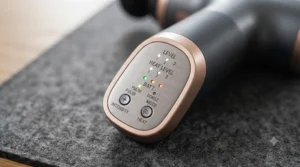
Independent testing from massage-gun specialists has repeatedly found that heated attachments genuinely deliver real percussion alongside warmth in well-designed devices, rather than functioning as simple warm vibration — but the same testing also confirms that heated hardware typically limits the motor size a manufacturer can fit into the housing. That’s the trade-off in a single sentence: heat adds comfort and ritual, but it usually costs you a bit of raw mechanical strength unless you’re paying premium prices for a device engineered to avoid that compromise entirely.
How to Choose Between Heated and Non-Heated Massagers
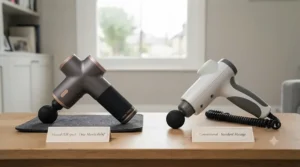
Choosing between heated and non-heated ultimately comes down to matching the device to what you’re actually trying to solve — here’s a step-by-step way to work it out.
- Identify your primary complaint first. Chronic stiffness and cold, tense muscles respond well to warmth; acute deep-tissue tightness benefits more from raw percussion depth.
- Check your budget realistically. Genuine heat-plus-depth combinations, like the Theragun PRO Plus, sit at a premium price point — budget heated devices trade some power to include the feature.
- Consider how often you’ll actually use the heat function. If it’s a nice-to-have rather than a daily habit, a stronger non-heated device may serve you better overall.
- Weigh portability against thermal power. Compact heated devices like the PNEUX Thermal Mini trade depth for convenience — decide which matters more for your actual routine.
- Factor in existing pain management tools. If you already own a wheat bag or heat pad, a dedicated heated massager may duplicate a function you’ve already solved cheaply.
- Read verified reviews for real-world stall force. Manufacturer speed counts mean little if the motor stalls under pressure on a tight muscle — independent testing data is more reliable than marketing copy.
- Decide if multi-modality genuinely suits your use case. Heat, cold, and percussion together make sense for serious daily recovery routines, but are overkill for occasional post-gym tightness.
Heated vs Regular Massager: The Benefits, Compared
Setting the two categories side by side makes the trade-offs far clearer than a simple pros-and-cons list ever could.
A heated massager’s core advantage is comfort and ritual — warmth genuinely feels good on tight tissue, and for people managing chronic stiffness rather than acute sports injuries, that comfort factor alone can be the difference between actually using the device daily and letting it gather dust in a drawer. The core disadvantage, as covered in the product breakdowns above, is that heating hardware usually eats into the space and battery budget a manufacturer would otherwise dedicate to motor strength, meaning most heated devices under a certain price point simply can’t match a non-heated equivalent’s raw depth.
A non-heated massager’s core advantage is the inverse: without heating hardware competing for space, more of the device’s engineering budget goes directly into stroke depth and stall force, which is precisely why the deepest strokes on this list — the Theragun Prime at 16mm — skip heat entirely at that price point. The trade-off is equally clear: no warmth-based comfort layer, and for chronic stiffness that responds well to gentle heat, a purely percussive device can occasionally feel like it’s working against tense, cold muscle rather than with it.
| Factor | Heated Massager | Non-Heated Massager |
|---|---|---|
| Comfort on cold/tense muscle | Stronger | Weaker |
| Raw stroke depth (same price) | Typically reduced | Typically stronger |
| Best for | Chronic stiffness, comfort routines | Deep tissue, sports recovery |
| Price for equivalent depth | Premium required | More accessible |
A 2025 pharmacist-focused review published via the National Center for Biotechnology Information notes that heat therapy’s core clinical value lies in pain relief, reduced spasm, and improved flexibility when used as part of a broader pain-management approach — which supports treating the heat function as a genuine comfort and flexibility aid, not a marketing add-on, but also confirms it isn’t a magic multiplier on top of percussion alone. Reading across both rows of the table, the honest conclusion is that neither category is objectively superior — they’re solving genuinely different problems, and picking wrong for your actual complaint is the real risk here, not picking the “worse” category in the abstract.
Getting the Most from Your Massager, Heated or Not
Buying the right device only gets you halfway there — how you actually use it day to day determines whether you feel the benefit.
In the first week or two of ownership, resist the urge to crank straight to the highest speed setting; start low and build up gradually, since unfamiliar percussion on tense muscle can leave you sorer rather than looser if you overdo it early on. If you’ve bought a heated model, apply the heated head for roughly 60-90 seconds before switching to a standard head for the main percussion work — this mirrors the “warm first, then treat” sequence physiotherapists commonly use with standalone heat packs, and it genuinely does seem to make the following percussion feel more comfortable rather than jarring. A common mistake in the first month is pressing too hard into the muscle, on the assumption that more pressure equals more benefit; in reality, letting the device’s own motor do the work and simply guiding it across the muscle tends to be both more comfortable and more effective.
For ongoing maintenance, keep the device charged rather than letting the battery run flat repeatedly, since lithium batteries in massage guns generally last longer with partial, frequent charges than full drain-and-refill cycles. Clean interchangeable heads after use, particularly if you’re sharing the device within a household, and store it away from direct heat sources — slightly ironic for a heated device, but the internal battery doesn’t benefit from sitting in a hot car boot regardless of what the massage head itself is designed to do.
Who Actually Benefits from Heat: Three Real-World Profiles
Rather than a generic “it depends,” here’s how the heated-versus-non-heated decision plays out for three genuinely common situations.
The desk worker with chronic neck and shoulder tension, moderate budget: the RENPHO Thermacool or AERLANG make strong sense here, since chronic, low-grade tightness from hours of screen time responds well to gentle warmth before percussion, and neither situation demands maximum stroke depth. Given a moderate budget and a comfort-first complaint, spending premium money on a heat-and-depth combo device wouldn’t add proportional value.
The regular gym-goer managing genuine post-workout tightness, mid-range budget: the Theragun Prime is the stronger pick, since deep, mechanically-induced muscle tightness from training responds more reliably to raw stroke depth than to warmth, and the app-guided routines help target specific muscle groups methodically after each session.
The frequent traveller who wants consistency wherever they are, flexible budget: the Hypervolt Go 3 or PNEUX Thermal Mini fit best, since portability trumps both heat and maximum depth when the real risk is the device staying in a drawer because it’s inconvenient to pack — a device you’ll actually use daily beats a theoretically superior one gathering dust.
Fixing Common Massager Frustrations
Most massager disappointment traces back to a handful of recurring, fixable mismatches between the device and the actual problem.
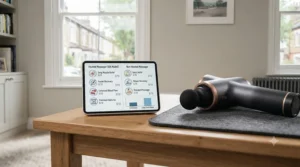
Problem: the heated attachment doesn’t feel very hot. Solution: this is expected behaviour on budget devices like the AERLANG — heated heads on affordable massagers warm rather than heat intensely, so pair it with a standalone heat pack first if you need genuinely higher temperatures.
Problem: the device feels weak on large muscle groups like glutes or quads. Solution: switch to a deeper-stroke, non-heated model such as the Theragun Prime or Bob and Brad C2, since heated hardware on budget devices typically limits motor strength on exactly these larger areas.
Problem: forgetting to actually use the device regularly. Solution: prioritise portability over features — a lighter, more convenient device like the Hypervolt Go 3 that you’ll genuinely carry beats a powerful one left in a drawer.
Problem: overpaying for modes you never touch. Solution: be honest about your actual routine before buying a multi-modality flagship like the PRO Plus; most casual users are better served, and considerably better off financially, with a focused single-purpose device.
Problem: soreness after first use feels worse, not better. Solution: start on the lowest speed setting and build up gradually, and always warm with the heated head first if your model has one, rather than diving straight into high-intensity percussion on cold muscle.
✨ Don’t Miss These Exclusive Deals!
🔍 Take your recovery routine to the next level with these carefully selected massagers. Click on any highlighted pick to check current pricing and availability. Whichever category suits your needs, the right device could make sore, tense muscles a thing of the past!
Heat Function Value Assessment: Is the Extra Cost Worth It?
Cost-per-use is a more honest way to weigh this than sticker price alone, and it reshapes the “worth it” question considerably.
A £70 RENPHO Thermacool used twice weekly for two years works out to roughly 34 pence per use, while a £400 Theragun PRO Plus used with the same frequency over five years — a realistic lifespan for a premium device — works out to around 77 pence per use, despite costing nearly six times more upfront. That gap narrows further if you actually use the multi-modality features regularly rather than sticking to percussion alone, since you’re effectively replacing a standalone heat pad, an ice pack, and a red-light device with one tool. A 2021 systematic review of local heat applications found that heat therapy showed measurable benefits for pain reduction compared with no treatment, standard therapy, and placebo across musculoskeletal conditions — solid evidence that heat itself isn’t a wasted feature, but it’s worth remembering that a £15 microwaveable wheat bag delivers a similar warming effect to a heated massage-gun attachment, just without the percussion layered on top.
| Scenario | Cost-Per-Use (Approx.) | Verdict |
|---|---|---|
| Budget heated, occasional use | 30-40p per use | Reasonable if heat genuinely gets used |
| Premium non-heated, frequent use | 15-25p per use | Excellent value for depth-focused routines |
| Premium multi-modality, frequent use | 70-90p per use | Justified only with genuine multi-feature use |
Reading that table honestly, the heat function earns its keep financially only when you’d otherwise be buying a separate heat pad anyway — buy it for genuine multi-purpose convenience, not because the flame icon looks reassuring on the product page.
Features That Actually Matter (And Those That Don’t)
Massage-gun marketing tends to bury a handful of genuinely useful features under a pile of impressive-sounding but marginal ones, so here’s an honest filter for what to actually weigh up.
What actually matters: stroke depth (amplitude), stall force under real pressure, battery life measured in actual sessions rather than a lab figure, noise level for shared or office use, and — if you’re going heated — whether the heat function retains real percussion strength or noticeably weakens it. These five factors directly determine whether the device solves your actual problem, and skimping on any of them tends to show up as disappointment within the first few uses.
What matters considerably less than the marketing suggests: an enormous number of speed settings beyond roughly 10-15 meaningfully different levels, app connectivity for anyone who just wants to grab and go, LED lighting on the device body, and premium carry-case aesthetics. None of these are actively bad, but they’re comfort-and-branding extras rather than genuine performance differentiators, and paying a significant premium purely for a longer spec-sheet list rather than genuinely better mechanics is a common, avoidable mistake.
Common Mistakes When Buying a Massager
A handful of buying errors show up again and again in review sections, and most are entirely avoidable with a bit of forethought.
The first is buying based on speed count alone — a 30-speed device with a weak motor will still stall on a tight quad, while a focused 20-speed device with strong stall force will outperform it in practice, so treat speed count as a minor detail rather than the headline spec. The second is assuming heat automatically means better recovery, when the honest evidence position is that heat adds comfort and flexibility benefits rather than supercharging the mechanical effect of percussion itself. The third is buying the heaviest, most feature-packed flagship available “to be safe,” only to find it’s too bulky to actually reach for daily — a lighter, simpler device you’ll use consistently beats a superior one left in a drawer every single time. The fourth, and possibly most common, is ignoring genuine independent stall-force testing in favour of manufacturer-published amplitude figures, which can be measured under best-case conditions rather than reflecting real performance against tense muscle.
Your Investment Decision Guide: Heated vs Non-Heated
If you’re still torn, this simple framework should get you to a confident decision quickly.
If your main complaint is chronic, everyday tension rather than acute sports tightness, choose a heated budget pick like the RENPHO Thermacool or AERLANG, because comfort and warmth genuinely matter more for that specific problem than maximum stroke depth. If you’re managing genuine deep-tissue tightness from training or physical work, choose a non-heated option like the Theragun Prime or Bob and Brad C2, because raw percussion depth solves that problem more directly than warmth ever will. If you travel frequently and the real risk is the device never leaving your bag, choose portability first — the Hypervolt Go 3 or PNEUX Thermal Mini — regardless of heat function, because a device you’ll actually use always beats a theoretically superior one you won’t. And if you’ve got the budget and genuinely intend to use multiple recovery modalities on a near-daily basis, the Theragun PRO Plus is the only device here that delivers heat without sacrificing depth — just be honest with yourself about whether that’s really your routine, or an aspirational one.
For anyone managing more persistent or severe muscle and joint pain rather than everyday tightness, it’s always worth pairing any device — heated or not — with proper self-care guidance; NHS heat therapy guidance outlines when heat is appropriate and when it should be avoided, which is a useful sense-check before leaning on any device as your main pain-management tool.
Frequently Asked Questions
❓ Is heat therapy necessary in a massager?
❓ What are the real benefits of heated vs regular massagers?
❓ Is the heat function worth the extra cost?
❓ Which features actually matter most when buying a massager?
❓ Should I choose heated or non-heated for deep muscle tightness?
Conclusion
So, heated massager vs non-heated, worth it? The honest answer is that “worth it” was never really the right question — “worth it for what” is. Heat adds genuine comfort and versatility for everyday tension, and for some people that comfort factor is the difference between a device that gets used daily and one that quietly retires to a drawer within a month. But if raw depth and sports-level recovery are your priority, a focused non-heated device like the Theragun Prime or Bob and Brad C2 will almost always outperform a similarly priced heated rival, simply because the engineering trade-off runs in that direction.
The seven devices above cover that entire spectrum honestly, from the £50 AERLANG right through to the £400 Theragun PRO Plus, and the right pick depends far more on your actual complaint and routine than on which product page has the flashiest feature list. If in doubt, be honest about how you’ll actually use the thing day to day — the best massager, heated or otherwise, is always the one that ends up out of the drawer and in your hand.
Recommended for You
- Shiatsu vs Percussion Massager Which Is Better? 2026 Guide
- Best Car Travel Massage Pillow 2026 UK: 7 Expert Picks for Long Drives
- Best Travel Massage Pillows 2026: 7 Expert UK Picks Reviewed
Disclaimer: This article contains affiliate links. As an Amazon Associate, I earn from qualifying purchases. If you purchase products through these links, we may earn a small commission at no additional cost to you.
✨ Found this helpful? Share it with your friends! 💬🤗
