In This Article
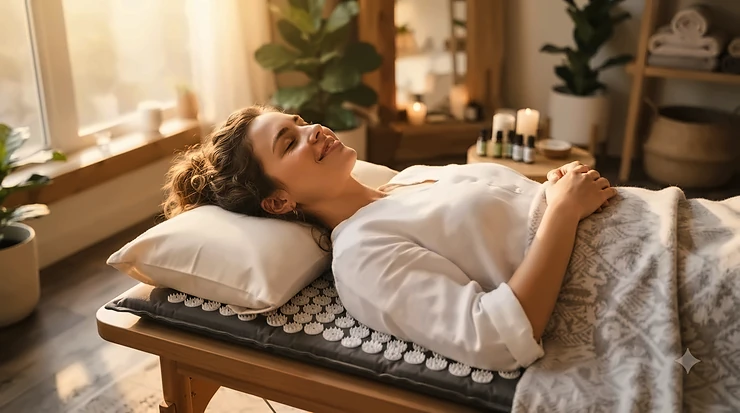
An acupressure mat and pillow set for sleep is a foam-backed, cotton-covered mat studded with thousands of rounded plastic spikes, paired with a small spiked neck pillow. You lie on it for 10 to 30 minutes before bed. The firm, even pressure is meant to loosen tight muscles and help your body shift from day mode to night mode.
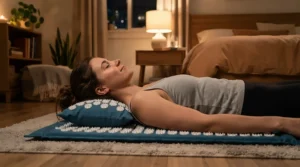
A confession before we go further: lying on a bed of spikes to fall asleep sounds like a medieval punishment for people who hit snooze too often. Yet these mats have become one of the most talked-about wind-down gadgets in UK wellness. They’re cheap, they take up less room than a yoga mat, and they give you a clear, tactile signal that the working day is over.
Here’s the honest bit. A 2018 systematic review and meta-analysis found that acupressure in general can improve sleep quality. That research mostly covers finger-pressure techniques, not spike mats. Evidence for the mats themselves is smaller and still preliminary. So think of an evening relaxation mat with pillow as a ritual tool rather than a cure. It’s useful for slowing down, but it doesn’t replace medical care.
In this guide I’ve compared seven real sets sold through Amazon UK, from budget to premium, and translated their specs into what they mean on your bedroom floor. You’ll also find what the evidence says, a 30-day plan, safety notes and cost-per-use maths. Every opinion here is analysis based on published specs and aggregated reviewer feedback, not hands-on testing.
Quick Comparison: 7 Sets at a Glance
I shortlisted sets that include a pillow, are listed on amazon.co.uk, have enough published detail to analyse properly, and together span roughly £15 to £70. Prices below are ranges at the time of research (November 2026) and may vary, so check the current price before buying.
| Product | Price range | Standout spec | Best For |
|---|---|---|---|
| PRO 11 Wellbeing Acupressure Mat and Pillow Set | Around £15-£25 | 65cm mat, pillow and bag included | First-timers testing the idea cheaply |
| Romix Acupressure Mat and Pillow Set | Around £20 | 64cm, high-density foam | Budget evening decompression |
| Base Yoga Acupressure Mat and Pillow Set | Around £20-£25 | 8,745 spikes, 74 x 43cm | Beginners wanting gentler pressure |
| Lixada Acupressure Mat and Pillow Set | High £30s to £40 | 120cm, 11,178 points, two massage balls | Taller users and full-body coverage |
| Yoke Wellness Acupressure Mat and Pillow Set | Mid-£40s | 7,000+ spikes, coconut fibre filling | Eco-minded back and neck tension |
| Yogi Bare Acupressure Set | Mid-£50s to around £60 | Cotton carry case with strap | Yoga fans and gift buyers |
| Bed of Nails Mat and Pillow Set | Around £70 | 10,962 spikes, 42 nails per plate | Premium, dense-spike comfort |
Looking at the table, the PRO 11 Wellbeing and Romix sets are the low-risk entry points. The Lixada is the only one long enough to support taller bodies from shoulders to calves. If you want the densest spike layout, the Bed of Nails set justifies its premium on paper, though the Base Yoga set gets surprisingly close on pressure distribution for far less money. The Yoke Wellness and Yogi Bare sets sit in the middle, where you’re paying more for materials, presentation and brand story than for raw spike count.
💬 Just one click — help others make better buying decisions too!😊
Top 7 Picks: Expert Analysis of Each Acupressure Mat and Pillow Set for Sleep
Each set below is judged on what the specs mean in practice, what reviewers consistently report, and who it genuinely suits. Where I couldn’t verify a solid review sample, I say so rather than fill the gap.
1. PRO 11 Wellbeing Acupressure Mat and Pillow Set — cheapest way to test the idea
The big draw is the low stakes: at roughly the price of a couple of takeaway coffees, you can find out whether spikes suit you at all. The mat is about 65cm long, so it covers shoulders to lower back. Taller people will find their hips hanging off the end. The included neck pillow and drawstring bag mean you aren’t buying extras. The build is foam and plastic, and it’s hand-wash only.
On paper, a shorter mat is a half-body tool. That’s fine for a bedtime ritual where you mostly care about upper back and neck, though it won’t blanket your legs. It suits sceptics who want a two-week experiment before spending real money.
Forum users and UK roundups describe a minute or two of discomfort, then a warm, loosened feeling across the back. One user said they very nearly drifted off on it. Treat that as anecdote, not trial data.
Pros:
- ✅ Pillow and carry bag included
- ✅ Very low-risk price for first-timers
- ✅ Warm, relaxing feel commonly reported
Cons:
- ❌ Short for taller users
- ❌ Spike count rarely stated clearly
Price and value: around £15-£25 at the time of research, which is strong value if your goal is simply to try the idea.
2. Romix Acupressure Mat and Pillow Set — built for evening decompression
This set is pitched squarely at the after-work slump, and its spec sheet backs up the idea. It’s about 64cm long, with a cotton cover, high-density foam, a pillow and a carry case. There are four colours: purple, green, grey and blue. The brand suggests wearing a T-shirt or socks to adjust intensity.
Dense foam matters because it resists squashing under your body weight. In principle, that keeps the pressure steadier rather than letting spikes sink unevenly. It’s also why this works as an evening relaxation mat with pillow: you set it down, lie back, and the mat does its job without fuss. The short length is the trade-off, same as the PRO 11 Wellbeing.
One forum user reported using it nightly to decompress, saying sleep improved and back niggles eased, though not “cured”. Other reviewers found the spikes painful at first, which is typical of most mats.
Pros:
- ✅ High-density foam for steadier pressure
- ✅ Pillow and carry case included
- ✅ Four colour choices
Cons:
- ❌ Short 64cm length
- ❌ Initial spike discomfort for beginners
Price and value: around £20, which makes it one of the best-value ways to build a bedtime ritual.
3. Base Yoga Acupressure Mat and Pillow Set — gentlest first-night feel
The standout here is how the spikes are spread. The mat measures 74 x 43cm and carries 8,745 spikes across 265 discs. By my arithmetic from those figures, that’s about 33 spikes per disc and roughly 2.7 spikes per square centimetre. More contact points means your weight is shared more widely, so each spike pushes in less. That’s why it’s often recommended for beginners.
You can start over a thin T-shirt, then progress to bare skin as you adapt. It’s also sold as a mat-only option if you already own a neck pillow. The only listed drawback is that it comes in darker colours only, which won’t matter if it lives under the bed.
Reviewer sentiment is positive but mixed. One forum user credited it with calmer anxiety and better sleep quality. A retailer-page reviewer with arthritis reported quick relief, while another called it relaxing but not fully effective.
Pros:
- ✅ High spike count for even pressure
- ✅ Pillow and carry bag included
- ✅ Affordable for the spec
Cons:
- ❌ Dark colours only
- ❌ Hand wash only
Price and value: around £20-£25, a strong all-rounder for first-timers.
4. Lixada Acupressure Mat and Pillow Set — longest mat for taller sleepers
At about 120cm, this is one of the longest mats around, so you can lie from neck to calves rather than stopping at the lower back. The quoted 11,178 points, plus the pillow, two massage balls and a drawstring bag, make it the most “complete” kit here. The central fold leaves a small spike-free band, so positioning matters.
Length doesn’t make it gentler, though. Softness depends on spike density, not mat size. What length does give you is the option to rest your calves and hamstrings, which tight desk workers often appreciate. The massage balls are handy for feet and hands before or after a session. Care advice conflicts between buying guides (hand wash versus a machine-washable cover), so follow the label.
A UK ranking site placed it first for full-body use, and a Mumsnet-affiliated guide named it best for larger users. Treat both as editorial opinion, not a large customer sample.
Pros:
- ✅ 120cm length suits taller users
- ✅ Pillow and two massage balls included
- ✅ Rolls into a drawstring bag
Cons:
- ❌ Unspiked section at the central fold
- ❌ Conflicting care guidance online
Price and value: roughly the high-£30s to around £40, good value if length is your priority.
5. Yoke Wellness Acupressure Mat and Pillow Set — nurse-designed, natural materials
This set was created by an NHS nurse, according to UK roundups, and it leans into natural materials: premium cotton with a coconut fibre filling. It carries 7,000-plus spikes, measures 71.5 x 42cm and comes with a shoulder bag. The brand donates to Water UK with every purchase, and the colourways are pale grey or forest green.
Coconut fibre is typically firmer and more breathable than foam, so expect a more structured feel under your back. The nurse backstory is a nice brand touch, but it isn’t clinical validation of the product. The mat is a good mid-size, covering the back and the base of the neck.
A UK buying guide praised it for neck, shoulder and back tension. I couldn’t verify a large pool of customer reviews in my research, so weigh that praise as editorial rather than a verdict from thousands of owners.
Pros:
- ✅ Cotton and coconut fibre materials
- ✅ Good mid-size mat
- ✅ Shoulder bag included
Cons:
- ❌ Costs more than basic sets
- ❌ Care instructions unclear in guides
Price and value: around the mid-£40s, worth it if you value natural fillings and ethical touches over raw spike count.
6. Yogi Bare Acupressure Set — yoga-brand polish with a cotton carry case
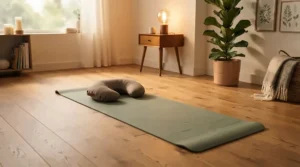
Built by a well-known yoga brand, this set adds presentation. You get a pillow and a 100 per cent cotton carry case with a long strap, plus poppers at the top and bottom of the mat and carry handles. The tips are rounded. The founder suggests resting your legs up a wall and adding a few drops of geranium oil to the mat to deepen relaxation.
The poppers and handles mean you can fasten the mat closed and carry it even without the bag, which suits anyone who takes it to a yoga class or on trips. If you already finish evenings with stretching, it slots in neatly. Part of the price is brand, so compare it against the Base Yoga set before buying.
UK lifestyle coverage is positive, but I couldn’t confirm a robust review sample or a verified spike count, so treat this as the least-quantified option on the list.
Pros:
- ✅ Cotton carry case with long strap
- ✅ Poppers and handles aid transport
- ✅ Brand-backed relaxation tips
Cons:
- ❌ Premium price versus similar sets
- ❌ Spike count not confirmed
Price and value: roughly the mid-£50s to around £60, a fair choice for yoga fans or gifting, less compelling on pure value.
7. Bed of Nails Mat and Pillow Set — densest spikes, premium feel
Most mats use 25 nails per plate. This one uses 42 across 261 plates, giving 10,962 spikes. That’s roughly 68 per cent more nails per plate than the standard layout. The plastic is recyclable, the cover is organic cotton, the foam is PU, and each plate is melted onto the cover rather than glued. The pillow wraps inside the mat and stores in the supplied carry case.
More nails per plate usually means pressure is shared more widely, so the mat feels less sharp than the spike count suggests. It’s a counterintuitive trade: more points, gentler sensation. It comes in black, pink or green.
A Mumsnet-affiliated guide reported high review scores across several retailers, and one forum user said they use theirs about three times a week on their back. Mat-only and pillow-only prices differ across listings, so make sure you’re viewing the set.
Pros:
- ✅ Very dense spike layout
- ✅ Pillow stores inside the mat
- ✅ Recyclable plastic, organic cotton
Cons:
- ❌ Priciest of the seven
- ❌ Hand wash only
Price and value: around £70 for the set at the time of research, best for people who’ll use it several evenings a week.
Spec Snapshot: Seven Sets Side by Side
| Product | Size | Spikes (as quoted) | Extras | Best For |
|---|---|---|---|---|
| PRO 11 Wellbeing | 65cm long | Not clearly stated | Pillow, drawstring bag | Budget trials |
| Romix | 64cm long | Not clearly stated | Pillow, carry case | Nightly decompression |
| Base Yoga | 74 x 43cm | 8,745 | Pillow, carry bag | Beginners |
| Lixada | 120cm long | 11,178 points | Pillow, two balls, bag | Taller users |
| Yoke Wellness | 71.5 x 42cm | 7,000+ | Pillow, shoulder bag | Natural-material fans |
| Yogi Bare | Not verified | Not verified | Pillow, cotton case | Yoga practitioners |
| Bed of Nails | Not verified | 10,962 | Pillow, carry case | Premium comfort |
Read the table as a decision aid, not a league table. Spike counts are marketing numbers quoted by sellers and reviewers, and they aren’t measured on a common basis. Only the Base Yoga, Lixada and Bed of Nails sets give enough detail to compare density at all. For everything else, length, filling and price tell you more about what you’re buying.
✨ Don’t Miss These Carefully Selected Picks!
🔍 Take your evening wind-down to the next level with these seven sets. Click any highlighted product name to check current pricing and availability. A few quiet minutes on the right mat could become the part of your day you look forward to most!
How to Choose an Acupressure Mat and Pillow Set for Sleep
The best acupressure mat and pillow set for sleep is the one you’ll actually lie on, so comfort matters more than spike bragging rights. Work through these seven steps.
- Define your goal. If you want a calming ritual, prioritise comfort and gentle pressure. If you’re chasing back relief, check with a GP first, because the evidence there is also limited.
- Judge spike density, not just count. More spikes spread over the same area usually feel gentler. That’s why the Base Yoga and Bed of Nails sets suit beginners.
- Match length to height. A 64-74cm mat covers the back. If you want calves involved, look at the Lixada.
- Pick a filling. Foam is softer and cheaper. Coconut fibre, as in the Yoke Wellness set, feels firmer and more natural.
- Inspect the neck pillow. Check its size and whether it packs inside the mat for storage.
- Plan your ramp-up. Wear a thin T-shirt for the first few sessions and build time gradually.
- Set your budget by use. If you’ll use it four evenings a week, a £40-£70 set costs only pennies per session, as the cost section below shows.
Acupressure Mat Before Bed for Insomnia: What the Evidence Actually Says
Let’s be careful here. Using an acupressure mat before bed for insomnia is a popular idea, but the research is thinner than the marketing.
A small 2011 exploratory study of 32 people found mat use raised subjective relaxation and shifted heart-rate variability, though salivary cortisol didn’t change. A 2021 randomised study of 44 people with lower back pain found improved comfort and quality of life, which may matter for sleep because pain disrupts it. A later training study reported reduced perceived stress, again mainly in how people felt rather than in physiological measures. Taken together, mat-specific sleep evidence remains pilot-level.
For chronic insomnia, the first-line treatment is different. UCLH’s insomnia service explains that most patients are offered cognitive behavioural therapy for insomnia (CBT-I). Insomnia lasting three months or longer is generally classed as long-term, and it deserves a GP conversation rather than a gadget.
My analysis: a mat can be a pleasant, low-risk adjunct for occasional bad nights or a stressful week. It’s not a substitute for CBT-I, and it won’t fix an underlying sleep disorder. If you’re lying awake most nights, book the GP appointment first and keep the mat as a supporting act.
Endorphin Release: What’s Really Happening Under the Spikes
Ask any brand or practitioner how these mats work and you’ll hear endorphin release within seconds. The theory goes that gentle, widespread pressure stimulates the skin and underlying tissue, triggering feel-good chemicals that ease tension and lift your mood. A UK acupuncturist quoted in a lifestyle roundup describes it as a calming wave after a busy day.
Here’s what I can say with confidence. The proposed mechanism is moderate-pressure tactile stimulation influencing the autonomic nervous system. People reliably notice local warmth and skin flushing as blood flow rises. And participants in small trials report feeling more relaxed afterwards.
Here’s what I couldn’t find: a trial that measured endorphins directly in spike-mat users. So endorphin release remains a plausible explanation rather than a demonstrated fact. That’s not a reason to dismiss the mat, because the felt effect, a looser body and a slower mind, is what you’re after at bedtime. It’s simply a reason not to believe promises of dramatic chemical changes.
Practical takeaway: pair the pressure with slow breathing, such as a four-count inhale and a six-count exhale. Focus on the exhale and let your shoulders sink. That slow rhythm is a well-known relaxation technique in its own right, and combining the two gives you the best chance of that “melting” feeling.
Neck Pillow: Why the Pillow Half of the Set Matters
The neck pillow is the unsung half of the set. Some sets quote roughly 1,400-1,800 points on the pillow alone, concentrated where desk workers hold their tension: the base of the skull and the top of the shoulders.
Think of the pillow as a flexible attachment rather than just a headrest. Here are four ways to use it:
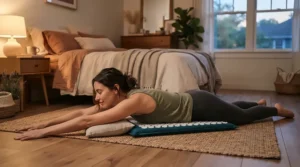
- Under the neck: lie with the pillow at the curve where neck meets shoulders, keeping your chin level.
- Under the lower back: a rolled pillow gives focused pressure in the lumbar area.
- Under the calves or hamstrings: one reviewer found this a useful way to target the backs of the legs.
- In your hands or under a foot: short sessions only, and expect it to feel intense.
Two cautions. First, the pillow is for your 10-20 minute wind-down, not for sleeping on all night. Your normal pillow still does the overnight job. Second, shape and storage differ by product. The Bed of Nails pillow wraps inside the mat for tidy storage, and one reviewer noted that larger curved pillows on other brands can’t be rolled inside their mats at all.
If neck tension is your main complaint, test the pillow separately for a couple of evenings before using the full mat. It’s the quickest way to find your comfort threshold.
Build a Sleep Routine Around Your Mat: A 30-Day Plan
A mat works best as part of a sleep routine, not a one-off hero move. The NHS Every Mind Matters guidance on sleep recommends a regular bedtime pattern and a calming wind-down. Here’s a simple month to build one.
Week 1 — Introduce it gently. Place the mat on a firm, flat surface, such as a rug or yoga mat on the floor. Lie on it over a thin T-shirt for 5-10 minutes, three evenings. Dim the lights and put your phone down.
Week 2 — Build consistency. Aim for 10-15 minutes, four or five evenings. Pick a fixed time, such as 45-60 minutes before bed.
Week 3 — Extend if comfortable. Try 15-20 minutes. If you’re ready, move to bare skin on your back.
Week 4 — Lock in the habit. Choose your best slot and stick with it. Trials of mat use typically involved 15-30 minute sessions several times a week, so there’s no need to exceed that.
Common mistakes in the first 30 days:
- Going bare-skinned and long on night one.
- Using it on a soft bed or sofa, where it slips and spikes press unevenly.
- Staying on for an hour because it “feels fine”.
- Treating it as a cure instead of one part of the evening.
If you still can’t fall asleep after 20 minutes in bed, the NHS advice is not to force it. Get up, do something quiet, and return when sleepy.
Evening Relaxation Mat With Pillow: Real-World Scenarios
Specs only mean something when they meet a real life. Here are three profiles matched to products, with budget, setting and frequency in mind.
Scenario 1: The desk worker on a budget. You work from a spare room, sit for eight hours, and your budget is about £20. You’d use the mat four or five evenings a week for 10-15 minutes. The PRO 11 Wellbeing or Romix set fits because both are cheap and include a pillow. The trade-off is the shorter length, which suits upper-back tension perfectly well.
Scenario 2: The tall gym-goer. You’re over six foot, lift after work, and want calves and hamstrings involved. You’d use it three evenings a week on the lounge floor. At 120cm, the Lixada is the only one of the seven that really covers you from neck to calves. Position the unspiked fold under your lower legs or just below your hips rather than under your spine.
Scenario 3: The eco-conscious yoga fan. You stretch most evenings, prefer natural materials, and don’t mind spending £45-£70. The Yoke Wellness set suits you for its cotton and coconut fibre, while the Bed of Nails set suits you if you want dense spikes and recyclable plastic. The Yogi Bare set is the pick if the cotton case and carry features matter to you more.
The common thread: match the mat to your body and schedule, not to a spike count on a listing.
Problem → Solution Guide: When the Mat Doesn’t Cooperate
Even a good set can feel wrong at first. Here are five common problems and fixes.
1. “It hurts too much.” Add a thin T-shirt, shorten the session to five minutes, and let your body adjust. If it still bites, consider a denser layout such as the Base Yoga or Bed of Nails sets.
2. “I feel wired, not sleepy.” Practitioners note that mats can energise as well as relax. Try moving your session earlier, perhaps 60-90 minutes before bed, and keep it to 10 minutes with slow breathing.
3. “My skin is red and blotchy.” Temporary redness is common as blood flow rises and usually fades. Persistent marks, bruising or soreness mean you should stop and, if needed, speak to a pharmacist or GP.
4. “The mat slides or feels uneven.” You’re probably on something soft. Move to a firm, flat floor, ideally with a yoga mat beneath it.
5. “My neck feels strained on the pillow.” Move the pillow lower toward the shoulders, reduce the time, or use a small rolled towel for extra support. The Lixada and Yoke Wellness sets both include pillows you can reposition easily.
If a problem persists beyond a few sessions, the mat probably isn’t for you right now, and that’s a perfectly sensible conclusion.
Acupressure Mat and Pillow Set vs Other Wind-Down Tools
Is a spike mat actually better than the other things you might do before bed? It depends on what you need. Here’s a comparison.
| Option | Upfront cost | Effort | Best For | Main drawback |
|---|---|---|---|---|
| Acupressure mat and pillow set | Low to moderate, one-off | Low | A tactile, repeatable wind-down | Initial discomfort, limited evidence |
| Massage ball | Very low | Low | Targeting individual knots | Small area, needs more manual effort |
| Warm bath | Low running cost | Moderate | Full-body warmth before bed | Needs time and a bath |
| Practitioner acupressure or massage | Higher per visit | Appointment needed | Skilled, tailored treatment | Ongoing cost and booking |
| Digital CBT-I programme | Varies, some NHS access | Moderate, weekly | Persistent insomnia | Needs commitment over weeks |
In plain terms: a mat is closest to a self-administered massage, with the added benefit that it needs no skill. A massage ball does something similar in a smaller area, which is why the Lixada bundles two. A warm bath addresses temperature and body heat rather than pressure. A practitioner brings expertise you can’t replicate at home. And for persistent insomnia, a structured CBT-I programme such as Sleepio or Sleepstation addresses the habits and thought patterns behind sleeplessness in a way no mat can.
The sensible conclusion: treat the mat as one tool among several. It’s a good fit if you like physical, hands-off relaxation and want something cheaper than regular treatments.
Features That Actually Matter (And Those That Don’t)
Marketing copy loves big numbers and exotic add-ons. Here’s what’s worth your attention.
What matters:
- Spike density and layout. This governs how sharp it feels far more than total spike count.
- Foam or fibre firmness. Dense foam or coconut fibre keeps pressure steady and resists collapsing.
- Length. Match it to your height and the areas you want to target.
- A usable pillow. Size, shape and storage are worth checking.
- A breathable cotton cover. It helps comfort, especially against bare skin.
- Clear care guidance. Most sets here are hand-wash only.
What matters less:
- Headline spike counts in isolation. A bigger number doesn’t guarantee a better experience.
- Magnets, heat or other add-ons. Some premium sets promote these, but I found no robust evidence for them in the sources I reviewed.
- Fancy colours. Darker tones hide wear and nobody sees the mat while you’re lying on it.
- Mystical wording. Phrases like “certified points” are marketing language, not clinical endorsements.
My rule of thumb: if the listing explains density, materials and size clearly, it’s probably a more trustworthy product than one shouting about spike totals with no context.
Safety Guide: Who Should Skip the Mat (and How to Use It Sensibly)
Acupressure mats are widely described as safe for most healthy adults, but they aren’t for everyone. Healthline’s acupressure mat guidance and various manufacturer instructions point to the same cautions. Speak to a doctor first, or avoid use, if any of these apply:
- You’re pregnant.
- You take blood thinners or have a bleeding or clotting disorder.
- You have open wounds, rashes, infections or very fragile skin.
- You have diabetes with reduced sensation, neuropathy or poor circulation.
- You have unmanaged high or low blood pressure, or heart concerns.
- You have a history of seizures. Some manufacturers advise caution here.
Children and babies shouldn’t use them. Stop immediately if you feel dizzy, numb, or notice radiating pain, bruising or prolonged redness. Persistent or unexplained pain should be assessed by your GP rather than self-treated.
On regulation: most mats are sold as wellness products rather than medical devices, so don’t expect clinical claims to have been independently tested. I couldn’t verify UKCA or CE marking for each set, so check the listing and manufacturer information if that matters to you.
Sensible use is straightforward: firm surface, thin T-shirt at first, short sessions, and never forcing yourself through genuine pain.
Long-Term Cost & Maintenance
Let’s do the maths. Imagine you use your set four evenings a week for a year: 208 sessions. A set costing around £20 works out at under 10p a session. A set at around £70 works out at roughly 34p. Use either for two years and those figures halve. Compared with a single massage appointment, that’s a bargain, provided you keep using it.
Value therefore rests on frequency. If you suspect you’ll use it twice and abandon it, the PRO 11 Wellbeing or Romix sets minimise regret. If you’ll make it a habit, the extra comfort and materials in the Yoke Wellness or Bed of Nails sets begin to make sense.
Maintenance is simple:
- Air the mat after use, especially after bare-skin sessions.
- Hand wash gently as per the label, then air dry. Don’t tumble dry.
- Store it rolled or flat in its bag, away from damp.
- Check spikes occasionally for cracks or loose discs. Replace the mat if they come away or soften.
One long-term reviewer of a US-market set reported it holding up for five years of occasional use, though they suggested refreshing spikes over time. Durability varies by product, so treat that as a loose indicator rather than a guarantee.
Frequently Asked Questions
❓ Is an acupressure mat and pillow set for sleep worth buying?
❓ How much should I spend on an acupressure mat and pillow set?
❓ Can I use an acupressure mat before bed every night?
❓ Which acupressure mat set suits taller people best?
❓ Is a neck pillow included in most acupressure mat sets on Amazon UK?
Conclusion
So, does an acupressure mat and pillow set for sleep deserve a place in your evening? Based on the evidence I could find, it’s a sensible, inexpensive relaxation tool with modest research behind it, best judged by how you feel after a fortnight rather than by marketing promises.
Here’s the quick decision guide:
- Tightest budget: the PRO 11 Wellbeing or Romix sets.
- Gentlest introduction: the Base Yoga set, thanks to its pressure spread.
- Taller users: the Lixada, with its 120cm length and bundled massage balls.
- Natural materials: the Yoke Wellness set.
- Yoga lovers and gift buyers: the Yogi Bare set.
- Premium comfort: the Bed of Nails set, if you’ll use it often.
Whichever you choose, build it into a steady sleep routine, start gently, respect the safety cautions, and see a GP if sleeplessness persists beyond three months. A mat can make winding down feel like a small ritual rather than a chore. It just can’t do the heavy lifting alone.
Recommended for You
- Foldable Massage Mat For Travel: 7 Best Picks For 2026
- Over Door Stretching Strap For Seniors: 7 Best Picks (2026)
- Flexibility Trainer For Martial Arts Kicks: 7 Proven Picks (2026)
Disclaimer: This article contains affiliate links. As an Amazon Associate, I earn from qualifying purchases. If you purchase products through these links, we may earn a small commission at no additional cost to you.
✨ Found this helpful? Share it with your friends! 💬🤗
