
In This Article
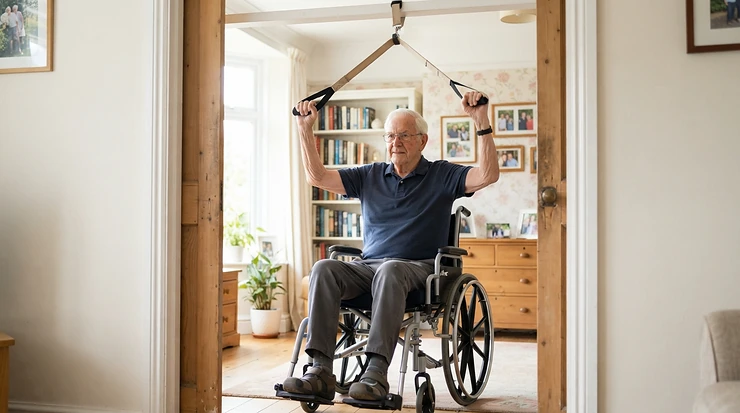
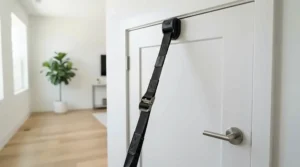
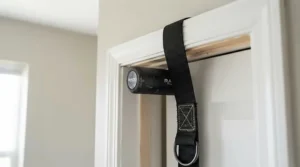
An over door stretching strap for seniors is a non-stretchy fabric strap with grab loops, paired with a padded door anchor that hooks over the top of a closed door. The anchor gives you a steady fixed point. Your arms do less of the work, and your hamstrings, hips and shoulders can ease into a stretch at your own pace.
Stiffness rarely announces itself. One morning you notice that putting on socks takes a strategy, and reaching the top shelf feels like a negotiation. The NHS physical activity guidelines for older adults say people aged 65 and over should do activities that improve strength, balance and flexibility on at least two days a week. A strap is one of the cheapest, quietest ways to meet the flexibility part of that advice without leaving the house.
The idea is simple. A plain strap needs you to hold both ends, which asks a lot of tired shoulders and arthritic fingers. A strap anchored to a door takes over the holding job, so you can lie back, breathe and let gravity help.
I’ve compared seven real options available to UK shoppers, interpreted their specs in plain English, and summarised what reviewers consistently say. I’ve also covered the door-safety questions most listings skip. Some picks include a door anchor and some don’t, and that difference matters for your wallet. Where I couldn’t verify something, I say so rather than guess.
Quick Comparison Table: Over Door Stretching Strap for Seniors at a Glance
Here is how the seven contenders line up before we go deeper. Price bands are indicative only and may vary, so check the current price before buying.
| Product | Door Anchor Included | Loops | Indicative Price Band | Best For |
|---|---|---|---|---|
| Zenmarkt | Yes | 10 | £15-£25 | Easiest all-in-one starter kit |
| Tchrules | Yes | Check listing | £15-£30 | Confident stretchers wanting deeper leg work |
| ZTFORUS | Yes (anchor strap) | 18 | £15-£25 | Very fine, gradual progression |
| CTRL Sports | No | 10 numbered | £20-£35 | Tracking progress loop by loop |
| Oak-Sports | No | 10 | £10-£20 | Budget-friendly recovery routines |
| Trideer | No | 10 plus leg lifter | £10-£20 | Bed, sofa and car-transfer help |
| OPTP | No | 10 | £20-£30 | Gold-standard strap with exercise booklet |
Only three of the seven ship with their own door anchor. That is the single biggest cost variable here, because a separate foam anchor is a small extra purchase, but it is still an extra. Zenmarkt is the lowest-effort path, ZTFORUS gives the finest steps between easy and hard, and Trideer and Oak-Sports are the budget picks if you are happy to add an anchor. Buyers prioritising a premium feel and a proper guide should look at OPTP and CTRL Sports.
💬 Just one click — help others make better buying decisions too!😊
Top 7 Over Door Stretching Strap for Seniors Picks: Expert Analysis
1. ZenmarktYoga Stretching Strap with 10 Loops and Door Anchor — easiest all-in-one starter kit
The standout is the bundle. The strap and door anchor arrive together, so there is no hunting for a compatible fitting. The strap has ten adjustable loops in polycotton (a polyester-cotton blend), a heavy-duty D-ring and a bonus booklet.
Polycotton is softer against skin than slick nylon, which matters if your fingers are tender or arthritic. Ten loops give you stepped hand positions, so you can start with a gentle hamstring stretch and creep deeper over weeks. Based on the spec sheet, this is the sensible pick for a first-timer who wants one purchase and one setup routine.
Reviewers consistently say the anchor slips over a door with no fuss and the loops are handy for hooking a foot or pulling in small increments. One reviewer reported that the middle metal ring didn’t feel strong enough. That is worth taking seriously. Inspect the ring before every session and never use it for bouncing or jerking.
Pros:
- ✅ Strap and door anchor arrive together
- ✅ Soft polycotton is kind to sore hands
- ✅ Ten loops allow gradual progression
Cons:
- ❌ One reviewer doubted the middle ring’s strength
- ❌ Strap length isn’t clearly confirmed in listings
Expect a price around the £15-£25 range at the time of research. As a one-box solution, the value verdict is strong.
2. Tchrules Leg Stretcher Strap with Door Anchor — door-friendly anchor built for deep leg work
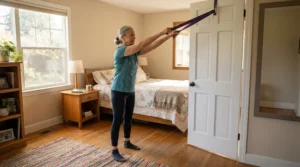
The hook here is the anchor design. The listing says the over-the-door piece won’t scratch or damage your door and won’t slide while you stretch your legs. That is exactly the claim you want from a door anchor.
This is the most athletic product in the roundup. It is marketed for gymnastics, dance, aerial yoga and ballet, which usually means it is designed for deeper stretching than a gentle senior routine needs. If you choose it, think of it as a tool for steady leg stretches, not for chasing splits.
The honest caveat is review depth. The listing had only about a dozen reviews at the time of research, and full specs such as loop count and length weren’t clearly confirmed. I won’t pretend otherwise, so check the listing carefully before buying.
On paper, the stable anchor is the appeal. For someone who stretches lying down and wants minimal fiddling, a firm anchor matters more than any extra loop.
Pros:
- ✅ Anchor designed not to scratch doors
- ✅ Stays put during leg stretches
- ✅ Includes the anchor in the box
Cons:
- ❌ Aimed at athletes rather than gentle routines
- ❌ Small review pool and thin spec detail
Prices sit around £15-£30. The value is reasonable if you value the anchor, but I’d rank it behind Zenmarkt for a first-time senior user.
3. ZTFORUS 18-Loop Stretching Strap with Anchor Strap — finest steps between easy and hard
The standout is 18 loops. Most straps give you ten, so the gaps between hand positions are noticeably smaller here. For people with limited mobility, small steps are gold, because you progress by a few centimetres rather than a leap.
The kit includes the flexibility strap, an anchor strap and a foam waist pad. The listing’s setup: thread the main strap through the anchor ring, clip the anchor over the door, give it a firm tug test, then adjust the buckle. That tug test is good practice for every strap in this guide.
The waist pad targets back-bend work, which is not a priority for most seniors. Treat it as a bonus you may never use. The more important question is fit. One reviewer said it felt unsafe and didn’t fit over their door, so measure your door thickness before ordering and test the setup before you trust it.
The listing also says the anchor can fasten over bars, which gives you options if a door isn’t suitable.
Pros:
- ✅ 18 loops allow very gradual progress
- ✅ Includes an anchor strap in the kit
- ✅ Can attach to bars as well as doors
Cons:
- ❌ One reviewer reported door-fit and safety concerns
- ❌ Waist pad and back-bend focus add little for seniors
Expect around £15-£25. It is good value if your door suits it, but the door-fit complaint makes careful testing essential.
4. CTRL Sports Stretching Strap with 10 Numbered Loops — numbered loops make progress visible
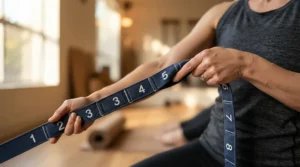
The hook is simple and clever: every loop is numbered. You can record “loop 4 last week, loop 5 today” and see real progress, which is motivating and useful to show a physiotherapist.
The strap is a non-elastic nylon band about 78 inches (just under two metres) long and 1.5 inches wide, with neoprene handles. Non-elastic means it won’t rebound or surprise you, so the stretch stays where you put it. Neoprene adds cushioning where your hand meets the loop, which helps when grip is weak. A compact carry bag makes it easy to store.
This one has no door anchor, so budget for a separate one. Reviewers describe it as matching the equipment used in physical therapy settings and praise the clear choice of progressive stretches over guesswork.
If you like data, charts and a visible trail of improvement, this is the one that rewards you for it.
Pros:
- ✅ Numbered loops make tracking progress easy
- ✅ Neoprene handles cushion the grip
- ✅ Compact carry bag for storage
Cons:
- ❌ No door anchor included
- ❌ Priced above the budget picks
Prices sit around £20-£35. The value verdict is good if you will actually track your progress, and less compelling if you will not.
5. Oak-Sports Stretching Strap with 10 Loops and Workout Guide — budget strap trusted for post-surgery routines
The standout is dependable simplicity at a modest cost. The strap is a 75-inch non-elastic nylon band with ten adjustable loops and a workout guide.
At 75 inches, the length suits most adults lying on a bed or sofa, so you can loop the strap around a foot with room to spare for hand positions. The non-elastic design means it holds your position firmly rather than springing back.
Reviewers include people months after a knee replacement and someone recovering from meniscus surgery. One neatly pointed out that the band doesn’t stretch because its job is to let your body do the deep work. That is exactly the right mental model.
There is no door anchor in the box, so add a basic foam one. Before using any strap after surgery, follow your physiotherapist’s or surgeon’s instructions on which stretches are safe.
Pros:
- ✅ Non-elastic nylon holds positions steadily
- ✅ Ten loops cover a wide range of reach
- ✅ Includes a basic workout guide
Cons:
- ❌ No door anchor included
- ❌ Plain design with little independent testing data
Expect roughly £10-£20. That makes it one of the best-value ways to start, as long as you buy an anchor too.
6. Trideer Stretching Strap with Leg Lifter — leg lifter doubles as a mobility aid
The hook is the bonus leg lifter. The loop at the foot end holds your foot in place so you can lift a stiff leg into bed or a car with less effort.
The main strap is a 75-inch, ten-loop, non-elastic band, built to a physio-style design. Reviewers commonly mention knee replacement rehabilitation and say their physiotherapist recommended or used the same kind of strap. The non-elastic webbing keeps your stretch steady and predictable.
One review roundup notes that the material is stiff by design and less comfortable on bare hands. If you have sensitive skin or arthritic fingers, wear thin gloves or wrap the loop with a soft cloth.
There is no door anchor in the box. Pair it with a separate one, and the leg lifter becomes handy even on days when you skip the stretching routine entirely.
Pros:
- ✅ Leg lifter helps with bed and car transfers
- ✅ Widely used for knee replacement rehab
- ✅ Non-elastic webbing keeps stretches predictable
Cons:
- ❌ Stiff webbing can feel rough on bare hands
- ❌ No door anchor included
Expect around £10-£20. For the price, the added leg lifter makes this one of the best-value picks here.
7. OPTP Stretch Out Strap — gold-standard strap with a 40-page exercise booklet
The standout is pedigree. This is a long-established strap that review sites repeatedly put at the top of their lists, and it comes with a 40-page exercise booklet.
It is a six-foot strap with ten loops in woven webbing. Sources differ slightly on whether the webbing is nylon or polyester, so check the listing. An eight-foot version exists for taller users. The booklet is a quiet strength because it turns the strap from a gadget into a routine.
Its main downside is the lack of a door anchor, so you will need to add one. Editorial reviewers commonly describe it as a dependable all-rounder suited to seniors who want a strap for daily mobility. I’d treat that as informed opinion rather than a guarantee.
Pros:
- ✅ Includes a 40-page exercise booklet
- ✅ Longer eight-foot option for taller users
- ✅ Long-established design with strong reputation
Cons:
- ❌ No door anchor included
- ❌ Costs a little more than basic straps
Expect around £20-£30. It is worth the premium if you want guidance in the box, and less compelling if you already have a physiotherapy plan.
Top 7 Specs Compared
| Product | Strap Length | Material | Handle Comfort | Best For |
|---|---|---|---|---|
| Zenmarkt | Not confirmed | Polycotton | Soft fabric | First-time buyers wanting one box |
| Tchrules | Not confirmed | Not confirmed | Standard | Deeper leg stretches |
| ZTFORUS | Not confirmed | Not confirmed | Standard | Tiny, gradual progressions |
| CTRL Sports | About 78 in | Nylon | Neoprene cushioned | Tracking progress |
| Oak-Sports | 75 in | Nylon | Standard | Budget recovery routines |
| Trideer | 75 in | Polyester-type webbing | Stiff by design | Transfer help plus stretching |
| OPTP | 6 ft (8 ft option) | Woven webbing | Standard | A guided routine |
Several rows read “not confirmed” because many listings leave out basic dimensions, and I’d rather flag that than invent data. If length matters to you, favour the products with clearly stated sizes. Seniors with limited mobility should lean towards CTRL Sports for padded grip or Zenmarkt for soft fabric.
How to Set Up Your Over Door Stretching Strap for Seniors (and Use It for 30 Days)
A good setup takes five minutes and saves a lot of worry. Here is a sensible first-month plan, framed as general practice rather than medical advice.
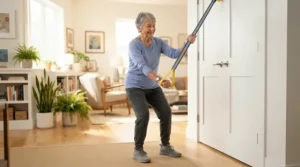
Setting up: Choose a solid internal door that closes firmly against its frame. Place the door anchor over the top, close the door fully, then tug the strap firmly before trusting it. Stand or lie on the side where the door would swing away from you if you opened it, so any pull presses the door into its frame. Always follow the manufacturer’s instructions if they differ.
Week one: Warm up first with a short walk or gentle movement, because stretching cold muscles is poor practice. Try one or two easy stretches, such as a lying hamstring stretch with the strap around your foot. Hold each for 15 to 30 seconds, a commonly used range, and stop at mild tension, never pain.
Weeks two to four: Add a second stretch, such as a calf or shoulder stretch, and move one loop deeper only when the previous position feels easy. The NHS Strength and Flex how-to videos show thigh, calf and chest stretches clearly, and they tell you to stop immediately if you feel pain or become unwell.
Common first-month mistakes include rushing, holding your breath and skipping the tug test. If you have not exercised for a while or have health concerns, speak to your GP first.
Three Real-World Scenarios: Matching the Strap to the Senior
These are illustrative profiles to help you think through the decision, not real customers.
Scenario 1: Recovering after a knee replacement, tight budget. Someone four months post-surgery, with physiotherapy sessions finished, needs a simple, reliable tool. Oak-Sports or Trideer plus a basic foam door anchor keeps the total low. The Trideer leg lifter also helps with getting into bed. Confirm the exercises with your physio first.
Scenario 2: Arthritic hands, wants minimal fiddling. A 78-year-old whose fingers ache wants one box, no assembly puzzles and soft materials. Zenmarkt and its polycotton strap suit best. If cushioning matters more than the bundled anchor, CTRL Sports with its neoprene handles is the alternative.
Scenario 3: Active 66-year-old who gardens and golfs and likes seeing progress. Here the fine steps of ZTFORUS or the numbered loops on CTRL Sports reward patience. If they prefer a structured plan, OPTP and its booklet make a good partner.
The common thread is that matching your hands, your budget and your routine matters more than chasing the longest strap or the highest loop count.
Problem-Solution Guide: When Your Door Anchor Setup Misbehaves
Setups fail in predictable ways. Here are the common ones and what to do.
The anchor slides or shifts. Check that the door is fully closed and the anchor’s padded side faces the right way. If it still slides, the door may be too thick or too thin for that anchor, which is the sort of fit issue a ZTFORUS reviewer reported.
The door opens or rattles. Stop immediately. Switch sides so the pull presses the door into its frame, or choose a heavier door. Fire doors with self-closers can fight the strap, so avoid them.
The strap feels too short. Longer straps such as the eight-foot OPTP option help taller users or anyone stretching from a chair.
The loops are hard to grip. Look for cushioned handles like those on CTRL Sports, or wrap stiff webbing like Trideer with a soft cloth.
You can’t get down to the floor. Use a firm bed or sofa instead, and keep the strap anchored at a height that lets you stay seated.
Most problems come down to the door, not the strap. If your door isn’t suitable, using a different fixed point or a standard strap by hand is better than forcing a risky setup.
How to Choose an Over Door Stretching Strap for Seniors
Here are seven steps, each with a reason behind it.
- Check your door first. Solid, well-hung internal doors that close firmly are best. A strap is only as safe as the door it hangs from.
- Decide whether you want the door anchor included. Bundled kits like Zenmarkt save effort. Separate anchors save money but add shopping.
- Pick a loop count that matches your starting point. Eighteen loops on ZTFORUS give tiny steps, while ten loops are enough for most people.
- Choose non-elastic. Elastic straps rebound, while non-elastic ones hold your position steadily.
- Check the grip. Soft polycotton, neoprene handles or non slip loops matter more with weak hands.
- Confirm the length. Around 75 to 78 inches suits most adults, and taller users may prefer the longer OPTP version.
- Ask your GP or physio when in doubt. This is especially wise after surgery or if you have joint conditions.
Treat this as a checklist, not a race. The right strap is the one you will still be using in three months.
Stretching Strap with Loops for Older Adults: What the Loops Actually Do
The loops are the whole point. Without them, you shuffle your hands up and down a bare strap and hope. With them, you get fixed grip points, which means you can repeat the same stretch tomorrow and know whether you improved.
A stretching strap with loops for older adults works as a graduated ladder. A gentle hamstring stretch might start at loop two, then move to loop three after a fortnight. The gaps between loops define how big each jump is. That is why the 18-loop ZTFORUS suits very cautious progress, while a ten-loop strap like Oak-Sports suits people who prefer fewer, larger steps.
Loops also reduce strain on your hands. Instead of clenching a flat strap, you hook a hand or foot through a loop and relax. For older adults with weaker grip, that is a quiet but significant advantage.
The catch is stitching. Every loop is a stress point, so check them periodically for fraying, especially on cheaper straps. If a loop looks worn, retire the strap rather than risk a failure mid-stretch.
Gentle Flexibility Strap for Limited Mobility: Features That Make the Difference
A gentle flexibility strap for limited mobility has different priorities from one built for gymnasts. Here is what to look for.
Non-elastic webbing. It gives you control. A stretchy band can pull you further than you intended.
Soft, wide handles or loops. Cushioned neoprene like CTRL Sports or soft polycotton like Zenmarkt spreads pressure across the hand.
Low-effort setup. If assembling the strap is a struggle, you will stop using it. Bundled kits remove steps.
Lie-down compatibility. If standing is difficult, a bed or sofa setup with the anchor at a sensible height lets you stay supported.
A leg lifter or transfer aid. The Trideer leg lifter is helpful if lifting a leg is the hard part.
The key principle is that the strap should reduce effort, not add it. If you find yourself wrestling with buckles, tiny loops or slippery fabric, it is the wrong tool, however good the specs look on paper.
Joint Mobility: What a Strap Can (and Can’t) Do for You
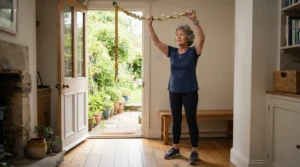
Joint mobility is the ability of your joints to move through their natural range comfortably. A strap supports it by making stretches repeatable and controlled, and by taking some of the load off tired muscles.
On the plus side, a strap helps you hold a stretch for a steady 15 to 30 seconds without gripping hard. It also helps you track progress, as numbered loops on CTRL Sports show, which can keep you consistent.
What it can’t do is replace professional advice. If you have a replaced joint, significant arthritis, osteoporosis or balance concerns, the safe range of movement may be limited, and your physio should set those limits. Joint mobility routines are best built gradually and kept pain-free.
Think of the strap as a patient assistant, not a coach. It holds the position, and you provide the judgement.
Non Slip Loops and Door Anchor: Features That Actually Matter (and Those That Don’t)
Non slip loops matter. If a loop slides off your foot or hand mid-stretch, the stretch ends abruptly and may jolt a joint. Textured stitching and snug loops help, and cushioned handles like those on CTRL Sports add comfort. Reviewers don’t always mention slipperiness, so inspect the loops when the strap arrives and test them with a gentle pull.
The door anchor matters even more. It is the only thing holding everything in place. Look for a padded design that grips the door without scratching, as the Tchrules listing claims, and check that the strap threads cleanly through the anchor ring as in the ZTFORUS setup. A separate foam anchor is a perfectly sensible purchase for Oak-Sports, Trideer, CTRL Sports or OPTP.
What doesn’t matter much: fancy colours, carrying bags and extra accessories. A waist pad is nice only if you will use it, and most seniors won’t.
Spend your money on a reliable door anchor and secure loops first. Everything else is decoration.
Over Door Stretching Strap for Seniors vs Traditional Alternatives
Here is how an anchored strap compares with the usual options.
| Option | Effort to Hold | Setup Needed | Best For |
|---|---|---|---|
| Over door strap (e.g. Zenmarkt) | Low | Door and anchor | Controlled leg and shoulder stretches |
| Plain handheld strap (e.g. Oak-Sports without a door) | Medium | None | Travel and simple stretches |
| Resistance band | Variable | Often an anchor | Strength work |
| Wall or counter stretching | Low | None | Quick calf and hamstring stretches |
An over door stretching strap for seniors takes the holding effort away, which is the main reason to choose it over a plain strap. A handheld strap such as Oak-Sports is more portable and needs no door, but your arms do all the work. Resistance bands are built for strength rather than flexibility, and elastic can pull unpredictably.
If your door is suitable and your shoulders tire easily, the anchored setup wins. If you travel often or don’t have a safe door, a handheld Trideer or OPTP still does the job.
Safety Guide: Doors, Joints and Knowing When to Ask a Professional
Safety deserves its own section because the risks sit in the setup, not the strap.
Doors. Use a solid door that closes firmly against its frame. Lightweight hollow doors can flex, and doors with self-closers can fight your pull. Don’t use any door that rattles or opens under load.
Joints. Stop at mild tension. If you feel sharp pain, pins and needles or dizziness, stop and seek advice. Anyone with a joint replacement or recent surgery should follow their surgeon’s precautions.
Falls. Balance matters. NHS Inform’s strength and balance guidance notes that regular strength and balance exercises can help reduce falls risk. Stretch while lying down or seated, avoid standing on one leg, and keep a stable surface within reach.
When to ask for help. Speak to your GP or physiotherapist before starting if you have medical conditions, a history of falls or recent surgery. A strap is a sensible helper, but it can’t judge your personal limits.
Long-Term Cost & Maintenance
A strap costing between £10 and £35 is cheap per use. Used four times a week for a year, even a premium option works out at pennies per session. The bigger costs are the items you forget to budget for.
Add a separate door anchor if your strap doesn’t include one, which is only a small extra. If the anchor or ring fails, replace it rather than repair it.
Maintenance is simple. Wipe the strap with a damp cloth and let it air dry. Check the stitching on every loop and the D-ring on Zenmarkt or the buckle on ZTFORUS monthly. Retire any strap with frayed loops, bent metal or a worn anchor.
Over a year, the cheapest strap that stays safe beats the premium one that sits in a drawer. Consistency is where the value really comes from.
FAQ
❓ Will an over door stretching strap for seniors damage my door?
❓ How often should seniors use a stretching strap with loops?
❓ Which strap suits recovery after knee replacement?
❓ Do non slip loops matter for arthritic hands?
❓ Can I buy a door anchor separately?
Conclusion
The best over door stretching strap for seniors is the one that fits your door, your hands and your routine. For most people starting out, Zenmarkt is the easiest all-in-one kit. ZTFORUS suits slow, finely stepped progress, CTRL Sports rewards anyone who likes tracking numbers, and Trideer and Oak-Sports keep the cost low. OPTP is the guided, premium-feeling choice, and Tchrules suits more confident stretchers who want a firm anchor.
Remember that three of these come without a door anchor, so budget a few pounds more. Whatever you choose, test the setup, stretch gently and speak to your GP or physiotherapist if you have any health concerns.
Small, consistent sessions beat heroic ones. A few minutes with a trusty strap could make tomorrow’s socks, shelves and steps feel a little easier.
Recommended for You
- Flexibility Trainer For Martial Arts Kicks: 7 Proven Picks (2026)
- Foam Wedge Stretcher For Tight Calves: 7 Proven Picks (2026)
- Hamstring Stretching Device For Runners: 7 Proven Picks (2026)
Disclaimer: This article contains affiliate links. As an Amazon Associate, I earn from qualifying purchases. If you purchase products through these links, we may earn a small commission at no additional cost to you.
✨ Found this helpful? Share it with your friends! 💬🤗
