
In This Article
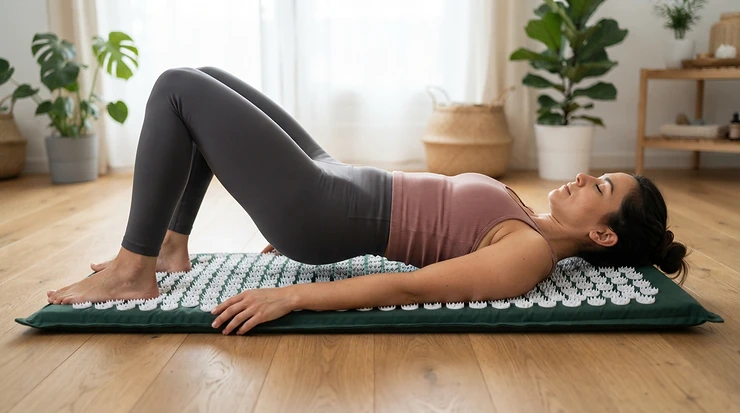
An acupressure mat for sciatica and lower back is a foam-cushioned mat covered in hundreds or thousands of small plastic spikes. You lie on it for 10 to 30 minutes. The spikes press into the skin across a wide area, which many people find eases muscle tightness and encourages relaxation. It is a comfort tool, not a cure for nerve compression.
Let’s be straight about the stakes. When your leg is burning, your bottom is aching and sitting through a meeting feels like a hostage situation, you will try almost anything. Sciatica is a symptom, not a diagnosis. According to the NHS guidance on sciatica, it usually improves within four to six weeks, but it can last longer. That means whatever you buy needs to be safe, cheap enough not to sting, and used alongside proper care.
So here is how this guide works. I have shortlisted seven real mats you can find through Amazon UK, covering budget, mid-range and premium. For each one I explain what the specs mean in practice, what aggregated buyer reviews keep saying, and who should skip it. Everything below is built on published specifications, review patterns and research, not on hands-on testing, so you will not find invented anecdotes here.
Prices are ranges only. They shift constantly, so check the current price and availability before you buy.
Quick Comparison: Best Acupressure Mats at a Glance
| Product | Listed spikes | Mat size (approx.) | Intensity | Price range* | Best For |
|---|---|---|---|---|---|
| ProsourceFit Acupressure Mat and Pillow Set | c. 8,910 (regular) / 11,178 (long) | 67 x 42 cm / 130 x 48 cm | Medium | Under £30 | Budget first-timers |
| Gaiam Acupressure Mat and Pillow Set | “Thousands” (count unclear) | 64 x 40 cm | Moderate | Under £30 | Cautious sceptics |
| XiaoMaGe Acupressure Mat and Pillow Set | 6,930 + 1,782 (pillow) | 73 x 42 cm | Sharp | Around £20-£35 | Taller users |
| Sivan Health and Fitness Acupressure Mat and Pillow Set | Thousands (varies by listing) | Roll-up; longer version exists | Moderate | Under £30 | Travel and storage |
| Bed of Nails Original Acupressure Mat | 8,820 | 74 x 41 x 2 cm | Gentler spread | Roughly £60-£90 | Quality beginners |
| Shakti Premium Acupressure Mat | 8,000 / 6,000 / 4,000 by level | 74 x 40 x 2.5 cm | Adjustable | Roughly £70-£120 | Choosing your intensity |
| Pranamat ECO Massage Set | 5,000+ lotus points | 73 x 45 cm | Intense | Roughly £150-£300 | Natural materials |
*Indicative ranges at the time of research. Check current price on Amazon UK.
Looking at the table, the ProsourceFit Acupressure Mat and Pillow Set and Gaiam Acupressure Mat and Pillow Set are the cheapest ways to find out whether spikes suit you at all. The Bed of Nails Original Acupressure Mat spreads your weight over more points, so it usually feels kinder at the start. If you already know you like pressure, the Shakti Premium Acupressure Mat lets you choose how fierce it feels, while the Pranamat ECO Massage Set is the splurge for natural materials.
💬 Just one click — help others make better buying decisions too!😊
Top 7 Acupressure Mats for Sciatica and Lower Back: Expert Analysis
1. ProsourceFit Acupressure Mat and Pillow Set — most-reviewed budget all-rounder
Popularity is not proof of quality, but a review pile this big at least tells you what ordinary buyers keep running into.
The regular mat measures roughly 67 x 42 cm on a cotton-covered, plant-based foam core. Listings quote between about 6,000 and 8,900 points, so check the exact version you buy. A long 130 cm option exists, and a 1,782-point pillow is included. The regular size covers the lumbar region and hips, which is where sciatic irritation is usually felt.
Based on the spec comparison, this suits people who want the full spiky experience without a big outlay. Moderate density means less pressure per point than on 4,000-spike mats, which is gentler for beginners. What the spec sheet won’t tell you is that the foam insert can shuffle around inside the cover, so smoothing it flat becomes part of the ritual.
Reviewers on the big Amazon listing consistently describe the first minute as uncomfortable, then easing. A minority find it too spiky. The headline rating sits around 4.2 out of 5 on a very large review base, but check the UK listing for current figures.
Pros:
- ✅ Huge review base and long track record
- ✅ Regular and long sizes available
- ✅ Pillow included for neck and upper back
Cons:
- ❌ Foam insert can slide inside the cover
- ❌ Hand wash only, so upkeep takes effort
Expect to pay under £30. Verdict: very strong value for a first mat.
2. Gaiam Acupressure Mat and Pillow Set — lowest-risk way to test the idea
Gaiam is a recognisable fitness name, which counts for something when you are handing money to a stranger for a bed of spikes.
The mat is about 64 x 40 cm with a smaller pillow, and it weighs under a kilo. That is compact enough to slide into a wardrobe. The compromise is coverage. This is a shorter, half-body design, so it sits under your lower back and hips rather than supporting your whole spine.
Here’s what to weigh. The shorter length is actually fine for lumbar tension, but taller users will find their shoulders hanging off the end. Specifications on spike counts and materials are thin, which makes it harder to compare like for like. Care is spot-cleaning only, so you cannot wash it properly.
Review volume is smaller than for the bestsellers. Buyers who have rated it are mostly positive, but I could not verify a large UK review base, so treat the rating as indicative rather than conclusive.
Pros:
- ✅ Very low cost of entry
- ✅ Lightweight and easy to store
- ✅ Familiar fitness brand
Cons:
- ❌ Only one grey colourway and half-body length
- ❌ Materials and spike count poorly specified
Expect to pay under £30. Verdict: a sensible “try before you commit” buy, not a long-term favourite.
3. XiaoMaGe Acupressure Mat and Pillow Set — extra length for taller frames
If you have ever lain on a mat and found it stopping at your ribs, length is your main concern.
At roughly 73 x 42 cm, this mat is one of the longer options in the budget bracket. It carries about 6,930 spikes on the mat and 1,782 on the pillow, over a high-elastic foam base with non-toxic plastic points. That extra length lets you run the mat from pelvis to mid-back without shuffling.
Based on the numbers, 6,930 points is a middling count. It will feel sharper than the 8,820-point Bed of Nails Original Acupressure Mat, because the same body weight is shared among fewer spikes. This is a pick for people who like a firmer sensation and are happy to build up slowly.
Reviewers frequently praise the size and value. The most common complaint is the initial sharp pain, which is typical of most mats of this kind.
Pros:
- ✅ Long mat suits taller users
- ✅ Pillow with 1,782 points included
- ✅ Good price for the size
Cons:
- ❌ Sharp first sessions for beginners
- ❌ Limited detail on materials and care
Expect around £20-£35. Verdict: great value if you are tall, but start gently.
4. Sivan Health and Fitness Acupressure Mat and Pillow Set — rolls up for travel and storage
Not everyone has room for a mat that lives permanently on the bedroom floor.
This set rolls up with its pillow, the mat is only around 1.8 cm thick, and a carry bag is typically included. A longer 51-inch version also appears on some listings. That portability makes it easy to use at your desk chair, on a hotel bed or on the sofa.
What most buyers overlook is that a thinner mat gives you less cushioning, so spikes feel more direct. It rewards a layer of clothing and a slow build-up. The cover is removable and hand-washable, which one roundup flagged as the easiest to keep clean.
Aggregated buyer feedback is mostly positive. One recurring caution is to check dimensions carefully because some buyers expected a larger mat. Tender-footed users are advised to ease on slowly.
Pros:
- ✅ Rolls up, easy to store and travel
- ✅ Removable washable cover
- ✅ Budget price with carry bag
Cons:
- ❌ Thin build gives less cushioning
- ❌ Size varies between listings, so check carefully
Expect to pay under £30. Verdict: a handy travel and office companion.
5. Bed of Nails Original Acupressure Mat — gentle spread of 8,820 spikes
This is the one for people who read “intense” on a product page and flinch.
The mat has 8,820 spikes across 210 plates, each carrying 42 points, in a 74 x 41 x 2 cm format designed in Sweden. More spikes and a longer surface mean your weight is spread across more contact points. In practice that is the difference between a firm massage and a bed of nails. The cover is removable for hand washing.
On paper, this is the strongest candidate for readers whose sciatica makes them wary of anything harsh. A long surface can support the lumbar curve and glutes in one go. One drawback: the pillow is sold separately, and reviewers have noted that foam can be visible at the top seam.
On one UK retailer’s page, most of the reviews (44 of 54) were five-star. That is a small sample, but it is consistent with the “prickly at first, then blissful” pattern buyers describe.
Pros:
- ✅ High spike count spreads pressure widely
- ✅ Removable cover for easy washing
- ✅ Long surface supports hips and lower back
Cons:
- ❌ Pillow not included
- ❌ Visible foam at seam bothers some
Expect roughly £60-£90. Verdict: worth it if you want to buy once and avoid a harsh start.
6. Shakti Premium Acupressure Mat — choose your own intensity
Shakti is the brand that popularised modern spike mats, and its signature trick is letting you pick how fierce the experience is.
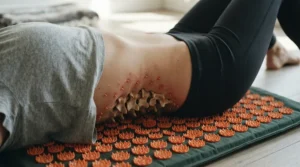
The Premium mat measures about 74 x 40 x 2.5 cm and weighs around a kilo. Intensity levels run from about 8,000 spikes (gentlest) through roughly 6,000 to about 4,000 (deepest). Fewer spikes mean more pressure per point. The cover is GOTS-certified organic cotton over a latex Blissfoam core.
The analysis is straightforward. If you are new to this and sciatica makes you sensitive, start at the gentlest level. Experienced users who find mid-priced mats too tame can step up. One practical catch is latex: check the foam material if you have a latex allergy.
Review ratings are strong, with listings around 4.6 to 4.7 stars. Complaints focus on intensity. A small number find the spikes too painful, and the brand’s own guidance is that its spikes are sharp.
Pros:
- ✅ Several intensity levels to choose from
- ✅ Organic cotton cover and quality build
- ✅ Strong buyer ratings
Cons:
- ❌ Pricier than most rivals
- ❌ Latex foam is a problem for allergic users
Expect roughly £70-£120 depending on level and colour. Verdict: best for those who want control and long-term durability.
7. Pranamat ECO Massage Set — natural materials, serious intensity
This is the boutique option, and it knows it.
The set includes a mat of about 73 x 45 cm and a pillow. It features over 5,000 lotus-shaped points, a linen cover and a coconut-fibre filling, with OEKO-TEX certification. Natural fill stays firm and breathes better than foam. The trade-off is that the lotus points feel intense, and there is no adjustable intensity.
For sciatica, I would treat this as a considered purchase rather than an impulse. It suits eco-minded, experienced users who have already tolerated a cheaper mat and know they like deep pressure. Beginners with sensitive skin or low pain tolerance are better served by a gentler first mat.
An independent review scored it around 3.85 out of 5, praising materials but marking down price and the lack of adjustability. UK buyers on Trustpilot have also complained about VAT and import duty adding substantially to the cost on some orders, so check whether the listing you choose is shipped from the UK with VAT included.
Pros:
- ✅ Natural linen, coconut fibre and buckwheat fill
- ✅ Handcrafted and OEKO-TEX certified
- ✅ Sturdy build designed to last
Cons:
- ❌ Highest price in this guide
- ❌ Intense with no adjustable levels
Expect roughly £150-£300 depending on set and source. Verdict: lovely, but only if you are sure you will use it.
Side-by-Side: Materials, Care and Pillows
| Product | Cover and fill | Care | Pillow included | Best For |
|---|---|---|---|---|
| ProsourceFit Acupressure Mat and Pillow Set | Cotton, plant-based foam | Hand wash, drip dry | Yes | Budget all-rounder |
| Gaiam Acupressure Mat and Pillow Set | Not clearly listed | Spot clean | Yes | Low-risk trial |
| XiaoMaGe Acupressure Mat and Pillow Set | Non-toxic plastic spikes, elastic foam | Check listing | Yes | Taller users |
| Sivan Health and Fitness Acupressure Mat and Pillow Set | Cotton cover, foam | Remove cover, hand wash | Yes | Travel |
| Bed of Nails Original Acupressure Mat | Organic cotton cover, foam | Removable cover, hand wash | Sold separately | Beginners wanting quality |
| Shakti Premium Acupressure Mat | Organic cotton, latex Blissfoam | Hand wash cover | Sold separately or in sets | Choosing intensity |
| Pranamat ECO Massage Set | Linen, coconut fibre, HIPS | Removable covers | Yes | Natural materials |
The practical takeaway is that cheap sets bundle a pillow, while the better-built mats make you pay for it separately. For sciatica, the pillow matters far less than the mat, since your lower back is the target, so do not let a “free” pillow sway you. Washability also deserves more weight than most buyers give it. Sweat and spikes are not natural friends, and a cover you can remove makes a mat far more pleasant to live with.
How to Choose an Acupressure Mat for Sciatica and Lower Back
Here are seven steps to choosing well.
- Start with intensity, not spike count alone. More spikes spread your weight and feel gentler. Fewer spikes feel sharper. If you are sensitive, pick the higher count.
- Check the length. For lower back and hip coverage, a mat of about 65-75 cm is the practical minimum. Taller people should look at longer versions.
- Look at the surface material. Cotton and linen covers feel better against skin, and a removable cover makes hygiene easier.
- Check the foam. Latex foam is fine for most people but a problem for those with latex allergies. Coconut fibre is firmer and breathes better.
- Set a realistic budget. A budget mat is usually enough to find out whether this approach helps you. Spend more only after you have proved the habit.
- Read recent reviews on the UK listing. Look for patterns about first-use discomfort, durability and sizing rather than headline stars.
- Check returns. A mat you cannot tolerate is wasted money, so confirm the return window before you buy.
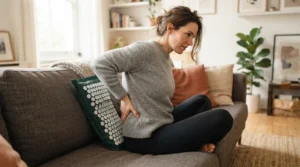
What Does the Research Actually Say?
This is where honesty matters most. Acupressure delivered by a practitioner has a reasonable research base for low back pain. A systematic review and meta-analysis of 23 randomised trials covering around 2,400 participants concluded that acupressure was effective for low back pain. However, the quality of evidence was downgraded, so more research is needed to confirm those findings.
The key distinction is that most of those trials involved practitioners applying finger or hand pressure to chosen points. A spike mat is a different intervention. It presses broadly across the skin rather than at specifically chosen points. Mat-specific trials are small and preliminary, so the strong findings from practitioner-delivered acupressure should not be assumed to transfer.
I could not find robust trial evidence specifically for sciatica and spike mats. Anything promising sciatica relief should therefore be read as “may help you relax and ease muscle tension”, not “treats the nerve”.
The most encouraging mat-specific data comes from lower back pain. We cover that in the next section, but the headline is this: mats look like a reasonable add-on to a proper exercise and self-management plan, not a replacement for one.
Acupressure Mat for Lower Back Tension and Lumbar Tension
Acupressure Mat for Lower Back Tension
Tight lower back muscles are the most believable use case for these mats. Hours at a desk shorten your hip flexors, load your lumbar muscles and leave them in a low-grade clench. Lying on a spiky surface for 15 minutes gives you a forced pause. Plenty of buyers describe the relaxation as the real benefit, rather than any dramatic pain change.
One small randomised study followed 44 people with chronic low back pain. All joined a rehabilitation programme, and the experimental group also used an acupressure mat for 60 minutes a day. According to the published abstract of the trial, the mat group showed additional benefit on pain, function and quality of life, especially in the medium to long term. That is encouraging but small, and it concerned chronic low back pain rather than sciatica specifically.
So an acupressure mat for lower back tension makes most sense as a daily wind-down alongside exercise.
Lumbar Tension: Where to Place the Mat
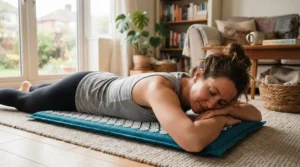
For lumbar tension, the sweet spot is a mat positioned across the hollow of your lower back, from the base of the ribs to the top of the buttocks. Bend your knees, or rest your calves on a chair or cushions, to ease the arch in your spine. Pressure should feel like “intense but breathable”. If you are clenching, it is too much.
Short, regular sessions beat heroic ones. Five to ten minutes is plenty at first. A ProsourceFit Acupressure Mat and Pillow Set or Bed of Nails Original Acupressure Mat suits this kind of gentle lumbar work well.
Acupressure Mat for Nerve Pain in Legs: Managing Expectations
Here is the awkward truth about an acupressure mat for nerve pain in legs. Sciatica pain travelling down the back of your leg comes from irritation at the nerve root in the lower back, often from a slipped disc. According to the NHS, symptoms usually affect the bottom and the back of one leg and can include burning pain, tingling, numbness and weakness. A spiky mat on the skin does not decompress that nerve.
What it may do is ease the surrounding muscle tightness that often tags along, and give you a calmer, more relaxed body while the nerve settles. If you try an acupressure mat for nerve pain in legs, keep the mat under your lower back and hips rather than pressing directly on painful or numb areas of the leg.
Numbness is the red flag here. Reduced sensation means you may not feel if the spikes are too much, so avoid using a mat on numb skin. If leg numbness or weakness is new, or getting worse, see your GP rather than reaching for a gadget. Treat any acupressure mat for nerve pain in legs as a relaxation aid only, and let a professional guide your actual treatment.
Trigger Points and Circulation Boost: What Spikes Can and Cannot Do
Trigger Points
Trigger points are tight, tender knots in muscle that can refer ache to other areas. The lower back, glutes and hips are common sites, and they often get mistaken for, or add to, sciatic discomfort. A spike mat is not a precision tool for trigger points. It spreads pressure across a broad area rather than sustaining it on a single knot.
If you want to work specific trigger points, a massage ball or a physiotherapist is a better instrument. Where a mat helps is in warming up and softening the broader muscle before you stretch. That is a useful role, as long as you do not expect it to dissolve individual knots.
Circulation Boost
Brands love promising a circulation boost. The honest version is modest. Pressing on skin for 20 minutes often leaves a pink, warm flush, which is a short-term skin response and can feel pleasant. Mat-specific research on measurable physiological changes is thin, so treat any circulation boost as a comfortable side effect, not a medical outcome.
The practical advantage is behavioural. If a mat gets you to lie still, breathe slowly and then stand up and move, the routine may help your back more than the spikes themselves. Gentle movement afterwards is what the NHS recommends for sciatica anyway.
Practical Guide: Your First 30 Days on an Acupressure Mat
Most people quit in week one because they start too hard. Pace yourself.
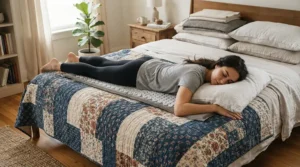
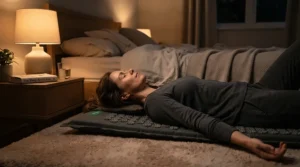
Week 1: acclimatise. Lie on the mat over a thin T-shirt for three to five minutes. Place the mat on a firm bed or a carpeted floor, with your knees bent or supported on cushions. If you are sensitive, lean against the mat on a sofa first. This puts less weight on the spikes.
Week 2: build up. Move to 10 minutes. Breathe slowly. The first minute is the hardest, and it usually eases as the sensation spreads and your body relaxes.
Weeks 3-4: settle into a routine. Reach 15-20 minutes, once a day at most. Try evenings for winding down. Always stand up and walk around afterwards. The NHS advises against lying or sitting for long periods with sciatica, so a mat session is not a reason to stay horizontal.
Stop immediately if you feel sharp, electric or worsening leg symptoms, new numbness or tingling, or skin pain that lingers.
Maintenance: Wipe or hand wash the cover as directed, let it dry fully and store it flat or rolled loosely. Sweat and body oil degrade covers quickly.
Common first-month mistakes: Going bare-skinned on day one, using it over broken or irritated skin, staying on for 40 minutes, and using it during a sudden severe flare-up.
✨ Ready to Pick One?
🔍 Take your recovery routine to the next level with these carefully selected mats. Click on any highlighted product name to check current pricing and availability on Amazon UK. A calmer, looser lower back could be a few gentle sessions away!
Real-World Scenarios: Which Mat Suits Which Life?
If you work at a desk and your lower back is stiff by 4pm and you want to spend as little as possible, start with the ProsourceFit Acupressure Mat and Pillow Set. Use it for ten minutes most evenings on the bedroom floor. It is cheap enough to abandon without guilt if it is not for you.
If you are over six feet tall, a short mat will leave your shoulders hanging off the end. The XiaoMaGe Acupressure Mat and Pillow Set or the long version of the ProsourceFit Acupressure Mat and Pillow Set gives you more coverage. Use it three or four evenings a week.
If your sciatica makes you wary of intensity, pick the Bed of Nails Original Acupressure Mat or the gentlest level of the Shakti Premium Acupressure Mat. The more spikes there are, the less pressure per point. Begin with short sessions, with a T-shirt on.
If you travel often, the Sivan Health and Fitness Acupressure Mat and Pillow Set rolls up and packs easily. Gaiam Acupressure Mat and Pillow Set is also light and compact for a similar purpose.
If you want a long-term, natural-materials purchase and already know you tolerate deep pressure, the Pranamat ECO Massage Set is the investment option, and the Shakti Premium Acupressure Mat is the middle path.
Acupressure Mat vs Traditional Alternatives
| Option | Typical outlay | Best For | Main limitation |
|---|---|---|---|
| Acupressure mat | £20-£300 one-off | Daily relaxation, muscle tightness | Limited sciatica-specific evidence |
| Heat pack | Low | Soothing tight muscles | Do not use on numb skin (scald risk) |
| Massage ball or foam roller | Low | Targeting specific knots | Needs technique, can be awkward on the back |
| Physiotherapy | Free on the NHS, or private | Assessment, exercise plan | Waiting times can be long |
The table shows why a mat works best as a supporting player. It is a low-cost, low-effort relaxation tool, but it does not replace an assessment or an exercise plan. Heat packs are a simple, inexpensive option, though the NHS cautions against hot water bottles if your skin is numb, because you could scald yourself. Physiotherapy is free on the NHS throughout the UK, and in many areas you can self-refer to community musculoskeletal services without seeing a GP first. For many people, the best combination is physiotherapy-guided movement plus a mat for winding down.
Common Mistakes When Buying an Acupressure Mat for Sciatica and Lower Back
Buying on spike count alone. A big number looks impressive, but sharpness, spacing and foam firmness matter as much. Compare like with like.
Buying too short. A 25 cm-wide, half-body mat may be fine for lumbar tension but will not support your hips and glutes if that is where your pain sits.
Ignoring the foam. Latex Blissfoam suits many people but not those with latex allergies. A thin foam layer feels harsher.
Expecting a cure. Marketing often implies mats treat sciatica. The evidence does not support that claim. Think relaxation, not repair.
Skipping the dull stuff. Returns, care instructions and actual dimensions are tedious to read but save regret later. Some listings bundle several sizes, so make sure the size you select matches the one you want.
Staying too long. More minutes do not mean more benefit. Short, regular sessions build tolerance without making your skin or nerves angrier.
Safety, Red Flags and When to See Your GP
Spike mats are low-tech, but they are not for everyone. Avoid using one over broken or irritated skin, over areas of numbness or reduced sensation, or if you have a bleeding disorder or are on blood thinners without checking first. Pregnancy also warrants clinical clearance before use.
More importantly, do not let a mat delay proper care. The NHS says to go to A&E or call 999 if you have sciatica on both sides or difficulty controlling your bowels, and lists further urgent warning symptoms. See a GP if pain is severe, getting worse or not improving after a few weeks. NHS pages also point out that you may be able to self-refer for physiotherapy.
The NICE guideline on low back pain and sciatica puts the emphasis on staying active, exercise and self-management. Its guidance on massage-type treatments is that they should only be considered as part of a package that includes exercise. That is a sensible rule of thumb for a mat too: use it to complement movement, not to replace it.
FAQ: Acupressure Mat for Sciatica and Lower Back
❓ How long should I lie on an acupressure mat for sciatica and lower back?
❓ Can I use an acupressure mat on bare skin?
❓ Is an acupressure mat safe if I have a slipped disc?
❓ Do acupressure mats leave marks?
❓ Which suits a beginner best, more spikes or fewer?
Conclusion: Is an Acupressure Mat for Sciatica and Lower Back Worth Buying?
An acupressure mat for sciatica and lower back is worth buying if you treat it as a relaxation and muscle-easing tool alongside exercise and proper medical advice. It is not worth buying if you are hoping it will fix a compressed nerve.
If you want to experiment cheaply, the ProsourceFit Acupressure Mat and Pillow Set and Gaiam Acupressure Mat and Pillow Set are low-risk ways in. Taller readers should look at the XiaoMaGe Acupressure Mat and Pillow Set, and travellers at the Sivan Health and Fitness Acupressure Mat and Pillow Set. If you want gentler pressure and a better build, the Bed of Nails Original Acupressure Mat is my pick on paper. The Shakti Premium Acupressure Mat suits those who want intensity control, and the Pranamat ECO Massage Set is the natural-materials splurge.
Whichever you choose, start slow, keep sessions short and keep moving. If your leg symptoms are worsening, speak to a healthcare professional promptly.
Recommended for You
- Acupressure Mat And Pillow Set For Sleep: 7 Best UK Picks (2026)
- Foldable Massage Mat For Travel: 7 Best Picks For 2026
- Over Door Stretching Strap For Seniors: 7 Best Picks (2026)
Disclaimer: This article contains affiliate links. As an Amazon Associate, I earn from qualifying purchases. If you purchase products through these links, we may earn a small commission at no additional cost to you.
✨ Found this helpful? Share it with your friends! 💬🤗
