In This Article
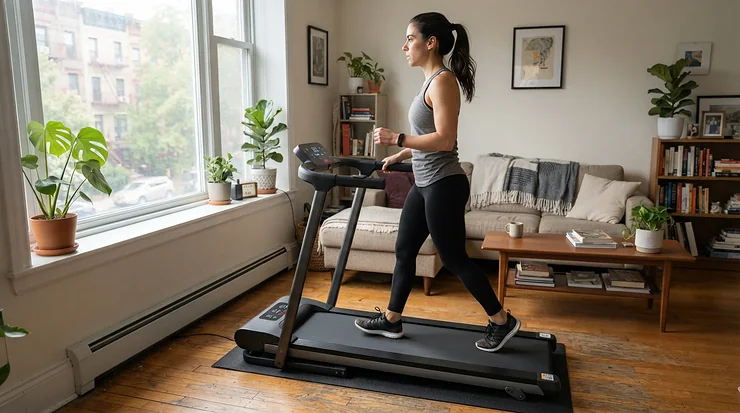
Most stretching kit was designed for dance studios with sprung floors and room to swing a leotard. Your flat has a radiator, a wardrobe door that opens exactly 90 degrees, and a hallway you share with a bike. So a portable stretching machine for small flats has to do something unusual: work hard for twenty minutes, then vanish.
That is a tougher brief than it sounds. A rocker-style split trainer, a three-bar stretcher and a chair-style frame all occupy very different amounts of floor and cupboard. Choose badly and you own an expensive coat hook.
I compared seven real models sold through Amazon UK, ranging from budget bars to a premium frame. For each one I looked at what the spec means in practice, what reviewers report where verifiable review data exists, and where the format will annoy you. Every price below is a range, because Amazon prices move constantly. Check the current listing before you buy.
What is a portable stretching machine for small flats?
A portable stretching machine for small flats is a lightweight, collapsible leg-stretching frame that gently opens your legs or lengthens your hamstrings under your control, then folds away when you’re done. It trades the bulk of gym equipment for a footprint you can tuck behind a door or under a bed.
The goal is improved range of motion, the angular distance a joint can move between its flexed and extended positions. In everyday terms, that means touching your toes, squatting deeper and sitting cross-legged without grumbling.
Quick Comparison: 7 Picks at a Glance
Here is the whole field on one screen. The “Best For” column is where the real decision lives.
| Product | Format | Price range | Best For |
|---|---|---|---|
| MAXSTRENGTH 3-Bar Leg Stretcher | 3-bar, hand-controlled | £15–£25 | Testing the idea cheaply |
| Acouto 3 Bar Leg Stretcher (9 Hole) | 3-bar, nine length holes | £20–£30 | Finer fit on a budget |
| Yes4All Leg Stretcher Split Machine | Floor-level rocker with handbrake | £35–£80 | Lightest rocker-style option |
| WARMOUNTS Split Machine (0-190°) | Rocker-style, listed 150kg | £55–£65 | Mid-range value |
| LIAIZE Leg Stretcher Split Machine | Foldable, backrest, rotating seat | £70–£75 | Seated comfort that folds |
| SUNGOOYUE Leg Stretcher (Backrest Type) | Backrest frame with roller wheels | £100–£115 | Steadier, supported sessions |
| MAR Leg Stretching Machine | Compact premium splits trainer | £270–£300 | Long-term, frequent use |
Looking at the table, the MAXSTRENGTH and Acouto bars win on sheer storability, since they are essentially poles. The Yes4All, WARMOUNTS and LIAIZE sit in the sweet spot where a mechanism does the holding for you. The MAR only makes sense if you will genuinely use it several times a week for years.
💬 Just one click — help others make better buying decisions too!😊
Top 7 Portable Stretching Machine for Small Flats: Expert Analysis
Each entry below explains what the numbers mean in a real flat, not just what the listing says. Where I couldn’t verify genuine UK customer reviews, I say so rather than pad the gap.
1. MAXSTRENGTH 3-Bar Leg Stretcher — cheapest way to find out if you’ll use one
The standout feature here is its simplicity. Three bars, padded grips, no seat, no frame. It is the closest thing to a compact stretcher for tight spaces that you can slide behind a wardrobe.
Three-bar designs generally work by resting the two outer bars against your legs while you push the central handle with your hands. You, not a gearbox, decide how far your legs open. The upside is instant release if something feels wrong. The catch is that nothing holds your position for you, so your arms tire before your hamstrings do.
Based on the format, this suits someone curious about stretching machines but unwilling to spend £70 on a gadget that may become a clothes rack. It is a poor fit if you want to read a book while you stretch.
I couldn’t verify a meaningful pool of recent UK reviews for this listing at the time of research, so treat this as a spec-based assessment. Read the newest verified-purchase reviews before buying.
Pros:
- ✅ Folds to almost nothing
- ✅ Lowest financial risk in this guide
- ✅ Hand control gives instant release
Cons:
- ❌ No mechanism to hold your position
- ❌ Arm fatigue limits session length
Expect to pay around £15–£25. As a trial purchase, the value is excellent.
2. Acouto 3 Bar Leg Stretcher (9 Hole) — nine adjustment holes for a finer fit
The headline feature is in the title: nine length holes. Where a six-hole bar jumps in coarser steps, nine holes let you set the width closer to your leg length.
That matters more than it sounds. If the bars sit slightly too long, you pre-stretch before you’ve even started. Slightly too short and you will never reach a useful angle. The extra holes narrow that window for taller or shorter users and for households where two people share one stretcher.
Like every three-bar tool, it relies on your arms for control. Think of it as a hands-on stretching aid, not a hands-free machine. Compared with the MAXSTRENGTH, the main analytical difference is adjustment resolution, so pick whichever reads better on current stock and delivery.
Verifiable UK review data was thin when I checked, and the seller information is sparse. That makes the returns policy more important than usual.
Pros:
- ✅ Nine holes allow finer length matching
- ✅ Stores in a drawer-sized space
- ✅ Budget price for a flexible set-up
Cons:
- ❌ Limited brand and support information
- ❌ Hands-on effort throughout the stretch
At around £20–£30, it earns its place if fit precision is your priority.
3. Yes4All Leg Stretcher Split Machine — the best-documented rocker-style option
This is the most thoroughly documented model in the guide. The Amazon.co.uk listing shows 4.3 out of 5 from 56 global ratings, though only a single rating came from the UK. So most feedback is from overseas buyers.
The mechanism is a handbrake-controlled rocker that opens from 0 to 180 degrees, with six adjustment holes on each pole. The listing’s leg-length range of roughly 24¾ to 33½ inches is about 63–85 cm. In a flat, the light frame is the selling point. It sits on the floor, so you need to be comfortable sitting there, and it slides away when finished.
One conflict deserves attention. The listing advertises a 330 lb capacity, but a US version lists a 300 lb recommended maximum. Check the manual that arrives rather than trusting either headline.
Reviewers describe it as sturdy and easy to use, though one reported a bent push arm and poor leg retention. That is a single report, not a pattern.
Pros:
- ✅ Handbrake allows controlled, gradual opening
- ✅ Light frame is easy to move and store
- ✅ Six holes per pole for fit
Cons:
- ❌ Conflicting weight-capacity figures
- ❌ Floor-level use suits only some bodies
Prices have swung from the mid-£30s to around £80, so watch the listing. At the lower end it’s strong value; at the top, less so.
4. WARMOUNTS Split Machine (0-190°) — mid-range value with a wider listed angle
The listing promises 0–190 degrees, a 150 kg capacity and “no installation needed”. In a small flat, the last point matters: a machine that arrives ready to use is one you will actually use on week one.
A 190° ceiling is mostly theoretical. Very few people will ever need an angle beyond 180, but the extra headroom suggests the frame is not maxed out at the standard setting. What matters more is the adjustment mechanism, since a smooth gear-driven opening lets you creep up by small increments instead of lunging.
If you are choosing between this and the Yes4All, the question is how you like to apply force. The WARMOUNTS is described as rocker-style, which suits those who want the machine to take over some control. Be aware that clone listings from other retailers quote a different weight limit than the 150 kg shown on Amazon, so confirm your own unit’s paperwork.
I could not verify enough UK reviews to summarise genuine buyer sentiment responsibly. A fair approach is to check the newest ones for noise, wobble and cushion durability.
Pros:
- ✅ Ready to use with little assembly
- ✅ Wide listed range gives headroom
- ✅ Comfortable mid-range price
Cons:
- ❌ Inconsistent capacity figures across listings
- ❌ Thin verifiable review data
Expect to pay around £55–£65. That’s fair value for what is promised.
5. LIAIZE Leg Stretcher Split Machine — folds down but keeps a backrest
The standout here is the combination of a foldable frame and a proper seat. The listing describes five length levels, a 168 cm extension, a 150 kg alloy frame, wheels, a sit-up backrest and a 360° rotating seat that doubles as a waist twister.
For a flat-dweller, the backrest is the underrated feature. Rocker-style floor models ask your lower back to support you, which is fine for twenty minutes and miserable for forty. A backrest lets you relax into the stretch, which is how most people get past the initial resistance. That is also where fold flat storage helps, because the frame collapses after use.
I’d treat the “waist twister” as a bonus, not a reason to buy. Rotating seats add moving parts, and moving parts add possible wobble. If you only want to stretch, test whether the rotation can be locked or ignored.
I found no reliable UK review pool to summarise, so judge the build from the newest photos in the buyer reviews.
Pros:
- ✅ Backrest improves comfort in longer holds
- ✅ Foldable frame suits flat storage
- ✅ Wheels make repositioning easier
Cons:
- ❌ Rotating seat adds possible play
- ❌ Little verifiable UK feedback
Around £70–£75, it is a sensible pick for comfort-first buyers.
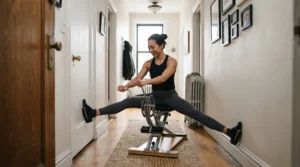
6. SUNGOOYUE Leg Stretcher (Backrest Type) — roller wheels and a more supported frame
The SUNGOOYUE backrest model is sold for adults and children and fitted with roller wheels. The wheels are what stand out in a flat, because moving a stretcher across laminate or between rooms is the daily chore nobody mentions.
The backrest edition is the better choice for anyone who wants to stay put. Compared with the LIAIZE, the pitch is a steadier, more chair-like seat rather than a convertible seat. In practice, support is what lets the stretch hold for longer, and holding is where changes in tolerance appear.
The trade-off is size and price. A backrest frame is bulkier than a floor-level rocker, so check its folded dimensions against your cupboard before you order. Always check dimensions in centimetres from the current listing, because I couldn’t confirm a folded size for this model.
Verified UK review volume looked low, so treat quality claims cautiously and lean on the returns window.
Pros:
- ✅ Roller wheels simplify moving it about
- ✅ Backrest supports longer sessions
- ✅ Listed for adults and children
Cons:
- ❌ Bulkier than floor-level models
- ❌ Folded size needs checking
At roughly £100–£115, it only wins if comfort is your priority and you have a spare corner.
7. MAR Leg Stretching Machine — premium compact splits trainer
The MAR is listed as a compact splits trainer with adjustable legs and a 180° range, and it is the priciest of the seven. The premium is hard to justify on a spec sheet alone, because the listing doesn’t reveal the build details that usually explain a price jump.
What the extra money can reasonably buy is durability and a smoother mechanism, since the gap between a £60 and a £280 frame is typically in the bearings, welds and padding. But I can’t verify that here, so the honest position is that this is a “check closely” purchase.
If you are the person who stretches five days a week and will still be using this in 2029, spreading the cost over years makes sense. If you’re in the first month of a new habit, buy cheaper and upgrade later.
I couldn’t verify enough review data to summarise sentiment fairly, so read recent buyer feedback and the seller’s returns terms before committing.
Pros:
- ✅ Compact design aimed at home users
- ✅ Suited to frequent long-term use
- ✅ Adjustable bar spreader format
Cons:
- ❌ Highest price in this guide
- ❌ Limited verifiable build detail
Expect around £270–£300. The value verdict: a considered upgrade, never a first purchase.
Top 7 Specs, Prices and Review Status
| Product | Format | Listed capacity or length | Price range | Review status | Best For |
|---|---|---|---|---|---|
| MAXSTRENGTH | 3-bar | Not stated | £15–£25 | Check recent UK reviews | Trial buyers |
| Acouto | 3-bar, 9 holes | Nine adjustment holes | £20–£30 | Check recent UK reviews | Fit precision |
| Yes4All | Rocker, handbrake | Six holes per pole; capacity figures conflict | £35–£80 | 4.3/5 from 56 global ratings | Documented value |
| WARMOUNTS | Rocker-style | 150 kg listed | £55–£65 | Limited data | Mid-range buyers |
| LIAIZE | Foldable, backrest | 168 cm, 150 kg listed | £70–£75 | Limited data | Comfort seekers |
| SUNGOOYUE | Backrest, wheels | Not confirmed | £100–£115 | Limited data | Supported sessions |
| MAR | Compact premium | 180° listed | £270–£300 | Limited data | Heavy users |
Read across the rows and a pattern emerges: only the Yes4All has enough public rating data to treat with any confidence. Prices cluster at three tiers (under £30, around £60–£75, and the premium MAR on its own). Unless you stretch near-daily, the mid-tier WARMOUNTS and LIAIZE deliver the most mechanism per pound.
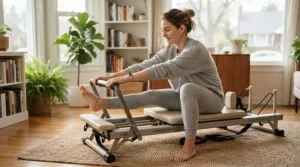
Practical Usage Guide: Setting Up a Folding Stretching Device for Home Use in a Tiny Flat
A machine you can’t use in the space you have is a machine you’ll stop using. Here’s how to set up a folding stretching device for home use without redecorating.
1. Find the 2-metre rule. Measure a rectangle roughly 2 metres by 1 metre. Open the machine at its widest listed setting and check that your hands, feet and getting-up room fit within it. A hallway usually works; a bedsit floor between bed and sofa often doesn’t.
2. Protect the floor. Wheels and metal feet can mark laminate. Put the machine on a yoga mat or a thin rug off-cut for the first few weeks and check for scuffs.
3. Warm up first. The NHS advice on stretching describes a gentle routine of roughly five minutes, with each stretch held for 15 to 20 seconds. It also says anyone with an injury, medical condition or pregnancy should talk to a physiotherapist or healthcare professional first. Stretch warm, not cold.
4. Start narrow. Set the arms well inside your comfortable range and widen in tiny steps across weeks, not minutes.
Common first-30-day mistakes:
- Bouncing instead of holding.
- Chasing the widest angle on day one.
- Setting the length holes wrongly, so you overextend before the stretch begins.
- Leaving the machine open “for tomorrow”, where it becomes a tripping hazard.
A simple maintenance schedule: wipe the cushions weekly, check bolts monthly, and oil any visible pivot points sparingly if the manual allows it.
Real-World Scenarios: Which Machine Fits Which Flat?
Specs only matter once you picture your own living room. Here are three realistic profiles and the reasoning behind each match.
The studio-flat commuter (budget £30, space under a bed). Your floor is shared with a sofa bed, and you stretch for ten minutes after work. A three-bar tool such as the MAXSTRENGTH or Acouto tucks under the bed and costs less than a takeaway for two. You accept more arm effort in exchange for zero storage pain.
The one-bed flat dweller who sits all day (budget £70, a spare hallway corner). Desk work tightens hips and hamstrings. A foldable seated model like the LIAIZE or WARMOUNTS lets you settle into longer holds while watching television. A backrest means your back isn’t working against you, and a folding frame returns your corner at bedtime.
The dancer or martial artist in a shared flat (budget £250+). You stretch most days and you want a stable, repeatable mechanism that won’t feel flimsy at higher angles. The MAR is the only option here aimed at that frequency. Test the folded dimensions against your cupboard before ordering, because large frames are the most common reason for returns.
✨ Ready to find the machine that fits your corner?
🔍 Compare the seven options above, open the listing for any highlighted product and check current pricing and availability. Your hamstrings (and your hallway) will thank you!
Problem → Solution Guide for Tight Spaces
A few predictable annoyances surface when stretching kit moves into a small home. Here are the most common ones and what to do about them.
Problem: the machine blocks the only walkway. Solution: choose a model that folds and keep it standing upright behind a door. The lighter the frame, the more likely you’ll actually put it away.
Problem: noise on laminate, and a downstairs neighbour. Solution: use a rubber-backed mat. Roller wheels such as those on the SUNGOOYUE roll quietly but can creep, so lock them or place a mat beneath.
Problem: lower-back tiredness halfway through. Solution: a backrest model like the LIAIZE or SUNGOOYUE takes load off your spine. If you are on the floor with a Yes4All, sit on a folded towel to tilt the pelvis forward.
Problem: the stretch feels sharp, not pulling. Solution: stop, reduce the angle and shorten the session. If the sharpness persists, speak to a clinician.
Problem: you stop using it after two weeks. Solution: put it where you’ll see it, and anchor sessions to an existing habit, such as the kettle boiling or an episode of something you already watch.
How to Choose a Portable Stretching Machine for Small Flats
Choosing well is mostly about honest measurement. These six steps cover it.
- Measure the open footprint, not just the folded size. A machine that folds to 70 cm can still need two metres of floor in use.
- Pick your control style. A three-bar tool gives you hand control and instant release; a rocker or handwheel model holds your position so you can relax.
- Check the adjustment resolution. More length holes (for example nine on the Acouto versus six on the Yes4All) means finer fit, and fit determines whether the stretch lands in the right place.
- Match the support to your session length. Under ten minutes, a floor-level frame is fine. Over twenty, a backrest earns its space.
- Verify the capacity from the manual. Listings sometimes contradict each other, as the Yes4All shows.
- Read the returns terms. A bulky item that doesn’t fit your flat needs an easy way back.
| Priority | Choose | Best For |
|---|---|---|
| Minimal storage | MAXSTRENGTH or Acouto | Studio flats |
| Hands-free control | Yes4All or WARMOUNTS | Slow, steady holds |
| Longer comfort | LIAIZE or SUNGOOYUE | Desk workers |
| Daily heavy use | MAR | Dancers and martial artists |
The table above is a decision shortcut: start with your storage limit, then your control preference, and let price break the tie. In my read of the spec comparison, the biggest regrets come from buying for angle (180°!) when the limiting factor was always fit and comfort.
Range of Motion and Muscle Elongation: What a Machine Really Does
Let’s separate marketing from physiology. Range of motion is how far a joint can travel. Muscle elongation, the idea of a muscle becoming longer, is the term you’ll see on packaging, and it deserves a little scepticism.
Here is what is reasonable to say. Regular stretching tends to improve how far you can comfortably go, and a common interpretation in sports science is that much of the early gain comes from your nervous system tolerating more stretch rather than your muscle literally growing longer. That is a hedged claim, and results vary between people.
So what does a machine add? Consistency and control. A frame holds a position while you breathe, which is the practical advantage over doing it by hand. It cannot replace warming up, and it can’t promise a full split by a certain date.
For hips and inner thighs, expect gradual change across weeks. For the hamstrings, a seated or semi-reclined position is usually easier to control than a standing reach. Quoted angles like 180° or 190° describe the machine’s mechanical limit, not a goal your body should chase. Your goal is a repeatable, pain-free position that nudges outward slowly.
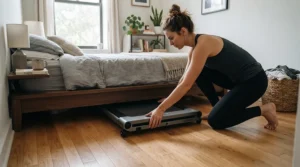
Fold Flat Storage: Making a Machine Disappear
For anyone shopping for a portable stretching machine for small flats, fold flat storage is the single feature that separates “keeper” from “regret”. Here is how each format behaves.
Bar formats (MAXSTRENGTH, Acouto) collapse into long thin bundles. They slot behind a wardrobe, down the side of a bed or in a tall cupboard, and they’re the easiest compact stretcher for tight spaces.
Rocker formats (Yes4All, WARMOUNTS) reduce to a flat or semi-flat frame. The Yes4All listing describes a notably light unit, which makes it the easiest rocker to carry between rooms.
Seated frames (LIAIZE, SUNGOOYUE) fold or compress but retain bulk because of the backrest. Measure your storage corner in centimetres before ordering.
A quick test: stand where you plan to store it and picture lifting it with one hand while holding a door with the other. If it feels awkward on paper, it will feel worse on a Tuesday evening. Good folding hardware also needs sturdy locking points, so check that the fold doesn’t leave sharp edges poking out in a cupboard.
Leg Stretcher Machines vs Traditional Stretching
Before spending money, it’s fair to ask whether a machine beats the free alternatives. The honest answer is that it depends on what you struggle with.
| Method | Control | Space and cost | Best For |
|---|---|---|---|
| Floor stretching | Fully self-directed | Free, a mat’s worth of space | Most beginners |
| Stretching strap | Good for hamstrings | Very cheap, drawer storage | Single-leg work |
| Class or video | Guided | Time or subscription cost | Learning technique |
| Yes4All, LIAIZE and similar | Machine holds position | £35–£75, a corner of space | Hands-free holds |
The NHS flexibility exercises page shows that plenty of useful stretching needs nothing more than a floor and some patience. A machine earns its place when you want to hold a position without muscular effort, or when joint position is awkward by hand. If you can already hold a 20-second hamstring stretch comfortably on the floor, a strap may be all you need.
In short, treat a machine as a convenience upgrade, not a necessity. If the free methods bore you into quitting, a machine’s structure can help. If you are happy on the floor, keep your money.
Features That Actually Matter (And Those That Don’t)
Marketing copy loves big numbers. Here is how to filter them.
Features that matter:
- Adjustment resolution. Fine steps beat wide jumps, particularly for beginners.
- Stable base and non-slip feet. Wobble kills relaxation.
- Padding quality. Cheap foam compresses within weeks, and you’ll notice it on the ankles first.
- A release you can reach. Know how to exit the stretch instantly.
Features that matter less:
- Headline angles of 190° or more. Very few bodies need them.
- Rotating seats and “waist twister” extras. Nice, but secondary.
- Huge weight capacities. Useful as a build-quality hint, but the conflicting figures on some listings prove they aren’t always reliable.
- Digital timers. A kitchen timer does the same job.
A smarter test is to ask whether a feature changes how comfortable your tenth session will be. The LIAIZE backrest does. The 190° ceiling on the WARMOUNTS probably doesn’t. Be wary of long feature lists on very cheap listings, because breadth is easy to advertise and hard to build.
Long-Term Cost and Value Analysis
Cost per use is the fairest way to compare a £20 bar with a £280 frame.
| Tier | Price range | What you realistically get | Best For |
|---|---|---|---|
| Entry | £15–£30 | Bars, hand control: MAXSTRENGTH, Acouto | Trial buyers |
| Mid | £35–£80 | Mechanism holds the stretch: Yes4All, WARMOUNTS | Steady routines |
| Comfort | £70–£115 | Backrest, wheels: LIAIZE, SUNGOOYUE | Longer sessions |
| Premium | £270–£300 | Built for frequent use: MAR | Daily stretchers |
A £60 machine used three times a week for a year works out at well under 50p a session, while a £280 one used the same amount is roughly £1.80. The premium only wins if it lasts several years or you outgrow the cheaper frame, and that is a difficult thing to verify from a listing.
Running costs are almost zero. Plan for the odd replacement bolt or a new pad cover, and keep the original packaging for the returns window. Prices may vary, so check the current listing.
Safety, Standards and Knowing When to Check First
A stretching machine applies force to joints, so common sense matters more than cleverness. Start with the basics: stop at any sharp or pinching pain, avoid bouncing, and never use the machine to chase a split on a deadline.
Check the manual’s weight limit, since listings disagree. Look for UKCA or CE marking where relevant. Many marketplace listings don’t state it clearly, so ask the seller and keep their reply.
Medical context matters too. The NHS guidance quoted earlier advises that people with an injury, a medical condition or pregnancy should talk to a physiotherapist or healthcare professional about which stretches suit them. Be careful with machines that claim to treat back pain or sciatica. NICE guidance on low back pain and sciatica advises against traction for managing low back pain, so a split stretcher is not a substitute for medical advice.
For children, supervise and use settings suited to their leg length. Some listings state a minimum height, such as users over 1 metre, so read the details before buying for a young gymnast.
FAQ
❓ Will a stretching machine scratch my laminate or wooden floor?
❓ Is a three-bar stretcher or a rocker-style machine better for a studio flat?
❓ Can I use a compact stretcher for tight spaces if I'm quite tall?
❓ How do I know if a cheap leg stretcher is worth buying?
❓ Is the premium MAR worth the extra money over a mid-range frame?
Conclusion
Here is the short version. If you want to dip a toe in without risking much, the MAXSTRENGTH or Acouto bars cost little and vanish into a cupboard. If you want a machine that holds your position while you breathe, the Yes4All is the best-documented rocker-style choice, and the WARMOUNTS is a sensible alternative. If comfort over twenty-minute sessions matters, the LIAIZE and SUNGOOYUE add a backrest. If you will genuinely use one most days for years, the MAR is the considered premium option.
Whatever you choose, the real win is consistency, not hardware. Measure your space first, confirm the weight limit in the manual, start narrow and widen gradually. Check range of motion in small, comfortable steps, and ignore headline angles. Prices vary, so check the current listing and the returns policy before you buy.
✨ Ready to reclaim your hallway and loosen up?
🔍 Click any highlighted product above to check current pricing and availability. A good portable stretching machine for small flats should earn its corner, then politely disappear!
Recommended for You
- Percussion Therapy Device For Athletes: 7 Essential Picks (2026)
- Massage Cupping Kit For Beginners: 7 Easy, Safe Picks (2026)
- Cupping Therapy Vs Percussion Massage For Recovery: 7 Top Picks 2026
Disclaimer: This article contains affiliate links. As an Amazon Associate, I earn from qualifying purchases. If you purchase products through these links, we may earn a small commission at no additional cost to you.
✨ Found this helpful? Share it with your friends! 💬🤗
