In This Article
Your back is killing you. Not dramatically — no sudden collapse, no hospital visit — just that dull, persistent ache that starts somewhere between your shoulder blades, radiates into your neck, and quietly ruins your evening. You’ve tried the foam roller gathering dust in the corner of your living room. You’ve attempted the tennis ball against the wall trick. You may have even Googled “sports massage near me” before quietly closing the tab when you saw the prices.
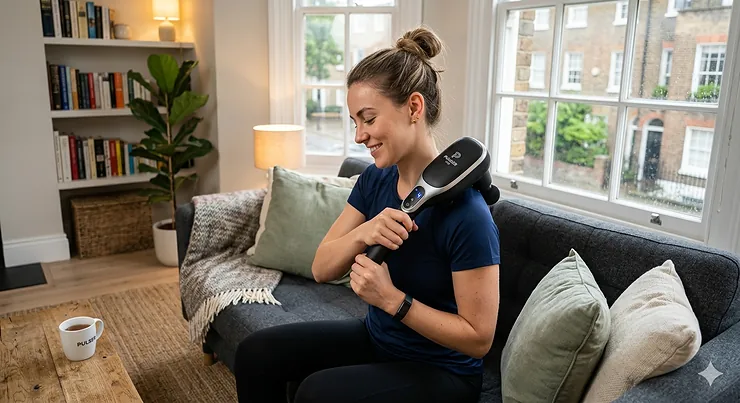
Here’s the thing: a professional handheld deep tissue massager does something neither a foam roller nor a clenched fist can manage. It delivers rapid, concentrated percussion — up to 40 pulses per second — directly into the muscle belly, increasing blood flow, breaking down trigger points, and genuinely reducing delayed-onset muscle soreness (DOMS). And it does all this from the comfort of your living room, at half eleven at night, while wearing your pyjamas if you like.
The market has exploded over the past few years. Walk into any high street sports shop or scroll through Amazon.co.uk and you’ll encounter dozens of options — from premium percussion therapy devices that cost as much as a weekend in Edinburgh, to budget models that look suspiciously like they were designed in a hurry. Choosing well matters, because the wrong purchase doesn’t just waste money. It wastes your time, your patience, and probably a drawer full of attachment heads you’ll never use.
This guide covers the best professional handheld deep tissue massager options currently available on Amazon.co.uk in 2026. We’ve looked at performance, build quality, noise levels, battery life, and — crucially — value for money in British pounds. Whether you’re a weekend runner in Sheffield, a desk worker in Manchester, or a physiotherapy professional in Edinburgh, there’s something in here for you.
Quick Comparison: Top Handheld Deep Tissue Massagers Available on Amazon.co.uk
| Product | Type | Speeds | Amplitude | Battery | Price Range (GBP) | Best For |
|---|---|---|---|---|---|---|
| Theragun Elite | Percussion (cordless) | 5 | 16mm | Up to 2 hrs | £250–£350 | Serious athletes, physios |
| Hyperice Hypervolt 2 Pro | Percussion (cordless) | 3 | ~14mm | Up to 2.5 hrs | £280–£350 | Daily users, gym-goers |
| Theragun Relief | Percussion (cordless) | 3 | 10mm | Up to 2 hrs | £100–£150 | Beginners, everyday use |
| HoMedics Pro Power Physio Gun | Percussion (cordless) | 6 | Standard | Up to 2 hrs | £50–£90 | Budget-conscious buyers |
| RENPHO Handheld Percussive Massager | Percussion (cordless) | Variable | Standard | Up to 3 hrs | £35–£60 | Casual users, home use |
| Bob and Brad C2 Massage Gun | Percussion (cordless) | 5 | Standard | Up to 2 hrs | £50–£80 | PT-developed, all-rounder |
| Wahl Deep Tissue Percussion Massager | Percussion (corded) | 2 | Extended | Mains powered | £30–£55 | Elderly, hard-to-reach areas |
What the table tells you: The premium options (Theragun Elite and Hypervolt 2 Pro) aren’t just flexing brand names — the higher amplitude (how deep the head travels into the muscle) genuinely makes a difference to perceived massage quality. For anything over 14mm amplitude, you start to feel it in the deeper muscle layers rather than just the surface. That said, most of us don’t actually need a professional-grade device; the mid-range picks here punch well above their price tags and cover 90% of everyday use cases.
💬 Just one click — help others make better buying decisions too! 😊
✨ Don’t Miss These Exclusive Deals!
🔍 Take your recovery to the next level with these carefully selected products. Click on any highlighted item to check current pricing and availability on Amazon.co.uk. These picks will help you find exactly what you need!
Top 7 Professional Handheld Deep Tissue Massagers: Expert Analysis
1. Theragun Elite — The Professional’s Workhorse
The Theragun Elite is the one that gets recommended by physiotherapists and sports coaches with genuine confidence, and for good reason. Therabody essentially invented the modern percussion massage gun category, and this model represents their sweet spot between raw professional performance and something a person can actually live with day-to-day.
The 16mm amplitude is the headline number here — that’s how far the attachment head travels on each stroke, and it’s meaningfully deeper than cheaper alternatives hovering around 10–12mm. In practice, it means the Elite reaches into the deeper glute and hamstring tissue that surface vibration simply can’t access. Combine that with a 40-watt motor and five speed settings ranging from 1,750 to 2,400 percussions per minute, and you’ve got a device that can both gently warm up a nervous muscle group before a run and aggressively work out a stubborn knot afterwards. The OLED screen and Bluetooth connectivity to the Therabody app add genuine utility rather than gimmick — the app guides you through timed routines that most users find far more effective than just pressing randomly at whatever hurts.
The Elite is sensibly suited to serious amateur athletes, fitness enthusiasts who train four-plus times a week, and anyone with a recurring injury that benefits from regular targeted treatment. It’s also popular among physiotherapy professionals looking for a reliable home-recommendation they can stand behind. UK buyers should note it ships with a compatible UK plug and 230V compatibility — no adapter faff required.
UK reviewers consistently highlight the noise levels as a genuine plus: it’s quiet enough to use while watching television, which is rather more civilised than some rivals that sound like a small aircraft preparing for take-off.
✅ 16mm amplitude for genuine deep tissue penetration
✅ App-guided routines via Therabody app
✅ Exceptionally quiet brushless motor
❌ Premium price point will raise eyebrows
❌ Heavier than budget alternatives
Price range: £250–£350 | A serious investment that pays for itself if you use it consistently — especially compared to £60–£80 sports massage sessions.
2. Hyperice Hypervolt 2 Pro — The Quiet Powerhouse
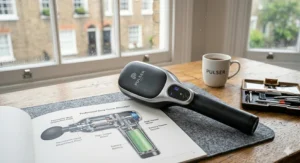
Where the Theragun Elite leans into performance credentials, the Hyperice Hypervolt 2 Pro offers a subtly different proposition: exceptional quietness combined with a build quality that feels like it was machined rather than moulded. Pick it up and you’ll notice the premium straight away — there’s no flexing, no rattling, no sense that it was assembled on a Friday afternoon.
The Quiet Glide™ technology isn’t just marketing copy. At its lowest setting, the Hypervolt 2 Pro operates at around 40 decibels — roughly the ambient noise level of a quiet library. That matters enormously if you live in a flat or terraced house (as most of us in British cities do) and don’t fancy apologising to your neighbours at nine in the evening because you’re working on your calves. Three speed settings feels lean compared to some rivals, but in practice most users settle on one speed and stay there, so the simplicity is a feature rather than a compromise.
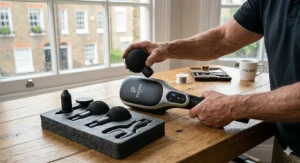
The five interchangeable heads cover the full range from a broad flat head for large muscle groups to a pointed thumb-style tip for getting into the spaces between shoulder blade muscles where tension loves to hide. Battery life runs to approximately two and a half hours — enough for a fortnight of evening sessions before you need to reach for the USB-C cable.
This is the massager for someone who wants premium performance without the conspicuous branding of the Theragun. It’s particularly well-suited to flat dwellers, light sleepers (for the quiet), and anyone who appreciates understated design. Available on Amazon.co.uk with UK plug compatibility confirmed.
UK buyers report it as an excellent gift option precisely because it looks and feels genuinely premium when unwrapped — not always a given at this price point.
✅ Whisper-quiet Quiet Glide™ motor technology
✅ Excellent build quality and premium feel
✅ USB-C charging — a small but welcome convenience
❌ Fewer speed settings than competitors
❌ Carrying case not included at standard purchase
Price range: £280–£350 | Comparable to the Elite in cost but a different experience — choose this if quiet operation is a priority.
3. Theragun Relief — The Sensible Entry Point
Not everyone needs 2,400 percussions per minute. Not everyone wants them, frankly. The Theragun Relief is Therabody’s acknowledgement that plenty of people just want to deal with everyday tension — the neck stiffness from eight hours at a laptop, the tight calves from a commute that involved more stairs than anticipated — without spending the best part of £300.
The Relief runs at a single speed of 1,750 percussions per minute with an amplitude of 10mm. That’s noticeably less aggressive than the Elite, but it’s also more approachable for people who’ve never used a percussion device before and aren’t entirely sure how hard to press. The ergonomic single-arm design makes it genuinely easy to reach your own back — something the more industrial-looking massage guns sometimes struggle with.
Three attachment heads keep things straightforward: a standard ball head, a cone for targeted pressure points, and a thumb head for spinal muscles. The Therabody app connectivity remains intact, which means you still get access to guided routines. Given that first-time users often have no idea how to structure a massage session, this is more useful than it sounds.
This is the massager for the person who’s curious about percussion therapy but not ready to commit fully at premium prices. Brilliant for desk workers, anyone with chronic neck tension, or as a thoughtful gift for a parent or partner who’d never ask for one themselves.
✅ Accessible single-speed operation — no decision fatigue
✅ App-guided routines included
✅ Lightweight and genuinely easy to self-apply
❌ Lower amplitude limits deep tissue penetration
❌ Three heads is a modest selection
Price range: £100–£150 | The most affordable way into the Therabody ecosystem — a solid choice if you’re not ready for a full commitment.
4. HoMedics Pro Power Handheld Physiotherapy Massager Gun — The Budget Contender
HoMedics is a brand that’s been in British living rooms for decades — those vibrating foot spas from the early 2000s didn’t appear from nowhere. Their Pro Power percussion massager applies that same practical, unpretentious philosophy to the massage gun format.
Six speed settings and six interchangeable heads give it notable versatility for its price bracket. The heated head attachment is the standout feature — warmth and percussion together is a genuinely effective combination for chronically tight muscles, particularly during colder months when British bodies tighten up like a wet rope. That’s not a feature you typically find under £100 from any brand, let alone one with HoMedics’ track record of after-sales support in the UK.
The motor won’t win any awards for power output, and the amplitude sits at the more modest end of the market. But for lighter daily use — post-run legs, office-tension shoulders, the general creakiness of being a person who spends too long sitting — it does the job competently. The rechargeable battery offers up to two hours of use, and the device comes supplied with a UK plug directly in the box, which feels obvious but isn’t guaranteed across all products at this price point.
UK reviewers particularly appreciate the noise levels, which are respectable for the price, and the fact that spares and accessories are readily available on Amazon.co.uk. Perfect for the casual user who wants solid results without spending serious money.
✅ Heated head attachment for warmth + percussion therapy
✅ Six heads — excellent variety for the price
✅ Established UK brand with reliable after-sales support
❌ Motor power limited compared to premium rivals
❌ Slightly bulkier than the more premium options
Price range: £50–£90 | Probably the best value-for-everyday-use pick in this entire list.
5. RENPHO Handheld Percussion Massager — The Crowd-Pleaser
RENPHO has built something of a cult following in the UK health and wellness space, largely by making reliable, well-featured devices at prices that don’t require a second mortgage. Their percussion massager follows that template reliably.
A large 2,600mAh battery is the headline spec — it translates to approximately three hours of continuous use, which is substantially better than most rivals. For those who use a massager regularly across multiple sessions before recharging, this matters considerably more than it might initially seem. Nobody enjoys the slightly passive-aggressive low-battery notification mid-session.
Variable speed settings allow for genuine customisation across multiple intensity levels, and the six included attachment heads cover most scenarios. The device is cordless, lightweight enough to use one-handed without fatigue, and connects via USB-C for charging. UK customers consistently report ease of use as the main draw — RENPHO’s design team clearly put thought into making something intuitive rather than technically impressive.
What RENPHO won’t offer you is the deep amplitude of the premium guns or the precision engineering feel of a Theragun. But for casual to moderate home use — recovery days, general tension management, the odd session on travel-stiffened back muscles — it consistently over-delivers for its price.
Available on Amazon.co.uk with Prime delivery; a thoughtful, practical gift option.
✅ 2,600mAh battery — market-leading runtime at the price
✅ Lightweight and ergonomically considerate design
✅ Excellent customer ratings across UK reviews
❌ Lower amplitude than premium options
❌ Build feel doesn’t match the premium tier
Price range: £35–£60 | A reliable everyday massager that’s hard to fault at this price point.
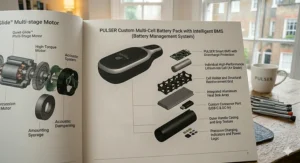
6. Bob and Brad C2 Massage Gun — The PT-Developed All-Rounder
Bob and Brad are physical therapists by trade, and it shows. Where many massage gun brands lead with engineering specifications, Bob and Brad lead with clinical reasoning — the C2 was developed with actual rehabilitation protocols in mind, which gives it a slightly different character to the usual fitness-focused devices.
Five speed settings and five attachment heads cover the standard range, but what distinguishes the C2 is the thoughtful design ergonomics. The handle angle and weight distribution are clearly the work of people who spend their days watching clients struggle to reach their own upper backs, and the result is a device that’s considerably easier to self-apply than rivals of comparable power output.
The build quality is reassuringly solid without being ostentatious, and the brushless motor is quiet enough for evening use. Battery life is approximately two hours. UK customers report durability as a notable plus — the C2 tends to last considerably longer than budget alternatives that use cheaper motor components.
This is the massager for the physically active person who wants something evidence-informed rather than just well-marketed. Runners, cyclists, gym-goers recovering from minor injuries, and anyone under the guidance of a physiotherapist who’s recommended a percussion device will find the C2 a natural fit. It’s also available on Amazon.co.uk with Prime delivery for most postcodes.
✅ Developed by qualified physical therapists — evidence-informed design
✅ Superior handle ergonomics for self-application
✅ Durable motor components backed by strong review history
❌ Less brand recognition than Therabody or Hyperice
❌ Fewer accessories available than premium competitors
Price range: £50–£80 | A well-built, clinically-considered choice at a sensible mid-range price.
7. Wahl Deep Tissue Percussion Massager — The Dependable Classic
Wahl is best known for professional hair clippers. Less well-known is the fact that their deep tissue percussion massager has been a quietly dependable choice in the UK wellness market for years — particularly popular among older users and those with limited hand strength or mobility.
The key distinction here is that the Wahl is corded — it runs off the mains rather than a battery. At a glance, that sounds like a significant limitation. In practice, for someone using a massager regularly at home rather than at the gym, mains power is actually rather liberating. No battery anxiety, no charging cycles, no gradual performance degradation over two years. It runs at consistent power for as long as you need it, full stop.
The long handle design is the other standout feature. Where most massage guns require some degree of contortion to reach the middle of the back, the Wahl’s extended reach handles most awkward angles with relative ease — a feature that endears it enormously to users with limited shoulder mobility and older buyers who’ve been disappointed by the compact form factor of modern percussion guns.
Two speed settings keeps operation simple. It won’t go as deep as a premium cordless device, but for gentle-to-moderate tension work — and particularly for users who find the aggressive percussion of higher-end models uncomfortable — it’s a dependable, long-lasting choice that won’t be rendered obsolete by a dead battery.
✅ Mains-powered — no battery degradation, unlimited session length
✅ Extended handle design for genuine reach of hard-to-access areas
✅ Simple two-speed operation ideal for older or less confident users
❌ Corded — limits where you can use it
❌ Less amplitude and percussion power than cordless rivals
Price range: £30–£55 | Modest price, genuine utility — the right choice for those who’ve been let down by battery-dependent devices.
How to Use a Handheld Deep Tissue Massager: A Practical Guide for UK Users
Buying the device is the easy part. Using it correctly — and avoiding the mistakes that turn a useful recovery tool into a bruised shoulder and a lesson in patience — is where most people quietly go wrong.
Start slow, always. It’s tempting to plunge straight in at maximum speed, particularly after a tough day. Don’t. Begin at the lowest speed setting and let the device glide slowly over the muscle, spending roughly 30 to 60 seconds per area. Your body needs a moment to adapt to percussion, particularly if it’s your first session. Going straight to maximum intensity is roughly equivalent to running a 5K without warming up.
Float, don’t press. This is the most commonly misunderstood principle of percussion therapy. The device generates its own pressure through the percussive action — you do not need to push it into the muscle. Pressing down adds resistance, reduces percussion speed, and can cause bruising. Simply rest the head on the skin and allow the device to do the work. Professional physiotherapists describe this as “floating” the device across the surface.
Two minutes per muscle group is your ceiling. More than this yields diminishing returns and can lead to tissue irritation. Set a timer. It’s surprisingly easy to lose track when you finally find a knot that responds, and three minutes on a single spot is firmly in the territory of too much of a good thing.
Cold and damp British weather tightens muscles reliably. After a soaking commute or a Saturday morning run in February drizzle, your muscles will be significantly tighter than they’d be in kinder conditions. In these situations, consider a brief warm shower before a massage session — warm tissue responds better to percussion and you’re less likely to create discomfort. The HoMedics heated head attachment is useful here for the same reason.
Storage in smaller UK homes. Most of these devices come with cases or pouches. Use them. Attachment heads rolling around a drawer get lost and damaged, and the device itself fares better when it’s not competing for shelf space with everything else in a British flat’s bathroom cabinet. The RENPHO and Bob and Brad devices are particularly compact and store easily.
Do not use over bones, joints, bruised areas, or active inflammation. This seems obvious but bears repeating. Percussion devices are for muscle belly — the fleshy centre of the muscle, not the tendon, joint, or spine. If you have a specific injury, speak to a GP or physiotherapist before using a percussion device on or near the affected area.
Real-World Scenarios: Which Massager Suits Your Life?
The London Desk Worker
Meet someone working nine-to-six in a Canary Wharf office, commuting an hour each way on the Tube, eating lunch at their desk, and experiencing what might diplomatically be called “structural consequences” from that lifestyle. Tight hip flexors, a stiff thoracic spine, perennial upper trap tension — these are the occupational realities of modern sedentary work.
For this person, the Theragun Relief or the RENPHO is the practical answer. Neither is excessive in power for daily maintenance work, both are quiet enough for a flat in East London, and neither requires a significant financial commitment. Using it for ten minutes in the evening — upper back, glutes, calves — creates a meaningful difference to both sleep quality and morning stiffness. The Theragun Relief’s app guidance is particularly helpful here because desk workers often have no idea where to start; guided routines remove the guesswork entirely.
The Weekend Athlete in Manchester or Leeds
A regular parkrunner, cyclist, or five-a-side footballer who trains three to four times a week, has access to a garden or at least a garage, and experiences genuine DOMS after harder efforts. This person needs something with more amplitude and power than the relief-focused entry models.
The Bob and Brad C2 or the Hyperice Hypervolt 2 Pro fits neatly here. The C2 offers excellent value and PT-informed design that suits recovery-focused use, while the Hypervolt is the choice if budget allows for something premium. Both handle the deeper quadriceps and hamstring work that a weekend athlete genuinely needs, and both are quiet enough for a residential neighbourhood.
The Retired Couple in the Cotswolds
Older users often find percussion devices more intimidating than they need to be — powerful percussion, complex controls, short battery life, and devices that require contortion to use properly. The Wahl Deep Tissue Percussion Massager was practically designed for this scenario. Mains-powered, extended handle, simple two-speed operation, and a familiar brand name. No batteries to charge, no apps to navigate, no heads to lose. It simply works, reliably, for years.
How to Choose the Best Professional Handheld Deep Tissue Massager in the UK
Faced with the variety available, a clear decision framework is more useful than vague advice about “considering your needs.” Here are the five criteria that actually separate a good purchase from a disappointing one.
1. Amplitude first, speed second. Amplitude — how far the massage head travels — is the single most important technical specification for massage quality. A device with 16mm amplitude and three speeds will out-massage a device with 10mm amplitude and thirty speeds. Marketing teams love the speed numbers; the amplitude number is what actually matters.
2. Noise levels matter more than you think. The British home is typically a terraced house, a semi-detached, or a flat. Walls are thin. Using a massager that sounds like a pneumatic drill at 10pm is not a sustainable lifestyle choice. Check for “brushless motor” in the specification — it’s consistently the indicator of quieter operation.
3. Battery life versus corded convenience. For gym bag use, cordless is non-negotiable. For home-only use, a corded device eliminates the battery maintenance cycle entirely and delivers consistent power without gradual degradation. Be honest about where you’ll actually use it before defaulting to cordless.
4. Attachment heads — count matters less than quality. Six heads that include a genuine variety (large ball for quads, flat head for back, cone for trigger points, fork for either side of the spine) is more useful than ten heads that are slight variations on the same shape. Check the actual head types, not just the number.
5. Weight and ergonomics for self-application. A massager you can only comfortably use for three minutes before your wrist gives out isn’t much use for a ten-minute recovery session. Pick up the device (or check the stated weight carefully) and consider how it’ll feel after five minutes on your own upper back.
Common Mistakes When Buying a Handheld Deep Tissue Massager in the UK
A few errors come up so regularly in UK reviews and returns that they’re worth flagging explicitly.
Confusing “30 speed settings” with “30 useful speeds.” Marketing copy frequently uses high speed-count as a proxy for quality. The reality is that most users settle on two or three speeds and never revisit the rest. Genuine quality shows up in motor construction, amplitude, and noise levels — not in how many settings are on the dial.
Buying a US-voltage model that requires an adapter. Less common than it once was, but it still happens. Any device that ships from Amazon.com rather than Amazon.co.uk may arrive with a Type A or Type B plug and 110V voltage requirements. The result is either a damaged device or an adapter that introduces unnecessary complexity. Always confirm UK plug (Type G) and 230V/50Hz compatibility before purchasing from Amazon.co.uk third-party sellers.
Neglecting UKCA and CE marking. Post-Brexit, electrical products sold in Great Britain should carry the UKCA mark (or meet transitional CE mark requirements). This isn’t bureaucratic pedantry — it’s the indication that a product has been assessed for electrical safety. Budget devices from less established sellers occasionally bypass this. Buying from established brands or verified Amazon sellers reduces this risk considerably. For more on UK product safety requirements, the UK Government’s product safety information is the definitive reference.
Underestimating the importance of return policies. Under the Consumer Contracts Regulations, UK online buyers have a 14-day right to return products purchased online. This is stronger protection than in many other markets. If a device doesn’t feel right — too heavy, too loud, not powerful enough — you have a legitimate route to return it. Don’t talk yourself into keeping something that doesn’t work for you.
Buying on amplitude alone without considering the use case. Professional-grade amplitude (16mm+) is genuinely useful for deep muscle work. It is also considerably more intense for sensitive users, those with chronic pain conditions, or those new to percussion therapy. Starting at a lower amplitude and upgrading later is a perfectly sensible approach.
Professional Handheld Deep Tissue Massager vs Traditional Alternatives
| Method | Cost (UK) | Accessibility | Depth of Treatment | Frequency | Best For |
|---|---|---|---|---|---|
| Sports massage therapist | £50–£90/session | Appointment required | High | Limited by cost | Complex injuries, diagnosis |
| Foam roller | £15–£40 one-off | Very high | Low-medium | Unlimited | Large muscle groups, general warmup |
| Handheld percussion massager | £30–£350 one-off | Very high | Medium-high | Unlimited | Daily recovery, targeted tension |
| Static stretching | Free | Very high | Low | Unlimited | Flexibility, warmup/cooldown |
| Professional physiotherapy | £60–£120/session | Appointment required | Very high | Limited by cost | Injury rehabilitation |
The comparison above is instructive for one reason above all: a professional handheld deep tissue massager occupies a specific and valuable middle ground. It delivers more targeted, deeper treatment than a foam roller, is available at any time without a booking, and pays for itself after a handful of avoided sports massage appointments. It is not, however, a substitute for professional physiotherapy when actual injury rehabilitation is required — and it would be misleading to suggest otherwise.
The NHS advice on managing muscle pain is worth reading alongside any self-treatment plan.
Long-Term Cost and Maintenance in the UK
One of the genuinely underappreciated aspects of buying a handheld massager is the total cost of ownership beyond the initial purchase — which, for most quality devices, is reassuringly modest.
Attachment heads are the most common replacement item. Quality silicone heads from reputable brands typically last one to two years of regular use before showing wear. Replacements from Therabody and Hyperice are readily available on Amazon.co.uk in the £15–£30 range. Generic alternatives are available more cheaply but vary in quality; prioritise fit over price here.
Battery degradation is worth factoring in for cordless devices. Lithium-ion batteries in consumer electronics typically retain around 80% of their original capacity after 300–500 charge cycles. At two sessions per week, that’s three to five years before you notice any meaningful performance reduction — longer than most people keep the same device. Replacement battery options are available for some premium models.
Maintenance is minimal. Wipe attachment heads with a clean, slightly damp cloth after use. Never submerge any part of the device in water. Store away from direct sunlight and damp environments — a consideration in the UK, where garages and outdoor cupboards are authentically damp for six months of the year. Most devices carry a one-year manufacturer’s warranty as standard; premium brands like Therabody and Hyperice offer extended warranty options.
The maths of avoided appointments: If a sports massage costs you £65 per session and you’re having one a fortnight, that’s £1,690 per year. A £300 Theragun Elite used correctly three times a week replaces perhaps a third of those appointments — and does so on your schedule, not your sports therapist’s. Over three years, the return on that investment is considerable.
Research published by the Journal of Sports Science and Medicine has supported the use of vibration and percussion therapy for improving range of motion, and a 2025 randomised controlled trial found percussion massage therapy was more effective than static stretching for DOMS recovery — further bolstering the case for regular use.
✨ Still unsure? Here are the top picks!
🔍 Whether you’re chasing post-workout recovery or simply trying to survive another week at a desk, the right professional handheld deep tissue massager is a legitimate quality-of-life upgrade. Click any product in this guide to check current pricing and availability on Amazon.co.uk.
FAQ: Professional Handheld Deep Tissue Massagers in the UK
❓ What is a professional handheld deep tissue massager and how does it work?
❓ Are handheld percussion massagers safe to use every day in the UK?
❓ Which is better for UK users — corded or cordless handheld massagers?
❓ Do percussion massagers sold on Amazon.co.uk need to be UKCA certified?
❓ What's the best professional handheld deep tissue massager for under £100 on Amazon.co.uk?
Conclusion: The Bottom Line on Deep Tissue Massagers in the UK
There’s a broader truth buried in all of this: most people in Britain carry more muscle tension than they realise, much of it accumulated slowly through long commutes, desk work, cold-weather stiffness, and exercise routines that could use a bit more recovery attention. A professional handheld deep tissue massager, used consistently and correctly, addresses a genuine physiological need — not a luxury one.
The right choice depends on your use case, your budget, and the reality of your home environment. If you’re serious about athletic performance and recovery, the Theragun Elite or Hypervolt 2 Pro is worth the investment. If you want something sensible and dependable for everyday tension management, the HoMedics Pro Power or Bob and Brad C2 deliver genuinely satisfying results without the premium price tag. And if simplicity and reliability are paramount, the Wahl’s corded, no-fuss design has earned its reputation across years of British living rooms.
Whichever you choose, you’ll be better off than you were with the tennis ball.
✨ Don’t Miss These Exclusive Deals!
🔍 Click any highlighted product to check the latest pricing and availability on Amazon.co.uk. Picked something? Well done — your back will thank you.
Recommended for You
- Best Handheld Back Massager UK 2026: 7 Top Picks Reviewed
- Best Massage Cushion for Recliner Chair UK 2026: 7 Top Picks
- Best Massage Cushion for Office Chair 2026: Top 7 Brilliant UK Picks
Disclaimer: This article contains affiliate links. As an Amazon Associate, I earn from qualifying purchases. If you purchase products through these links, we may earn a small commission at no additional cost to you.
✨ Found this helpful? Share it with your mates! 💬🤗
