In This Article
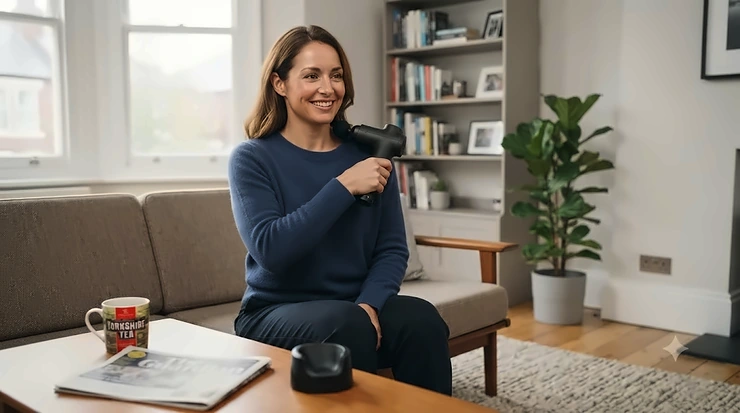
There’s a particular kind of ache that turns up after a long run, a heavy leg day, or simply too many hours hunched over a laptop — the kind that a hot shower helps for about ten minutes before it creeps straight back into your shoulders. This is exactly the gap a tapping massage device is built to fill, and it’s why these handheld gadgets have gone from niche physio kit to something sitting in gym bags and desk drawers across the country.

So what is a tapping massage device? At its simplest, it’s a handheld electric tool that drives a small head rapidly back and forth into the muscle — a mechanised version of the tapotement technique physiotherapists have used for decades — delivering rapid, percussive pressure that a hand simply can’t sustain for long. This mechanism, more formally called percussive therapy, has picked up genuine scientific interest in recent years; a 2023 systematic review published via the National Center for Biotechnology Information found reasonable evidence that these devices can improve short-term flexibility and range of motion, even while noting the evidence for boosting raw strength or explosive performance is much thinner.
For this guide, we’ve dug into verified specifications, aggregated review sentiment, and independent lab-style testing data on seven genuinely different tapping massage devices sold through amazon.co.uk — from ten-pound budget picks to premium athlete-grade guns. We’ll cover amplitude, stall force, interchangeable heads, and exactly where the evidence for percussive therapy benefits does and doesn’t hold up, so you can buy based on what these devices actually do rather than marketing gloss.
Quick Comparison Table: Tapping Massage Devices at a Glance
| Device | Amplitude | Price Range | Best For |
|---|---|---|---|
| Toloco EM26 | Around 10mm | Under £70 | Absolute beginners on a budget |
| Bob and Brad C2 | 8mm | £70-£90 range | Physio-designed everyday relief |
| Renpho R3 | 10mm | £80-£110 range | Interchangeable heads on a budget |
| Power Plate Mini+ | Moderate | £100-£150 range | Portability and battery life |
| Theragun Mini (3rd Gen) | 12mm | £150-£190 range | Travel-sized deep tissue |
| Hyperice Hypervolt 2 Pro | 14mm | £350-£420 range | Serious athletes, high stall force |
| Theragun Prime Plus | 16mm | £300-£400 range | Deepest percussion in this lineup |
Scanning across this table, the pattern is fairly predictable but still worth spelling out: amplitude and stall force climb steadily as price climbs, but that doesn’t mean the cheapest options are pointless. The Toloco EM26 and Bob and Brad C2 deliver genuinely useful percussive therapy benefits for everyday stiffness at a fraction of the flagship price, while the Theragun Prime Plus and Hyperice Hypervolt 2 Pro earn their premium positioning through depth and stall force that matter far more to someone training hard several times a week than to someone easing a stiff neck after a desk day.
💬 Just one click — help others make better buying decisions too!😊
Top 7 Tapping Massage Devices: Expert Analysis
Choosing a tapping massage device comes down to matching amplitude, stall force, and attachment range to how you actually intend to use it — daily desk-related stiffness calls for something very different from post-marathon calf recovery. The seven devices below span budget to premium, each earning its place for a distinct reason, with commentary grounded in manufacturer specifications and aggregated, verified review sentiment throughout.
1. Toloco EM26 — best ultra-budget entry point
The Toloco EM26 has become one of Amazon’s best-selling percussion massagers largely on the strength of its price-to-feature ratio, arriving with ten interchangeable heads, a touchscreen display, and seven speed settings for well under £70. On paper, that spec sheet reads like something twice the price.
Independent measurement has found the real-world amplitude runs closer to 9.9mm rather than the advertised 12mm — worth flagging honestly rather than taking the marketing figure at face value. In practice, a stroke length just under 10mm still delivers a genuinely percussive (rather than purely vibrational) massage, so the shortfall matters less for casual use than the number gap might suggest.
Based on the spec comparison with pricier rivals, this is squarely a device for occasional stiffness and general relaxation rather than serious athletic recovery work — the touch controls have also been described as a little slow to respond, which is a minor irritation rather than a dealbreaker for anyone who isn’t switching speeds constantly. Reviewers consistently report the six-hour advertised battery life holds up reasonably well under normal use, though high-speed sessions with firm pressure will drain it faster than the box suggests.
Pros:
- ✅ Ten interchangeable heads included in the box
- ✅ Touchscreen display with seven speed settings
- ✅ Genuinely low price for a full-feature percussion massager
Cons:
- ❌ Real-world amplitude measures below the advertised figure
- ❌ Plastic casing feels noticeably basic up close
At under £70, the Toloco EM26 is the value verdict for anyone dipping a toe into percussive therapy for the first time without committing serious money to the experiment.
2. Bob and Brad C2 — best physio-designed everyday relief
Developed by physiotherapist duo Bob and Brad — whose YouTube channel has built a genuinely large following on straightforward, credible advice — this compact device leans on that professional pedigree rather than raw power. It ships with five silicone heads and five speed settings running from 2,000 to 3,200 RPM.
The trade-off here is amplitude: at 8mm, it’s the shortest stroke length in this entire lineup, meaning it leans more toward a firm, comfortable massage than genuinely deep tissue penetration. What most buyers overlook is that this shorter amplitude is precisely why independent reviewers describe it as approachable for first-time users and partners helping each other out, rather than solely athletes chasing maximum depth.
Independent testing has clocked the C2 at a notably quiet 63dB on its highest setting — genuinely low compared with most competitors — and its 680g weight makes one-handed use across a full session far less fatiguing than heavier full-size guns. Reviewers consistently praise the ergonomic, silicone-wrapped handle and note the USB-C charging as a welcome modern touch, while a recurring criticism is that the head attachment itself can’t be swapped for third-party options the way some rivals allow.
Pros:
- ✅ Designed with input from practising physiotherapists
- ✅ Notably quiet even at maximum speed
- ✅ Light, ergonomic build for extended one-handed use
Cons:
- ❌ Shortest amplitude in this comparison at 8mm
- ❌ Attachment head itself isn’t third-party compatible
Sitting in the £70-£90 range, the Bob and Brad C2 earns its spot as the sensible, credible-brand choice for everyday muscle relief rather than serious athletic-grade deep tissue work.
3. Renpho R3 — best interchangeable-head massager on a budget
The Renpho R3 has built its reputation specifically around accessibility and ease of use, and the interchangeable head system is genuinely one of its strongest features — reviewers consistently note the heads are easier to attach and detach than on the pricier Theragun range, even if the material quality doesn’t quite match.
Specs put the amplitude at 10mm with five speed settings from roughly 1,800 to 3,200 RPM, which lands it in reasonable percussive territory without approaching deep-tissue territory. Here’s what the spec sheet won’t spell out plainly: the ball and air-cushion heads have been flagged by reviewers as occasionally catching on clothing during use, a small but genuine practical niggle worth knowing before you buy rather than discovering mid-massage.
On the plus side, the R3’s battery life and overall simplicity have been consistently praised as beginner-friendly, and it undercuts flagship devices by a significant margin while still covering the core percussive therapy benefits most casual users are actually after. Reviewers note that it lacks Bluetooth connectivity and app-guided routines, which is a fair trade-off at this price rather than an oversight.
Pros:
- ✅ Interchangeable heads that are easy to attach and detach
- ✅ Five speed settings covering gentle to firm pressure
- ✅ Significantly cheaper than flagship interchangeable-head rivals
Cons:
- ❌ Ball and cushion heads can snag on loose clothing
- ❌ No Bluetooth or app-guided routines
In the £80-£110 range, the Renpho R3 is the value verdict for anyone who specifically wants to experiment with different head attachments without paying flagship prices to do so.
4. Power Plate Mini+ — best portability and battery life
Power Plate built its name on vibration training platforms before bringing that engineering background to a compact percussion device, and the Mini+ leans heavily into portability as its defining trait — at 435g, it’s genuinely one of the smallest devices in this comparison, small enough to live in a desk drawer without a second thought.
The standout spec here is battery life: independent testing clocks up to five hours of runtime, comfortably ahead of most rivals at this size, alongside four speed settings and a smartphone app that several reviewers single out as unusually well designed for a compact device. Based on the spec comparison with similarly sized travel massagers, the Mini+’s combination of a five-hour battery and genuine quietness makes it a strong fit for shared spaces — office use, a family living room — where a loud, bulky gun would draw unwanted attention.
Reviewers consistently highlight the compact design as a real strength for anyone wanting relief between desk sessions rather than post-marathon recovery, and note it warms up slightly during charging, a minor quirk rather than a functional issue. Its two included attachments are fewer than most rivals offer, reflecting its focus on convenience over sheer versatility.
Pros:
- ✅ Genuinely compact at 435g, easy to store discreetly
- ✅ Class-leading battery life at up to five hours
- ✅ Well-reviewed companion smartphone app
Cons:
- ❌ Only two attachment heads included
- ❌ Runs slightly warm during charging
Priced in the £100-£150 range, the Power Plate Mini+ is the value verdict for anyone whose priority is genuine day-to-day convenience over maximum depth or power.
5. Theragun Mini (3rd Gen) — best travel-sized deep tissue option
Therabody’s Mini has become something of a benchmark for what a genuinely portable massage gun can achieve, and the third generation pushed that further — 30% smaller and lighter than its predecessor while still delivering a scientifically calibrated 12mm amplitude, a stroke length that punches well above what its size would suggest.
Independent testing that pitted it against other miniature devices found it delivered the strongest massaging experience of the group, attributed largely to a genuinely powerful motor packed into a sub-one-pound body — for comparison, competitors offering the same 12mm amplitude in this class typically weigh more than double. Three speed settings keep the interface simple, and it ships with a smaller attachment range than full-size Theragun models, reflecting its travel-first design brief rather than an oversight.
What most buyers overlook about the Mini is that its portability doesn’t come at the expense of real percussive depth the way it does on many rivals shrunk down to travel size — reviewers consistently describe it as genuinely usable for proper muscle work, not just a gentle vibration toy. The trade-off, as with any Theragun product, is the price relative to its size.
Pros:
- ✅ 12mm amplitude in a sub-one-pound, travel-ready body
- ✅ Strong motor power relative to its compact size
- ✅ Straightforward three-speed interface
Cons:
- ❌ Fewer included attachments than full-size Theragun models
- ❌ Premium pricing for a device this small
At around £150-£190, the Theragun Mini (3rd Gen) is the value verdict for anyone who genuinely travels or commutes with their recovery kit and refuses to sacrifice depth for size.
6. Hyperice Hypervolt 2 Pro — best for serious athletes and high stall force
The Hypervolt 2 Pro sits at the top of Hyperice’s percussion range, and it’s explicitly positioned for serious athletes rather than casual users — reviewers have been consistent that this “is not a casual gun for office workers or ad-hoc runners.” That’s a fair characterisation once you look at the numbers.
Independent measurement puts its amplitude at roughly 14mm with a stall force in the region of 60 to 70 pounds — meaningfully higher than most devices in this guide — which translates into genuinely deep, sustained pressure that can push through denser muscle groups like the glutes and quads without the motor bogging down. A detachable, swappable battery is a genuinely practical touch competitors mostly lack, and Bluetooth connectivity unlocks app-guided routines through the Hyperice app.
The honest trade-offs are weight and price: at around 2.6 pounds, several reviewers note it’s noticeably easier to use on someone else than on your own back, and the deep amplitude specifically isn’t recommended for anyone with weak or very sensitive muscles. Reviewers consistently flag the absence of an included carrying case at this price point as a genuine oversight for a flagship device.
Pros:
- ✅ High stall force handles dense muscle groups without stalling
- ✅ Swappable battery for uninterrupted longer sessions
- ✅ App-guided routines via Bluetooth connectivity
Cons:
- ❌ Noticeably heavy for extended self-massage sessions
- ❌ No carrying case included despite the premium price
In the £350-£420 range, the Hyperice Hypervolt 2 Pro is the value verdict for genuinely serious athletes and regular gym-goers who need power and stall force more than they need a light, portable footprint.
7. Theragun Prime Plus — deepest percussion in this lineup
Therabody’s Prime Plus tops this comparison specifically on amplitude, delivering a 16mm stroke — the deepest of any device covered here — paired with five speed settings and three heat cycle options that combine warmth with percussion in a single tool. Independent testing has specifically praised this amplitude as a genuine advantage when working through larger, denser muscle groups like the quads and hamstrings.
The heat function deserves an honest caveat rather than uncritical praise: while percussive therapy itself carries reasonable supporting evidence, the added benefit of combining heat with percussion specifically is far less well established in current research, so it’s worth treating the warmth as a comfort feature rather than a proven performance upgrade. Reviewers consistently praise the intuitive light-up dial controls, which let users cycle through speed and heat settings without repositioning their grip mid-massage — a small design touch that matters more than it sounds during actual use.
Therabody pairs the Prime Plus with four attachments made from notably forgiving, skin-friendly materials, and reviewers highlight this as a step up in build quality from the brand’s own entry-level Mini. Battery life sits in respectable rather than exceptional territory for this price bracket, and the overall package positions this squarely as a serious recovery tool rather than an occasional-use gadget.
Pros:
- ✅ Deepest amplitude of any device in this comparison at 16mm
- ✅ Heat and percussion combined for added comfort
- ✅ Intuitive dial controls for one-handed speed switching
Cons:
- ❌ Evidence for heat’s added benefit over percussion alone is thin
- ❌ Premium pricing sits well above mid-range alternatives
At roughly £300-£400, the Theragun Prime Plus is the value verdict for anyone whose muscles genuinely need the deepest percussion available and who’s ready to pay for it.
Practical Usage Guide: Getting the Most From Your Tapping Massage Device
Buying the right device only solves half the equation — how you actually use it determines whether you get genuine percussive therapy benefits or just an expensive buzzing sensation. Start every session on the lowest speed setting regardless of how sore you feel, gradually working upward as your muscles adjust; jumping straight to maximum intensity is one of the most common first-30-days mistakes and can leave bruising rather than relief.
Keep the device moving rather than parking it in one spot. A slow, sweeping motion across the muscle belly — roughly 30 to 60 seconds per muscle group — spreads the percussive effect evenly and reduces the risk of overworking a single area. Avoid direct bone contact entirely; joints, the spine, and areas with limited soft tissue coverage should be avoided or approached only with a softer attachment head at low speed.
Attachment choice matters more than most first-time buyers assume. A rounded ball head suits large muscle groups like the quads and glutes, a flatter head works well across broader back muscles, and a smaller bullet-style head targets specific trigger points — using the wrong head for the job is a common early mistake that reduces both comfort and effectiveness.
Finally, timing matters: a short session before activity can help with warm-up and short-term flexibility, while a slightly longer session afterward supports recovery-related comfort — but as the research referenced earlier makes clear, this isn’t a substitute for a proper warm-up routine or professional treatment if pain is severe or persistent.
Real-World Scenarios: Matching a Device to How You Actually Use It
Consider Tom, a weekend 10k runner who deals with tight calves and a stiff lower back after long runs but isn’t training seriously enough to justify flagship spending. For him, the Bob and Brad C2 or Toloco EM26 covers the essentials — enough percussive depth for post-run stiffness, at a price that doesn’t feel like overkill for occasional use.
Then there’s Chloe, who spends most of her working day at a desk and wants something she can genuinely keep within reach without it looking like gym equipment cluttering her home office. The Power Plate Mini+‘s compact size, long battery life, and quiet operation solve exactly that problem — small enough to disappear into a drawer, quiet enough not to disturb a video call in the next room.
And consider Marcus, training for his first marathon and logging serious weekly mileage, who’s started dealing with genuinely stubborn tightness in his glutes and IT band that lighter devices simply don’t touch. For him, the higher stall force and deeper amplitude of the Hyperice Hypervolt 2 Pro or Theragun Prime Plus make far more sense — the extra spend buys genuine depth his training volume actually demands.
Problem → Solution: Fixing Common Tapping Massage Device Complaints
Problem: the device feels like buzzing rather than genuine percussion. This usually points to low amplitude — devices under around 8-10mm, like the Bob and Brad C2, prioritise comfort over depth by design. If deep tissue penetration is the goal, a device with 12mm amplitude or higher, like the Theragun Mini or Theragun Prime Plus, is the more appropriate fix rather than assuming the device is faulty.
Problem: the motor stalls or slows noticeably under firm pressure. This is a stall force issue, not a fault — budget devices generally offer lower stall force, meaning firm pressure on dense muscle simply overwhelms the motor. Devices like the Hyperice Hypervolt 2 Pro, with stall force well above 50 pounds, are specifically built to resist this.
Problem: attachment heads keep catching on clothing or skin. This is a known issue with certain ball and cushion-style heads, flagged specifically on the Renpho R3 by independent reviewers — switching to a flatter head attachment for clothed use, or working directly on skin with the ball head, generally resolves it.
Problem: arm and wrist fatigue after only a few minutes. This usually comes down to device weight relative to session length. Heavier flagship devices like the Hypervolt 2 Pro are genuinely harder to hold steady for extended solo sessions — a lighter option like the Theragun Mini or Power Plate Mini+ solves this directly rather than requiring you to power through discomfort.
Problem: battery life doesn’t match the advertised figure. High-speed use with firm pressure genuinely does drain batteries faster than manufacturer figures, which are typically measured at lower speeds with minimal pressure — this is worth factoring in when comparing advertised runtimes rather than treating the number as fixed.
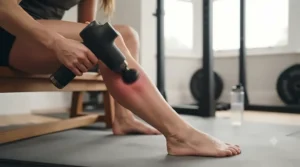
How to Choose a Tapping Massage Device
Working through the same questions a physiotherapist would ask keeps the decision grounded in your actual needs rather than marketing claims.
- Decide how deep you actually need to go. Occasional stiffness responds well to 8-10mm amplitude devices; genuine deep tissue work on dense muscle groups benefits from 12mm and above.
- Check stall force against your typical pressure. If you tend to press firmly, a higher stall force (40lbs-plus) prevents the motor bogging down mid-session.
- Weigh portability against your actual use case. A device that lives in a gym bag or travels with you needs to prioritise weight and battery life over raw power.
- Count the interchangeable heads you’ll genuinely use. More heads sound appealing, but most people settle into using two or three regularly — check those specific heads suit your target muscle groups.
- Factor in noise if you’ll use it in shared spaces. Devices under roughly 65dB at top speed, like the Bob and Brad C2, suit offices and shared living spaces far better than louder flagship models.
- Set a realistic budget against frequency of use. Daily users training seriously get genuine long-term value from premium depth and stall force; occasional users are usually better served saving the difference.
- Confirm battery life matches your session habits. Longer or more frequent sessions justify paying for the extended runtime of devices like the Power Plate Mini+.
Percussion Massager for Muscles: What It Actually Targets
A percussion massager for muscles works by driving rapid, repeated pressure into muscle tissue and the surrounding fascia — the connective tissue wrapping around muscle fibres — rather than simply vibrating against the skin’s surface. This distinction matters: genuine percussion (typically anything above roughly 8-10mm amplitude) reaches deeper tissue layers, while lower-amplitude vibration mostly affects surface sensation.
The muscle groups that respond best to this kind of targeted pressure tend to be larger and denser — quads, hamstrings, calves, glutes, and the upper trapezius are the most commonly cited areas across the research and reviewer feedback gathered for this guide. Smaller, more delicate muscle groups, and anywhere close to bone or joint, generally need a gentler approach or should be avoided with percussive devices altogether.
It’s worth being precise here rather than making sweeping claims: the systematic review referenced earlier found the strongest evidence for improvements in short-term flexibility and range of motion in specific muscle groups including the iliopsoas, hamstrings, and posterior chain, alongside genuine reductions in perceived stiffness — while evidence for boosting raw strength, balance, or explosive power was notably weaker or even slightly negative in some measures. That’s a useful, honest distinction between what percussion massagers reliably do and what they’re sometimes marketed as doing.
Deep Tissue Percussion Massager: When You Actually Need One
Not every ache calls for a deep tissue percussion massager specifically — a lot of everyday stiffness responds perfectly well to a gentler, lower-amplitude device. The genuine case for stepping up to deep tissue territory (generally 12mm amplitude and above, alongside meaningful stall force) is when you’re dealing with dense, well-developed muscle that a lighter device simply can’t penetrate — think serious runners’ calves, a weightlifter’s glutes, or chronic knots that persist despite regular lighter treatment.
The honest trade-off worth naming clearly: deeper amplitude and higher stall force generally means a heavier, noisier, and more expensive device, and it’s genuinely not always the better choice. Reviewers and physiotherapists alike consistently caution against jumping straight to maximum depth as a default, particularly for anyone new to percussive therapy or working on genuinely tender, previously injured tissue.
Among the seven devices in this guide, the Theragun Prime Plus and Hyperice Hypervolt 2 Pro are the two genuinely built for deep tissue work, with amplitude and stall force well ahead of the rest of the lineup. For anyone still uncertain whether they need that level of depth, starting with a mid-range device like the Theragun Mini and upgrading later if it proves insufficient is a genuinely sensible, lower-risk approach.
Percussive Therapy Benefits: What the Evidence Actually Supports
It’s worth separating marketing language from what current research genuinely supports, because the gap between the two is real. The systematic review published through the National Center for Biotechnology Information found meaningful evidence that percussive therapy can improve short-term flexibility in specific muscle groups and help reduce perceived stiffness after use — genuinely useful outcomes for everyday recovery and pre-activity preparation.
Where the evidence is notably thinner is around strength, balance, and explosive performance — the same review found little to no improvement in these areas, and in some measured outcomes, a slight decrease immediately after use. This matters practically: using a percussive device immediately before an activity requiring explosive power, like sprinting or heavy lifting, may not be the performance boost some marketing implies, and a traditional dynamic warm-up likely remains more appropriate for that specific goal.
There’s also a longer-running body of research specifically on massage gun devices and rehabilitation, including a widely cited literature review that found no significant difference between percussion massage, foam rolling, and static stretching in terms of measurable muscle characteristics or performance improvement — a useful reminder that percussive devices are one tool among several established options, not a replacement for all of them. None of this means the devices lack value; it means the value is real but specific, centred on flexibility, comfort, and perceived recovery rather than a blanket performance upgrade.
✨ Don’t Miss These Exclusive Deals!
🔍 Take your recovery routine to the next level with the carefully researched picks above. Click through on any highlighted device to check today’s price and availability. The right tapping massage device could be exactly what your evenings after training have been missing! 💪
Interchangeable Head Massager: Why the Attachments Matter
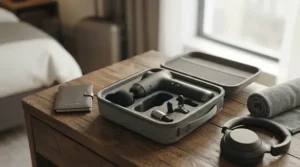
An interchangeable head massager isn’t just a gimmick — different head shapes genuinely change how pressure is distributed across muscle tissue, and using the wrong one for a given muscle group is one of the more common reasons people feel underwhelmed by an otherwise capable device. A rounded ball head spreads pressure broadly and suits large muscle groups like the quads and glutes; a flatter, wider head covers broad areas like the upper back; and a narrower bullet or fork-shaped head concentrates pressure into specific trigger points or tighter spaces like the arch of the foot or along the Achilles.
Among the devices in this guide, the Toloco EM26 offers the widest range at ten heads, though reviewers note not every head sees regular use in practice — most people settle into a rotation of two or three favourites. The Renpho R3, by contrast, keeps things simpler with five heads that are genuinely easy to swap in and out, which several reviewers specifically praise over the sometimes fiddlier attachment systems on pricier devices.
It’s worth noting that head material matters almost as much as shape. Firmer foam or silicone heads suit larger, less sensitive muscle groups, while softer, cushioned heads are better suited to bonier areas or anyone with lower pain tolerance. Buying based purely on head count, without checking the actual shapes and materials included, is a common mistake that leaves buyers with attachments they never use.
Sports Recovery Gadget: Fitting It Into a Wider Routine
As a sports recovery gadget, a tapping massage device works best as one part of a broader routine rather than a standalone fix for every post-training ache. The NHS’s own guidance on treating sprains and strains specifically recommends avoiding massage in the first couple of days after an acute injury, while swelling is still active — a useful reminder that percussive devices are a recovery and maintenance tool for muscle fatigue and stiffness, not a treatment for a fresh sprain or strain.
Used appropriately, a percussive device slots naturally alongside stretching, proper hydration, and adequate rest as part of a sensible recovery routine — the research referenced earlier specifically supports its role in easing perceived stiffness and improving short-term flexibility, both genuinely useful pieces of a training week rather than a complete recovery strategy on their own. Athletes training multiple times a week generally get the most consistent value from including it, while occasional exercisers may find a device useful but not essential.
It’s also worth being realistic about what “gadget” implies here: this is a comfort and maintenance tool, not medical equipment, and persistent pain that doesn’t ease with normal self-care — including gentle percussive use — is worth raising with a GP or physiotherapist rather than treating with an ever-longer massage session.
Common Mistakes When Buying a Tapping Massage Device
The most common mistake is buying purely on amplitude number without considering stall force alongside it — a device can have an impressive stroke length but stall out the moment real pressure is applied, which defeats the purpose entirely for anyone with dense muscle mass. Always check both specifications together rather than treating amplitude as the sole measure of quality.
A close second is over-prioritising attachment count. Ten heads sound more impressive than five, but as covered above, most people settle into using two or three regularly — a device with fewer, well-designed heads often serves better than one with a drawer full of rarely used extras. Buyers also frequently underestimate noise level, assuming all devices are similarly quiet, when in practice the gap between a 63dB device and a 75dB device is genuinely noticeable in a shared home or office.
Finally, many first-time buyers assume more power is always better and reach straight for a flagship device, when a lighter, gentler option would suit their actual needs and budget far better — as covered in the deep tissue section above, jumping straight to maximum depth isn’t automatically the right call for everyday stiffness.
Long-Term Cost & Maintenance
A cheaper device isn’t automatically the better long-term value once realistic lifespan enters the equation. Budget devices in the £70 range from newer or less established brands may need replacing within a year or two of regular use as motors and batteries degrade, while premium devices from established brands like Therabody and Hyperice typically carry longer warranties and more consistent long-term reliability reports, spreading their higher upfront cost across a genuinely longer working life.
Maintenance is minimal but worth doing properly: wipe attachment heads down after each use, particularly foam and cushioned heads that absorb sweat and skin oils over time, and store the device in its case rather than loose in a bag where dust and debris can work into the motor housing. Avoid fully draining the battery repeatedly, as this shortens lithium battery lifespan across virtually every device in this category, and periodically check that attachment heads click in securely rather than working loose during use.
For anyone using a device several times a week, the long-term cost calculation increasingly favours investing in a mid-range or premium option with a genuine multi-year warranty, rather than replacing a budget device annually — the maths tends to even out, or tip in favour of paying more upfront, once you factor in a couple of years of regular use.
Frequently Asked Questions
❓ Is a tapping massage device the same as a massage gun?
❓ How often can I safely use a percussion massager?
❓ What amplitude do I actually need for deep tissue work?
❓ Can a massage gun replace a warm-up before exercise?
❓ Are cheaper percussion massagers actually worth buying?
Conclusion
Choosing the right tapping massage device really comes down to matching amplitude, stall force, and portability against how often and how intensely you’ll actually use it — not chasing the highest spec sheet or the biggest brand name by default. Whether that means the budget-friendly Toloco EM26 for someone testing the waters, the physio-credible Bob and Brad C2 for everyday relief, or the genuinely deep Theragun Prime Plus for serious training demands, the underlying logic covered throughout this guide stays consistent: buy for your actual muscles and routine, not the marketing copy.
None of the seven devices here is objectively the best in isolation — the right one is whichever matches your training frequency, your tolerance for weight and noise, and your budget, backed by the genuine, evidence-supported benefits around flexibility and perceived stiffness rather than overstated performance claims. Work through the “How to Choose” checklist above before buying, and narrowing these seven strong options down to the right one should be straightforward.
✨ Ready to Ease Those Tight Muscles?
🔍 Revisit the picks above and check today’s price on the device that best matches your recovery routine. Your muscles will thank you after the very first session!
Recommended for You
- 7 Best Vibrating Handheld Massagers in 2026
- Full Body Wand Massager: 7 Best Picks That Actually Work (2026)
- Vibrating Wand Massager: 7 Best Picks for Back Pain (2026)
Disclaimer: This article contains affiliate links. As an Amazon Associate, I earn from qualifying purchases. If you purchase products through these links, we may earn a small commission at no additional cost to you.
✨ Found this helpful? Share it with your friends! 💬🤗
