In This Article
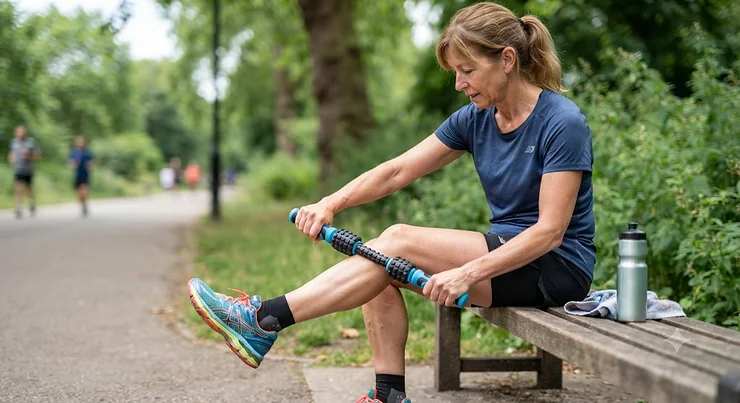
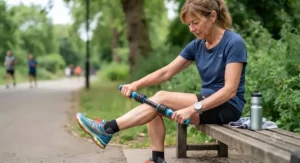
Your calves feel like two clenched fists and you haven’t even finished lacing up your trainers yet. Sound familiar? A therapy stick for legs is one of those unglamorous bits of kit that quietly earns its keep in a kit bag, a hallway cupboard, or wedged down the side of a sofa cushion — always within reach for the moment your quads start staging a protest. Unlike a foam roller, which asks you to get down on the floor and use your own bodyweight, a leg-focused massage roller lets you sit on the sofa, watching whatever you’re watching, and simply glide it up and down a sore muscle with as much or as little pressure as you fancy.
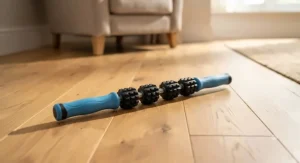
What is a therapy stick for legs? It’s a handheld self-massage tool — typically a row of independently spinning rollers or beads on a rigid or semi-flexible shaft with two handles — used to apply pressure to tight, fatigued, or knotted leg muscles for relief and improved circulation.
This guide draws on real product specifications, genuine aggregated customer sentiment, and independent research into self-myofascial release to help you separate the tools that genuinely earn a place on your shelf from the ones that are mostly marketing copy. We’ve researched seven real, currently available options across budget, mid-range, and premium price points, and we’ll walk through exactly what each one does well, where it falls short, and who it actually suits. Physiotherapy guidance on pain after exercise suggests that stretching and gentle self-care after activity can help manage delayed onset muscle soreness, even though it may feel a little uncomfortable to begin with — a leg-focused roller stick fits neatly into that same post-exercise routine, giving you a targeted, low-effort way to work through the same tight spots.
Whether you’re a weekend 5k runner, a cyclist who spends Sunday mornings grinding up hills, or someone who’s simply on their feet all day at work, the right recovery stick can shave real discomfort off your week. The wrong one, though, ends up in a drawer within a fortnight. Let’s make sure you pick the former.
Quick Comparison Table
For readers short on time, here’s the condensed version before we dig into the full seven-product breakdown below.
| Product | Price Range | Best For |
|---|---|---|
| 66fit Trigger Point Massage Stick | Under £15 | Best budget travel pick |
| Beenax Muscle Therapy Massage Stick | Under £15 | Best gear-tooth grip on a tight budget |
| Tiger Tail Roadster 11″ Massage Stick | £15-£25 range | Most compact, easiest to pack |
| Kamileo Muscle Roller | £15-£25 range | Firmest pressure for stubborn knots |
| MOBO 7-in-1 Muscle Roller Stick | £20-£30 range | Most versatile multi-attachment kit |
| THERABAND Roller Massager+ | £25-£40 range | Best clinically studied design |
| TriggerPoint GRID STK | £30-£45 range | Best overall build quality |
Looking at this spread, there’s a clear pattern: the budget end (66fit Trigger Point Massage Stick and Beenax Muscle Therapy Massage Stick) trades a bit of longevity for an easy entry point, while the premium pick, the TriggerPoint GRID STK, justifies its higher price through a more durable AcuGRIP handle system and a foam surface engineered to mimic a therapist’s hands rather than just cog-shaped plastic beads. The middle tier is where most people should probably be shopping, because it’s where you start seeing genuinely clever engineering — the THERABAND Roller Massager+, for instance, is one of the few tools in this category actually built on a design lineage with published clinical research behind it, which is worth something if you’re the sort of buyer who likes evidence over marketing claims.
💬 Found a pick you like already? Scroll down for the full breakdown before you commit — the differences matter more than they look on paper.
Top 7 Therapy Sticks for Legs: Expert Analysis
We’ve grouped these seven real, currently available products to cover every budget and use case — from a first-timer testing the waters to a marathon runner who needs something that survives being thrown in a kit bag three times a week.
1. 66fit Trigger Point Massage Stick — best budget travel pick
The 66fit Trigger Point Massage Stick is about as no-frills as this category gets, and that’s precisely the point. It uses four independently rotating rollers on a rigid shaft with two grip handles, a layout that’s changed very little since the original trigger-point stick concept was popularised over a decade ago. The lightweight build (well under 200g) means it slips into a gym bag or a suitcase side pocket without you noticing the extra weight, and the rollers themselves spin freely enough to glide over denim or leggings without snagging.
Based on the spec comparison, this is a tool built for targeted, precise work on quads, calves, and hamstrings rather than broad-strokes coverage of a whole limb — four rollers simply cover less surface area per pass than a nine-roller design. It’s best suited to beginners who want to try self-massage without committing much money, and to frequent travellers who don’t want to pack anything bulky. Reviewers consistently report that the rollers stay smooth after months of use, though a handful mention the plastic handles feeling a little hollow under heavy pressure.
Pros:
- ✅ Genuinely pocket-sized and travel-friendly
- ✅ Simple four-roller design is easy to learn
- ✅ Comes with an instructional ebook for technique
Cons:
- ❌ Narrower coverage per stroke than larger sticks
- ❌ Handles feel less substantial under heavy pressure
Priced under £15, the 66fit Trigger Point Massage Stick is a sound low-risk way to find out whether roller-stick massage suits your routine before spending more.
2. Beenax Muscle Therapy Massage Stick — best 360° gear grip on a tight budget
Where the 66fit keeps things simple, the Beenax Muscle Therapy Massage Stick leans into its ridged, gear-shaped rollers, which grip the muscle rather than simply sliding across the surface. That toothed texture is the standout feature here, and it changes how the tool feels in practice — you get more bite into the tissue per pass, which matters when you’re working a genuinely tight calf rather than just giving it a light rub.
The ridged gears mean this stick digs a little deeper than a smooth-roller design at the same pressure, which in practice translates to needing fewer passes to feel a knot start to release. On paper this makes it well suited to runners and gym-goers dealing with recurring tightness in the quads and calves rather than someone after a gentle, relaxing rub. What most buyers overlook about this style of stick is that the aggressive grip is a double-edged sword — brilliant on bare skin over big muscle groups, less comfortable directly over bony areas like the shin. Aggregated review sentiment on this model is largely positive for value, with recurring praise for how firm the pressure feels relative to the price, alongside occasional comments that the gears can pinch loose clothing if you’re not careful.
Pros:
- ✅ Toothed rollers dig deeper than smooth designs
- ✅ Strong grip reduces slipping mid-stroke
- ✅ Very competitively priced for the build quality
Cons:
- ❌ Can pinch loose clothing during use
- ❌ Too firm for sensitive or bony areas
At under £15, the Beenax Muscle Therapy Massage Stick offers some of the best pressure-per-pound of anything in this whole line-up.
3. Tiger Tail Roadster 11″ Massage Stick — most compact, easiest to pack
Tiger Tail is one of the longest-standing names in handheld muscle recovery, and the Tiger Tail Roadster 11″ Massage Stick is its stripped-back, travel-first model. At just 11 inches long, it’s noticeably shorter than most of the sticks on this list, trading some reach for genuine pocketability — this is the one that realistically fits in a rucksack’s side pocket alongside a water bottle.
The shorter shaft means you’ll need more repositioning to cover a full thigh or hamstring in one sitting, but the firm foam roller material distributes pressure evenly rather than concentrating it in hard points, which reviewers describe as a gentler introduction to roller-stick massage than bead-based designs. Here’s what to weigh: this is a tool built for convenience over intensity, so it suits someone who wants a “carry everywhere” option for light daily maintenance rather than someone chasing a deep-tissue dig into a stubborn IT band. Aggregated customer feedback consistently highlights the ergonomic handles, which are shaped to reduce hand fatigue during longer sessions, a detail that matters more than it sounds once you’re five minutes into rolling out a tight quad.
Pros:
- ✅ Genuinely compact — fits most bag pockets
- ✅ Even pressure distribution feels gentler on skin
- ✅ Ergonomic handles reduce hand fatigue
Cons:
- ❌ Shorter length needs more repositioning
- ❌ Less intense pressure than bead-style sticks
In the £15-£25 range, the Tiger Tail Roadster 11″ Massage Stick earns its keep purely on portability.
4. Kamileo Muscle Roller — firmest pressure for stubborn knots
Independent testers have previously singled out the Kamileo Muscle Roller as one of the stiffest designs they’ve tried, built around ten cog-shaped plastic beads resting on a stainless steel axle rather than a foam-wrapped roller. That rigidity is the whole story with this one: it’s not trying to be gentle, and it doesn’t apologise for that.
What that stiffness means in practice is that the Kamileo Muscle Roller can reach deep into large muscle groups — quads, hamstrings, calves — with less physical effort from you than a softer stick would need, because the hard beads concentrate force rather than spreading it. Based on the spec comparison, that makes it a strong fit for athletes and gym regulars who already tolerate deep-tissue massage guns or firm foam rollers and find softer sticks feel like nothing. The trade-off, and independent reviewers have flagged this consistently, is precision: the large beads and metal axle make it genuinely harder to pinpoint a small, specific trigger point compared with a narrower stick, so if you’re after surgical accuracy on one exact spot rather than broad coverage, this isn’t the ideal shape for the job.
Pros:
- ✅ Reaches deep into large muscle groups easily
- ✅ Steel axle adds durability under heavy use
- ✅ Includes a printed exercise guide
Cons:
- ❌ Hard to target small, specific trigger points
- ❌ Too intense for first-time users
Sitting in the £15-£25 range, the Kamileo Muscle Roller rewards buyers who already know they like firm pressure.
5. MOBO 7-in-1 Muscle Roller Stick — most versatile multi-attachment kit
Rather than committing to one roller configuration, the MOBO 7-in-1 Muscle Roller Stick ships with interchangeable components so you can reconfigure the shaft for different muscle groups and pressure levels — a bit like swapping heads on an electric toothbrush, except each swap changes how deep the massage actually goes.
That modularity is genuinely useful in practice, because a single 20-something-year-old’s legs and their grandparent’s legs do not want the same pressure profile, and this stick lets two people in the same household get a setup that actually suits them. Reviewers consistently note that the swap-out process is quick once you’ve done it a couple of times, though a few mention the smaller loose components are easy to misplace if you don’t keep them in the original box. On paper, this makes the MOBO 7-in-1 Muscle Roller Stick a smart pick for households with more than one user, or for anyone whose needs shift across the week — firmer for a hard leg day, gentler for an evening wind-down. What most buyers overlook is that this versatility comes with a slightly steeper learning curve than a fixed-roller stick, since you do need to think about which configuration suits the muscle you’re targeting.
Pros:
- ✅ Reconfigurable for different pressure needs
- ✅ Genuinely useful for multi-person households
- ✅ Covers legs, back, and arms with one kit
Cons:
- ❌ Small components can go missing over time
- ❌ Slight learning curve versus fixed-roller sticks
At roughly £20-£30, the MOBO 7-in-1 Muscle Roller Stick is the closest thing here to a genuine multi-tool.
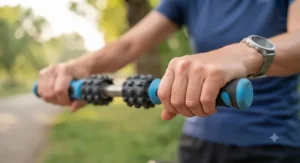
6. THERABAND Roller Massager+ — best clinically studied design
TheraBand built its name in physiotherapy clinics long before “recovery tools” became a consumer category, and the THERABAND Roller Massager+ carries that clinical DNA into a retractable 19–21 inch handheld design. The textured, contoured rollers are shaped specifically to avoid pinching skin while still allowing variable pressure — a detail that sounds minor until you’ve used a cheaper stick that catches on the back of your knee mid-stroke.
What most buyers overlook about this brand is that its parent design has actually been the subject of published research: independent studies on self-myofascial release using roller massagers of this style have measured meaningful reductions in reported muscle soreness after intense exercise. One trial recorded that self-myofascial release reduced next-day soreness by roughly 50% in the treated leg compared with around 20% in the untreated control leg, alongside a modest increase in hip range of motion. That’s a genuinely rare thing to be able to say about a product in this category — most manufacturers lean on testimonials rather than anything peer-reviewed. Aggregated customer sentiment praises the retractable design for travel, with the standard 21-inch version generally preferred by anyone doing this at home rather than on the road.
Pros:
- ✅ Backed by published self-myofascial release research
- ✅ Retractable design genuinely saves packing space
- ✅ Contoured rollers avoid pinching skin
Cons:
- ❌ Pricier than most sticks in this list
- ❌ Retractable version slightly less rigid than standard
In the £25-£40 range, the THERABAND Roller Massager+ is the pick for buyers who want evidence, not just anecdotes.
7. TriggerPoint GRID STK Handheld Massage Roller — best overall build quality
The TriggerPoint GRID STK Handheld Massage Roller is the flagship here, and at 61cm it’s also the longest stick on this list — long enough to cover a full hamstring or quad in a single pass without repositioning halfway through. It’s wrapped in EVA foam with TriggerPoint’s patent-pending GRID three-dimensional surface, a texture pattern originally developed for the brand’s popular foam rollers and adapted here for a handheld format.
Here’s what the spec sheet won’t tell you outright: that GRID surface is designed to mimic the varied pressure of an actual massage therapist’s hands rather than delivering one uniform sensation, alternating firmer ridges with softer channels as you roll. Based on the spec comparison, that variability is what separates this from the simpler bead-and-shaft sticks earlier in this list — it’s a more nuanced tool, better suited to someone who wants to work an entire muscle group thoroughly rather than hammer one specific knot. The AcuGRIP handles let you customise pressure without your hands cramping, and it’s available in two densities so you can match firmness to your pain tolerance. Reviewers consistently rate the build quality highly, and it’s backed by a one-year manufacturer warranty and a water-resistant, easy-to-clean surface — a small but genuinely useful detail if you’re using it straight after a sweaty session.
Pros:
- ✅ Full-length 61cm shaft covers more per pass
- ✅ GRID texture mimics varied hand pressure
- ✅ Backed by a one-year manufacturer warranty
Cons:
- ❌ Most expensive option in this round-up
- ❌ Longer length is less pocket-friendly
In the £30-£45 range, the TriggerPoint GRID STK Handheld Massage Roller is the one to buy if you only ever want to buy one.
How to Use a Therapy Stick for Legs the Right Way
Getting a leg-focused massage roller out of the box is the easy part — using it well is where most people either get genuine relief or just annoy their own calves for five minutes and give up. Start seated or standing with the muscle relaxed, not flexed; a tensed muscle resists pressure and makes the whole exercise pointless. Position the stick across the muscle belly, apply light-to-moderate pressure, and roll slowly — around one pass every two to three seconds, not a frantic scrub. When you find a genuinely tender spot, pause and hold gentle, sustained pressure for 15-30 seconds rather than repeatedly jabbing at it; that’s when the tissue actually has a chance to release.
A sensible first-30-days routine looks like five to ten minutes per leg, two to three times a week, gradually increasing pressure as your tolerance builds — the most common beginner mistake is going in too hard, too soon, and ending up with bruising rather than relief. Clean the rollers after sweaty sessions with a damp cloth, and store the stick somewhere it won’t get crushed under other gym kit, since bent shafts are the most common reason these things end up in the bin early. If you’re using it pre-workout, keep sessions short and brisk to warm the tissue; post-workout, slow everything down and lean into the sustained-pressure technique described above.
🔧 Next up, a look at exactly who benefits most from adding one of these to their routine.
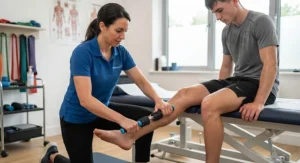
Real-World Scenarios: Who Actually Needs a Leg Recovery Stick
Picture a 34-year-old training for their first half marathon, running three evenings a week on top of a desk job. Their calves and hamstrings are the first to complain, usually around Thursday, and a five-minute session with something like the Beenax Muscle Therapy Massage Stick before bed keeps the following morning’s run from feeling like wading through treacle. Budget matters here — they’re not about to spend big on kit for a hobby they’re still testing the limits of — so a sub-£15 option that does the job is genuinely the right call, not a compromise.
Now picture someone entirely different: a 58-year-old keen cyclist who’s noticed their quads take longer to recover than they used to, riding 40+ miles most weekends across varied terrain. For this profile, the firmer, deeper reach of the Kamileo Muscle Roller or the clinically backed THERABAND Roller Massager+ makes more sense, since the goal is genuine deep-tissue work on tired, larger muscle groups rather than a light daily touch-up. Environment matters too — a home-based routine after a Sunday ride allows for the slightly bulkier standard THERABAND design rather than needing something pocket-sized.
Finally, consider a shared household — two adults with different pain tolerances and different sports, one doing HIIT classes and one doing long walks. Here the MOBO 7-in-1 Muscle Roller Stick‘s reconfigurable design solves a genuine practical problem: one stick, two very different pressure needs, no arguing over whose roller is whose.
Common Leg Muscle Problems — And How to Solve Them
Tight calves after running are probably the single most common complaint in this category, and the fix is consistent, gentle rolling along the gastrocnemius and soleus muscles rather than aggressive pressure directly on the Achilles tendon — a firmer stick like the Kamileo Muscle Roller works well here, provided you keep pressure moderate near the ankle.
IT band tightness along the outer thigh is trickier, because the IT band itself is fascia rather than muscle and doesn’t respond the same way to direct pressure — most physiotherapy guidance suggests working the surrounding quad and glute muscles instead, which a longer stick like the TriggerPoint GRID STK Handheld Massage Roller covers efficiently in fewer passes.
Post-leg-day quad soreness (the kind that makes stairs feel personal) responds well to the sustained-pressure technique on visibly tender spots, and this is precisely the scenario the published THERABAND-style research addressed, showing a meaningful drop in next-day soreness after treated sessions.
Shin splints need real caution — a stick can help the surrounding calf muscles, but direct pressure on the shin bone itself isn’t appropriate self-treatment, and persistent shin pain deserves a proper physiotherapy assessment rather than more rolling. And for hamstring tightness that flares up after long periods of sitting, short, frequent sessions with a compact option like the Tiger Tail Roadster 11″ Massage Stick kept at a desk drawer tend to get used more consistently than a bulkier stick left at home.
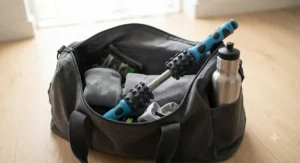
How to Choose a Deep Tissue Massage Stick
Picking the right one comes down to seven practical questions, roughly in order of importance:
- What’s your pain tolerance? Firmer bead-style sticks like the Kamileo Muscle Roller suit higher tolerance; softer foam-wrapped designs suit sensitive users.
- How much are you willing to spend? Sub-£15 options genuinely work for occasional use; frequent users get more longevity from the £25+ tier.
- Do you need portability? Shorter sticks like the Tiger Tail Roadster 11″ Massage Stick travel better than 60cm-plus designs.
- How large an area are you covering? Longer shafts like the TriggerPoint GRID STK Handheld Massage Roller need fewer repositions on big muscle groups.
- Is more than one person using it? Reconfigurable kits like the MOBO 7-in-1 Muscle Roller Stick solve mismatched pressure preferences.
- Does evidence matter to you? The THERABAND Roller Massager+ is one of the few backed by published research on its design lineage.
- How will you store and transport it? Rigid shafts need protecting from being crushed; retractable designs solve this neatly.
Common Mistakes When Buying a Physical Therapy Roller Stick
The single most common mistake is buying based on length alone, assuming longer automatically means better — in reality, a 61cm stick is genuinely awkward for calf work in a cramped office, while an 11-inch stick struggles to cover a full hamstring efficiently. Buyers also frequently underestimate firmness preferences, ordering the firmest option available because it looks “more serious,” then finding it too intense to actually use consistently, which defeats the entire purpose.
Another recurring error is ignoring hand and wrist comfort in favour of roller design alone — a stick with brilliant rollers but hard, narrow handles will fatigue your hands well before your legs feel done, particularly for anyone with existing wrist sensitivity. Reviewers also commonly flag disappointment when a budget stick is bought expecting premium-level durability; a sub-£15 tool genuinely isn’t built for daily heavy use by a competitive athlete, and expecting otherwise sets you up for an unfair one-star review. Finally, plenty of buyers skip checking whether the rollers spin independently versus being fixed to a single axle — independent rollers glide more smoothly and reduce skin drag, a detail easy to miss when scanning product photos.
Therapy Stick vs Foam Roller vs Massage Gun
| Feature | Massage Stick | Foam Roller | Massage Gun |
|---|---|---|---|
| Precision targeting | High | Low-Medium | High |
| Effort required | Low | High (bodyweight) | Very low |
| Portability | Excellent | Poor-Fair | Good |
| Typical price range | £10-£45 | £15-£40 | £40-£150+ |
| Best For | Targeted spot work, seated use | Large muscle groups, full-leg coverage | Fast, powered relief, minimal effort |
A therapy stick for legs earns its place in this trio because it sits in a genuinely useful middle ground: unlike a foam roller, you don’t need to get down on the floor or use your own bodyweight to generate pressure, which matters if you’ve got limited mobility or you’re simply knackered after a long run. Unlike a massage gun, there’s no battery to charge, no motor to eventually wear out, and the learning curve is close to zero — pick it up, apply pressure, roll. Where the massage gun wins is speed and power delivered with almost no physical effort on your part, which suits anyone who wants recovery without any technique to learn, though that convenience comes at a noticeably higher price point across the board.
What to Expect: Real-World Performance
On paper, “self-myofascial release” sounds like something from a lab coat, but in practice it translates to a fairly ordinary sensation: mild discomfort on a tender spot that eases within 20-30 seconds of sustained pressure, followed by a genuine sense of looseness in the muscle. It is not, generally, a dramatic experience — don’t expect instant miracle relief, expect gradual improvement over repeated sessions.
The research backs this up in a measured way rather than a hype-filled one. A peer-reviewed study on self-myofascial release and recovery after high-intensity training examined how foam rolling and roller-based massage affect range of motion, soreness, and lower-limb performance after a Tabata-style workout. Researchers found that the treated leg reported roughly half the delayed onset muscle soreness of the untreated control leg, alongside a modest increase in hip range of motion. Interestingly, the same study found little measurable effect on actual jumping performance, so it’s worth being realistic: this is a soreness and mobility tool first, not a performance-enhancing one. Reviewers across all seven products in this guide echo that same pattern — noticeable soreness relief within a session or two, more modest and gradual gains in flexibility over weeks of consistent use.
Muscle Therapy Tools for Runners, Cyclists and Desk Workers
Runners tend to get the most consistent benefit from calf- and hamstring-focused sessions timed for right after a run, while muscles are still warm and more receptive to pressure — a firmer stick like the Kamileo Muscle Roller suits marathon-training intensity, while the compact Tiger Tail Roadster 11″ Massage Stick suits someone squeezing sessions in before work.
Cyclists generally carry more tension through the quads and IT band than runners, given the repetitive, seated pedalling motion, and benefit from a longer stick that covers the full thigh in fewer passes — the TriggerPoint GRID STK Handheld Massage Roller‘s 61cm length is genuinely well matched to this use case.
Desk workers are a slightly different profile again: the issue usually isn’t intense exercise soreness but circulation and stiffness from hours of sitting, particularly through the hamstrings and calves. A short, gentle session with something like the 66fit Trigger Point Massage Stick kept in a drawer at the office, used for five minutes during a lunch break, tends to do more good over a working week than an occasional deep-tissue session at home — and it pairs well with the broader movement targets in the UK Chief Medical Officers’ physical activity guidelines, which recommend adults stay active in some form most days rather than relying on one big weekly session.
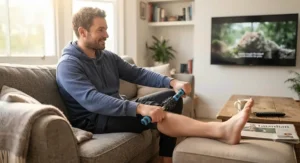
Long-Term Cost & Maintenance
A sports massage stick is genuinely one of the better value-for-money recovery tools available, largely because there’s very little to maintain and nothing to replace. There’s no battery, no charging cable, no attachment heads that wear out — the entire cost of ownership is the upfront price and, eventually, a replacement when rollers stop spinning smoothly or a shaft cracks.
Working out cost-per-use makes the comparison stark: a £15 stick used twice a week for two years works out to roughly 7p per session, while a £150 massage gun used at the same frequency, once you factor in an eventual battery replacement or motor wear, sits closer to 70p-£1 per session. That’s not an argument against massage guns, which offer genuine advantages in power and convenience, but it does mean a manual stick remains one of the most cost-effective ways to build a consistent recovery habit. The main cost risk with cheaper sticks is needing to replace them sooner — a sub-£15 option might need swapping after a year or two of heavy daily use, while the TriggerPoint GRID STK Handheld Massage Roller‘s more robust construction and one-year warranty are designed to outlast several cheaper alternatives, which can make the higher upfront price genuinely worthwhile for frequent users.
Features That Actually Matter (And Those That Don’t)
Independently spinning rollers matter enormously — fixed or poorly rotating rollers drag on skin and clothing rather than gliding, turning a massage into an irritation. Handle ergonomics matter more than most buyers expect going in, since hand fatigue is the most common reason people cut sessions short. Shaft length matters relative to your actual use case rather than in the abstract — there’s no universally “best” length, only the right length for the muscle group and setting you’ll use it in most.
What matters considerably less than marketing copy suggests: colour options, branded carry pouches, and claimed “medical grade” materials on products with no actual clinical backing. A stick doesn’t need a companion app, LED lights, or Bluetooth connectivity to do its job — those additions tend to signal a brand chasing novelty rather than function, and they add cost without adding recovery benefit. If a listing spends more words describing the packaging than the roller mechanism, treat that as a mild red flag.
Safety Guide: Using a Sports Massage Stick Responsibly
Keep pressure moderate and build up gradually — bruising is a sign you’ve gone too hard, not a sign of a more effective session. Avoid rolling directly over joints, bones, varicose veins, or any area with broken skin, swelling, or acute injury; a stick is for muscle tissue, not for working around an actual injury without professional guidance. If you’re pregnant, managing a chronic condition, recovering from surgery, or dealing with persistent pain that isn’t easing with rest, checking in with a GP or physiotherapist before starting any new self-massage routine is the sensible move rather than an overcautious one.
NHS physiotherapy resources describe this ordinary post-exercise ache as delayed onset muscle soreness, typically appearing 24-72 hours after activity and normally considered harmless — though persistent or worsening soreness is worth discussing with a physiotherapist, GP, or NHS 111 rather than working through it alone. That distinction matters: ordinary post-exercise tightness is exactly what these sticks are designed for, but sharp, localised, or worsening pain isn’t something to roll through and hope improves on its own.
FAQ
❓ How often should you use a therapy stick for legs?
❓ Can a leg massage stick help with cellulite?
❓ Is a massage stick better than a foam roller for legs?
❓ How long does a deep tissue massage stick last?
❓ Can you use a physical therapy roller stick on calves and shins?
Conclusion
A therapy stick for legs isn’t going to replace a proper sports massage or a physiotherapist’s hands, and none of the products above claim otherwise — what they genuinely offer is a low-cost, low-effort way to take the edge off ordinary post-exercise tightness on your own schedule. If you’re new to this entirely, the 66fit Trigger Point Massage Stick or Beenax Muscle Therapy Massage Stick are sensible, low-risk starting points. If you already know you like firm pressure and want maximum coverage, the TriggerPoint GRID STK Handheld Massage Roller is the one built to last the distance, while the THERABAND Roller Massager+ stands out as the pick genuinely backed by published research rather than just marketing language.
Whichever you choose, the real value comes from consistency — five minutes, a couple of times a week, beats one heroic 40-minute session the day your legs finally give out. Build it into a routine, keep pressure sensible, and it’ll quietly become one of the more useful things in your kit bag.
✨ Ready to give your legs the recovery they’ve been asking for? Pick the option that matches your budget and pressure preference above, and check current pricing and availability before you order.
Recommended for You
- 7 Best Trigger Point Massage Sticks for 2026 (UK Buyer’s Guide)
- Best Muscle Roller Stick 2026: 7 Tested Picks That Actually Work
- Wooden Massage Roller: 7 Brilliant Picks Compared (2026)
Disclaimer: This article contains affiliate links. As an Amazon Associate, I earn from qualifying purchases. If you purchase products through these links, we may earn a small commission at no additional cost to you.
✨ Found this helpful? Share it with your friends! 💬🤗
