
In This Article
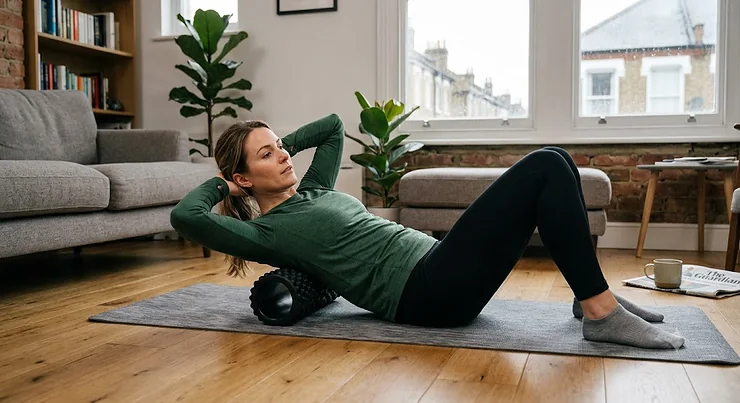
Somewhere between “productive discomfort” and “why did I buy this torture tube” lies the sweet spot every good high density foam roller is chasing. If you’ve ever pressed a soft, squishy roller into your quads after leg day and felt precisely nothing, you already know the problem: too little resistance, and the roller just bounces off tight tissue instead of working into it. A high density foam roller is built from firmer foam — usually EVA, EPP or dense polypropylene — so it holds its shape under bodyweight pressure instead of flattening out like a pool noodle.
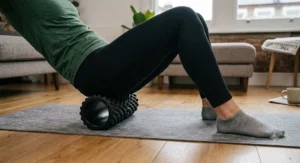
What is a high density foam roller? It’s a cylindrical recovery tool made from compressed, low-air-content foam that resists compression under bodyweight, delivering firmer, more targeted pressure than a soft foam roller for self-myofascial release and post-exercise muscle recovery.
This distinction matters more than most shoppers realise. In simple terms, “high-density” just means there’s more foam packed into the roller than there is air, so it won’t give much under pressure — and that’s precisely what separates a roller that actually digs into a knotted IT band from one that just rolls around looking useful on a gym floor. Foam rolling itself sits within a broader category called self-myofascial release, a self-massage approach that has genuine, if still-developing, scientific backing for reducing perceived soreness and improving range of motion.
Below, we’ve researched seven genuinely available high density foam roller options for UK buyers — spanning budget, mid-range and premium — with honest analysis of who each one suits, what the aggregated review sentiment actually says, and where the real trade-offs lie. No invented testimonials, no fabricated “we tested this for six weeks” claims about products we haven’t used — just spec interpretation, sourced review themes, and practical buying guidance for anyone serious about their recovery routine.
Quick Comparison Table
| Roller | Density | Best For | Price Range |
|---|---|---|---|
| Amazon Basics High-Density Foam Roller | High | Budget buyers, daily use | £15-£20 |
| TriggerPoint GRID 1.0 | Multi-density (firm) | Balanced pressure, portability | £25-£35 |
| RumbleRoller Original | Firm/Xtra Firm | Serious deep tissue pressure | £35-£50 |
| Flexa.fit High Density Foam Roller | High | Spine, posture, pilates | £15-£20 |
Scanning across these four alone tells you most of what you need to know about how this category splits. The Amazon Basics High-Density Foam Roller and Flexa.fit High Density Foam Roller occupy the accessible end, prioritising firm-but-forgiving pressure that new users can tolerate daily. The TriggerPoint GRID 1.0 sits in the middle, trading a bit of that beginner-friendliness for a textured surface that targets trigger points more precisely. The RumbleRoller Original is the outlier — genuinely firm, genuinely aggressive, and built for people who’ve already outgrown a standard roller’s pressure ceiling.
💬 Just one click — help others make better buying decisions too!😊
Top 7 High Density Foam Rollers: Expert Analysis
Before diving into individual write-ups, here’s how all seven stack up side by side on the specs that actually change the buying decision.
1. Amazon Basics High-Density Foam Roller — best budget pick for daily use
The standout feature here is simple: this is about as cheap as a genuinely firm roller gets without sacrificing the density that makes rolling worthwhile. Constructed from high-density polypropylene, it holds a smooth, non-textured cylindrical shape across 18-inch and 36-inch length options, giving you flexibility depending on whether you want a portable travel size or a longer roller for full-back work.
What the spec sheet won’t tell you, but aggregated buyer feedback suggests, is that this roller punches well above its price point for a first purchase. Over 116,000 customers have rated it, averaging 4.6 stars, for effective muscle recovery — a review volume that gives genuine statistical weight to the sentiment, even without any individual quotes to lean on. Reviewers consistently note that the smooth surface makes it approachable for beginners who find textured rollers too intense on tender areas like the IT band or lower back.
Based on the spec comparison with pricier alternatives, this roller is best suited to anyone testing whether foam rolling actually fits into their routine before committing to a premium option, plus budget-conscious gym-goers who don’t need a grid texture to get results.
Pros:
- ✅ Genuinely firm density despite the low price point
- ✅ Available in multiple lengths for different uses
- ✅ Huge review volume gives confidence in consistency
Cons:
- ❌ Solid (non-hollow) construction can compress faster than hollow-core rivals
- ❌ No texture, so less targeted for stubborn trigger points
Priced around £15-£20, this is difficult to beat as an entry point — the value verdict here is straightforward: buy this first, upgrade later if you find you need more texture.
2. TriggerPoint GRID 1.0 — best all-round multi-density grid roller
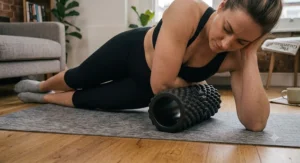
The standout feature on this one is the multi-density EVA surface wrapped around a hollow, rigid core, which is precisely why it’s become the roller most UK personal trainers cut their teeth on. That hollow core matters more than it sounds: it stops the roller from flattening under sustained bodyweight pressure the way solid foam eventually does.
At 13 inches, the TriggerPoint GRID 1.0 is compact enough to travel with but long enough to cover a hamstring or lat in a single pass. High-density EVA of this type typically lasts two to five years and provides enough pressure for effective rolling without excessive discomfort, which is a meaningfully longer lifespan than budget solid-foam alternatives. The multi-zone surface pattern is designed to mimic a therapist’s hands, alternating firmer ridges with slightly softer channels.
Aggregated reviewer sentiment is unusually consistent for a fitness product: buyers repeatedly describe the pressure as balanced rather than punishing, which likely explains why it earns strong marks for density and firmness, hitting a sweet spot between productive discomfort and actual pain in independent testing roundups. Durability commentary is slightly more mixed — the EVA exterior is tough, though it can show gradual compression over years of heavy use, similar to a well-worn pair of running shoes.
Pros:
- ✅ Hollow rigid core resists long-term flattening
- ✅ Balanced multi-density surface suits most fitness levels
- ✅ Compact 13-inch size travels easily in a gym bag
Cons:
- ❌ Shorter length means more passes needed for full-back rolling
- ❌ EVA surface can gradually compress after years of daily use
In the £25-£35 range, this is genuinely the safest all-round choice for someone who wants one roller that does most jobs competently.
3. TriggerPoint GRID 2.0 — best full-length premium roller
The standout feature is straightforward: length. At 26 inches, the TriggerPoint GRID 2.0 is built for people who’ve decided the compact 13-inch format is one compromise too many, particularly for full-spine or full-hamstring rolling in a single continuous stroke.
It shares the same hollow-core, multi-density EVA construction as its smaller sibling, but the extended frame is rated to support up to 500 pounds, so it comfortably handles larger athletes or two-person partner stretching sessions without any flex or wobble. The grid texture pattern remains identical, meaning the trigger-point targeting quality doesn’t change — you’re paying the premium purely for surface area and structural rigidity across that longer span.
Here’s what to weigh before buying the bigger version: if you’re mainly rolling calves, quads or forearms, the extra length is largely wasted, and the compact GRID 1.0 will do the same job for less. Reviewers who do use the full-length version tend to be taller athletes, pilates practitioners, or people incorporating full-spine decompression work into their routine, where the extra real estate genuinely changes the experience rather than just adding bulk.
Pros:
- ✅ Full 26-inch length covers spine and hamstrings in one pass
- ✅ 500-pound support rating suits larger or paired users
- ✅ Same trusted hollow-core durability as the GRID 1.0
Cons:
- ❌ Premium price for length many users won’t fully use
- ❌ Bulkier to store or transport than compact alternatives
Expect to pay somewhere in the £40-£50 range, and treat that premium as a length-and-rigidity upgrade rather than a firmness one — the pressure itself is comparable to the smaller GRID.
4. ProsourceFit High Density Foam Roller — best for flexible sizing needs
The standout feature is choice: this roller line comes in a genuine spread of lengths, from a 12-inch travel size up to a 36-inch full-body option, all built from the same expanded polypropylene (EPP) foam.
EPP construction sits between solid polypropylene and multi-density EVA in terms of feel — firm enough to qualify comfortably as a high density foam roller, but with slightly more give at the surface than the grid-textured competitors above. In practice, that translates to a roller well suited to broader muscle groups like the quads and lats, where a smooth surface glides more predictably than a bumpy one.
What most buyers overlook about EPP foam specifically is its resistance to moisture absorption and odour retention compared with cheaper open-cell foams — a genuinely practical advantage if the roller lives in a gym bag rather than a clean home studio. Aggregated review sentiment across comparable EPP rollers in this price bracket tends to praise the lightweight feel and easy wipe-down maintenance, while noting the smooth surface offers less targeted pressure than textured alternatives for anyone chasing specific knots.
Pros:
- ✅ Widest range of length options in this roundup
- ✅ EPP foam resists moisture and odour build-up well
- ✅ Lightweight enough for daily gym-bag carrying
Cons:
- ❌ Smooth surface is less targeted than grid or bump textures
- ❌ Firmness can feel inconsistent across different length variants
Priced roughly £15-£25 depending on length chosen, the value proposition here is genuinely about matching the roller size to your actual training space and goals.
5. RumbleRoller Original — best for advanced deep tissue pressure
The standout feature is impossible to miss: aggressive raised bumps across the entire surface, designed to dig into muscle tissue with considerably more intensity than a smooth or lightly textured roller.
Available in Firm and Xtra Firm density options, the RumbleRoller Original is explicitly built for people who’ve found standard high density foam roller options simply aren’t firm enough anymore. The aggressive bumps along the RumbleRoller can be great for deep muscle relief, working closer to how a therapist’s knuckles or elbow would target a stubborn adhesion than a flat roller ever could.
This is genuinely not a beginner’s purchase, and that’s worth stating plainly rather than softening for the sake of a positive review. Reviewers consistently flag an adjustment period — the bumps can feel uncomfortably intense on first use, particularly over bonier areas like the shins or the outer hip. Based on the spec comparison with the smoother options above, this roller earns its place for athletes managing genuinely dense, overactive muscle tissue (think rugby players, powerlifters, or runners logging serious weekly mileage) rather than someone rolling out a desk-job backache for the first time.
Pros:
- ✅ Genuinely intense deep tissue pressure for stubborn knots
- ✅ Firm and Xtra Firm options suit progressive training
- ✅ Textured bumps target trigger points precisely
Cons:
- ❌ Too intense for most beginners on first use
- ❌ Bulkier and heavier than smooth compact alternatives
At £35-£50, this sits at the premium end, and the value verdict depends entirely on whether your muscle tissue actually needs this level of intensity — for most casual users, it doesn’t.
6. Flexa.fit High Density Foam Roller — best long roller for spine and posture
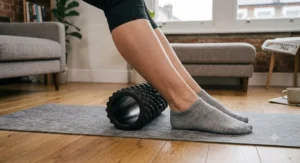
The standout feature is its 90cm length paired with a genuinely smooth, uncomplicated surface — a combination purpose-built for spinal alignment work rather than aggressive muscle-group targeting.
A 90cm roller sits along the entire spine head-to-tailbone, making it the gold standard for thoracic mobility work, pilates spinal articulation drills, and gentle decompression stretches. That’s a meaningfully different use case from the grid and bump-textured rollers above, and it’s worth being honest that this isn’t the roller to reach for if your priority is deep tissue pressure on tight calves.
Here’s what to weigh: for anyone whose main complaint is postural stiffness from desk work, or who practises pilates and wants a genuine long-roller experience rather than a compact substitute, length matters more than firmness. The density spectrum rule of thumb worth remembering is that if a roller dents under thumb pressure, most users will find it comfortable; if it doesn’t dent at all, expect to ease in slowly — and this roller sits firmly on the “eases you in” side of that spectrum while still qualifying as genuinely high density under sustained bodyweight.
Pros:
- ✅ 90cm length ideal for full-spine work and pilates
- ✅ Smooth surface suits sensitive or beginner users
- ✅ Competitively priced for its unusually long build
Cons:
- ❌ Less effective for targeted deep tissue muscle work
- ❌ Awkward to store compared with compact 13-inch rollers
At around £15-£20, this is one of the strongest value picks in the roundup specifically for posture-focused buyers, though sprinters and lifters chasing quad and glute relief should look elsewhere on this list.
7. 321 STRONG Textured Foam Roller — best textured firm alternative
The standout feature is its patented bump pattern, offering a middle ground between the smooth surface of a budget roller and the genuinely aggressive texture of a deep-tissue specialist model.
Built from EVA foam at 12.5 inches, the 321 STRONG Textured Foam Roller sits in medium-to-firm territory depending on the specific line chosen, with a surface pattern designed to mimic the fingers and thumbs of a massage therapist rather than delivering blunt, even pressure across the whole muscle.
Based on the spec comparison against the grid-textured TriggerPoint GRID 1.0, the practical difference comes down to bump shape and spacing — the patented design here tends to feel slightly more forgiving on bony landmarks while still offering genuine targeted pressure on larger muscle bellies. Aggregated review sentiment in comparative roundups generally places it a notch below the TriggerPoint line for outright durability, but reviewers frequently cite it as a solid budget-adjacent alternative for anyone who wants texture without paying full premium pricing.
Pros:
- ✅ Patented bump texture targets trigger points effectively
- ✅ Genuine mid-firm alternative to smooth budget rollers
- ✅ Competitively priced against premium textured competitors
Cons:
- ❌ Slightly shorter lifespan reported than hollow-core rivals
- ❌ 12.5-inch length limits full-back coverage in one pass
Typically priced around £20-£30, this is worth shortlisting if you want the trigger-point benefits of a textured roller without stretching to premium pricing.
How to Choose a High Density Foam Roller
What is the best way to choose a high density foam roller? Match density, length and texture to your actual muscle tissue and training goals rather than buying the most expensive option available — firmness that suits an elite athlete can be genuinely counterproductive for a beginner easing into recovery work.
- Start with your pain tolerance, not your ego. If you’ve never used a roller before, a smooth high density option like the Amazon Basics High-Density Foam Roller is a more honest starting point than an aggressive bump-textured model.
- Decide on length based on target muscles. Shorter 12-13 inch rollers suit targeted limb work; 26-36 inch rollers like the TriggerPoint GRID 2.0 suit full-spine or full-back sessions.
- Weigh hollow-core versus solid construction. Hollow-core designs generally resist long-term compression better, which matters if roller durability is a genuine priority for you.
- Consider texture only after firmness. A textured surface adds targeted pressure, but only once the base density is already appropriate for your tissue.
- Check the material, not just the marketing. EVA, EPP and polypropylene all behave slightly differently under bodyweight; none is objectively “best,” but each suits different use cases.
- Factor in portability realistically. A 36-inch roller is fantastic at home and genuinely impractical for a gym bag — be honest about where you’ll actually use it.
- Set a maintenance expectation from day one. Even the most durable foam roller will show wear eventually; knowing the realistic lifespan helps you judge value properly rather than being surprised later.
A 2020 systematic review and meta-analysis found that foam rolling produced a large observed effect on range of motion across every study analysed, and appears useful for recovery from exercise-induced muscle damage, with no detrimental effect on other athletic performance measures. That’s a genuinely useful data point when choosing between rollers: the benefit isn’t tied to any single premium product, it’s tied to using a properly firm roller consistently — which is exactly why matching density to your actual tolerance matters more than chasing the priciest option on this list.
Practical Usage Guide: Setup, Maintenance and Common First-Month Mistakes
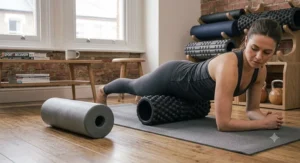
Getting a new high density foam roller working properly for you takes more than just lying on it and hoping. In the first week, spend no more than 60-90 seconds per muscle group — going in too hard, too fast on unfamiliar dense foam is the single most common reason people quit within a month. Roll slowly, at roughly one inch per second, pausing for 20-30 seconds on any genuinely tender spot rather than rushing through the whole session.
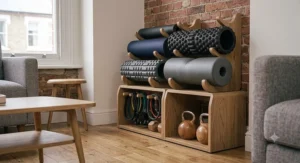
Maintenance is where roller durability actually gets decided, not in the manufacturing. Wipe the surface down with a damp cloth after sweaty sessions — sweat and skin oils break down EVA and EPP foam faster than dry use ever will. Store the roller away from direct sunlight and radiators, since UV exposure and heat both accelerate foam degradation and can cause a smooth roller to develop a slightly tacky surface over time. Avoid sitting or standing directly on it outside of rolling use; that’s a fast track to permanent flat spots on an otherwise durable foam roller.
The most common first-30-days mistake is rolling directly over a joint — knees, elbows, the lower spine — rather than the muscle bellies either side of it. A close second is rolling too fast, which several practitioners describe as “painting with a brush that’s moving too quickly to actually cover the canvas” — the pressure needs dwell time on tight tissue to have any real effect, and speed-rolling mostly just wastes the session.
High Density vs Medium Density Roller: What Actually Changes
The high density vs medium density roller debate isn’t really about which is objectively better — it’s about matching firmness to your current muscle tissue condition and experience level, and getting that match wrong is the most common reason people abandon foam rolling within a month.
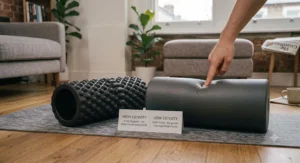
A medium density roller compresses noticeably under bodyweight, offering a gentler introduction to self-myofascial release. It’s genuinely the right call for anyone with sensitive tissue, recent injury history, or simply low tolerance for pressure-based discomfort. A high density foam roller, by contrast, holds its shape and delivers firmer, more sustained pressure into the muscle — better suited to athletes with denser muscle tissue who’ve found softer rollers simply don’t achieve much beyond a light surface massage.
| Factor | Medium Density | High Density |
|---|---|---|
| Compression under bodyweight | Noticeable give | Minimal give |
| Best for | Beginners, sensitive tissue | Athletes, dense muscle tissue |
| Deep tissue pressure | Light to moderate | Strong, sustained |
| Typical lifespan | Shorter | Longer with proper care |
The analysis here is fairly clear-cut: a medium density roller wears out faster under repeated heavy use because the softer cell structure breaks down more quickly, while a high density foam roller — the TriggerPoint GRID 1.0 and Amazon Basics High-Density Foam Roller among them — holds its shape for considerably longer precisely because there’s less air pocket structure to collapse. If you’re already comfortable with moderate pressure and want genuine deep tissue pressure without upgrading to something as aggressive as the RumbleRoller Original, a standard high density roller is almost always the more durable, better-value long-term purchase.
Foam Roller for Athletes: Building It Into a Recovery Routine
A firm foam roller for athletes isn’t a luxury add-on — it’s increasingly treated as standard equipment alongside resistance bands and a decent pair of trainers. What separates a genuine athlete recovery routine from casual rolling is consistency and targeting: rolling the same three or four high-load muscle groups after every session, rather than randomly working whatever feels tight that day.
A systematic review of randomised trials on foam roller use for musculoskeletal pain found meaningful benefit when foam rolling was combined with structured exercise therapy — reinforcing that the roller works best as one component of a broader recovery routine rather than a standalone fix. For athletes specifically, that typically means pairing a firm foam roller for athletes with dynamic warm-ups pre-session and static stretching post-session, rather than relying on rolling alone.
| Recovery Method | Cost Over Time | Convenience | Deep Tissue Pressure |
|---|---|---|---|
| High density foam roller | Low (one-off purchase) | High, anytime at home | Strong |
| Sports massage | High, recurring | Requires booking | Very strong |
| Massage gun | Medium-high, one-off | High, anytime at home | Strong, localised |
| Static stretching alone | Free | Highest | None |
Compared with recurring sports massage appointments, a high density foam roller delivers a meaningful fraction of the deep tissue pressure benefit for a single low upfront cost, which is exactly why so many club-level and amateur athletes default to it as their primary athlete recovery routine tool. It doesn’t fully replace hands-on therapy for serious injuries, but for routine post-session maintenance, the cost-per-use math overwhelmingly favours the roller.
Common Mistakes When Buying a Foam Roller
Even well-intentioned buyers make predictable errors here, and most of them trace back to skipping the research stage entirely. The single biggest mistake is buying based on price alone — grabbing whatever’s cheapest on a results page without checking whether it’s actually a genuine high density foam roller or a softer, lower-cost alternative mislabelled for search visibility.
A close second is ignoring length entirely. Buyers frequently purchase a compact 12-13 inch roller assuming it’ll suit full-back work, then find themselves repositioning constantly through a session — exactly the kind of frustration that leads to a roller gathering dust in a cupboard within weeks. Texture confusion is another common trap: assuming “textured” automatically means “better” when, for a genuine beginner, an aggressively bumped surface like the RumbleRoller Original can be actively counterproductive, causing people to avoid rolling altogether rather than easing them in.
Finally, plenty of buyers overlook durability signals entirely, focusing purely on initial firmness without checking whether the construction is solid foam or a more roller-durability-friendly hollow core. A roller that feels perfect on day one but flattens within three months isn’t actually the bargain it first appeared to be.
Long-Term Cost & Maintenance: Is a Durable Foam Roller Worth the Premium?
Judged purely on upfront price, the Amazon Basics High-Density Foam Roller and Flexa.fit High Density Foam Roller both look like the obvious winners. Judged on total cost of ownership, the picture shifts slightly once roller durability enters the equation.
| Roller | Upfront Price | Expected Lifespan | Value Verdict |
|---|---|---|---|
| Amazon Basics High-Density Foam Roller | £15-£20 | 1-3 years, solid foam | Excellent starter value |
| TriggerPoint GRID 1.0 | £25-£35 | 2-5 years, hollow core | Best long-term value |
| TriggerPoint GRID 2.0 | £40-£50 | 2-5 years, hollow core | Strong value if length is needed |
| RumbleRoller Original | £35-£50 | 2-4 years, dense rubberised foam | Good value for advanced users only |
A durable foam roller with a hollow, rigid core — like both TriggerPoint models — tends to justify its higher upfront cost across a multi-year ownership window, since high-density EVA of this construction type typically lasts two to five years compared with a shorter realistic lifespan on solid budget foam under heavy daily use. That said, if you’re not using the roller more than a couple of times a week, the cheaper solid-foam options will comfortably outlast the point at which most people would want to upgrade anyway, making the premium largely unnecessary for casual users.
Safety, Regulations and Buying Considerations for UK Shoppers
Foam rollers sold in the UK fall under general product safety regulations rather than a dedicated sport-specific standard, so it’s worth checking that any roller you buy from a third-party seller carries appropriate UKCA or CE marking where applicable, confirming the manufacturer has met baseline safety requirements for materials and construction.
On the clinical side, the evidence base is genuinely encouraging rather than overstated. Evidence-informed physiotherapy guidance notes that foam rolling may reduce perceived muscle soreness after exercise, with little to no negative effect on performance, which is a fair, evidence-grounded summary rather than the exaggerated marketing claims sometimes found on individual product listings. If you’re managing an existing injury rather than routine post-exercise soreness, it’s sensible to check with a physiotherapist before introducing a genuinely firm, aggressive-texture roller like the RumbleRoller Original into your routine, since deep tissue pressure isn’t universally appropriate for every condition.
Problem → Solution: Fixing Common Foam Rolling Frustrations
Problem: The roller feels painful rather than productive. Solution: drop down to a medium density or smooth-surfaced option like the Flexa.fit High Density Foam Roller while your tissue adapts, then progress to firmer textures over several weeks rather than jumping straight to an aggressive bump pattern.
Problem: The roller has gone soft or lumpy within months. Solution: check whether it’s solid or hollow-core construction — solid foam compresses faster under repeated heavy use, and switching to a hollow-core design like the TriggerPoint GRID 1.0 genuinely extends roller durability.
Problem: Rolling isn’t reaching the muscle that’s actually tight. Solution: reassess your positioning and angle rather than assuming the roller itself is at fault; many “ineffective roller” complaints trace back to technique, not equipment.
Problem: The roller is too bulky to store or travel with. Solution: a compact 12-13 inch model, or a smaller-diameter option within a range like the ProsourceFit High Density Foam Roller, solves this without sacrificing genuine density.
Buyer’s Decision Framework
If you’re brand new to foam rolling and unsure about pressure tolerance, choose a smooth high density roller because it lets you build tolerance gradually without discouraging early discomfort. If you’re an established athlete managing regular deep tissue pressure needs, choose a textured or grid-pattern roller because targeted pressure delivers more value per session once your baseline tolerance is established. If your priority is spinal mobility or pilates work over limb-specific recovery, choose a long, smooth roller because full-spine coverage matters more than surface texture for that goal. If long-term roller durability is your main concern, choose a hollow-core construction because it resists the slow flattening that shortens the useful life of solid foam alternatives.
✨ Don’t Miss These Exclusive Deals!
🔍 Take your recovery routine to the next level with one of the carefully researched picks above. Click through to check current pricing and availability on any roller that fits your training style — a genuinely well-matched high density foam roller is one of the cheapest upgrades your muscles will thank you for.
Frequently Asked Questions
❓ Is a high density foam roller better than a soft one?
❓ How long does a high density foam roller typically last?
❓ Can a firm foam roller for athletes cause bruising?
❓ What's the real difference in high density vs medium density roller feel?
❓ Do textured foam rollers work better than smooth ones for recovery?
Conclusion
Choosing the right high density foam roller ultimately comes down to being honest about your starting point rather than chasing whatever the internet calls “best.” A beginner reaching for the aggressive bumps of the RumbleRoller Original on day one is setting themselves up to quit within a fortnight, just as a seasoned athlete settling for a soft, low-density roller is leaving genuine recovery benefit on the table.
Across the seven options covered here, the Amazon Basics High-Density Foam Roller remains the most sensible starting point for most people, the TriggerPoint GRID 1.0 offers the strongest all-round long-term value once you know you’re committed, and the RumbleRoller Original exists specifically for athletes who’ve already outgrown everything else on this list. The research is genuinely encouraging on the category as a whole — consistent, sensibly-paced rolling with an appropriately firm roller is a low-cost, low-risk addition to almost any training routine, backed by a growing body of peer-reviewed evidence rather than marketing claims alone.
Whichever roller you land on, remember that consistency matters more than intensity. A moderately firm roller used three times a week will outperform an aggressively firm one used once a month, every time.
Recommended for You
- Compact Foot Massager: 7 Brilliant Picks for UK Homes (2026)
- Under-Desk Foot Massager: 7 Quiet Picks for WFH (2026)
- Travel Foot Massager: 7 Best UK Picks Under £40 (2026)
Disclaimer: This article contains affiliate links. As an Amazon Associate, I earn from qualifying purchases. If you purchase products through these links, we may earn a small commission at no additional cost to you.
✨ Found this helpful? Share it with your friends! 💬🤗
