In This Article
Somewhere between “I’ll definitely stretch after this workout” and actually doing it, most of us end up face-down on the sofa instead. A vibrating foam roller is the tool built for that gap: strap a motor and a battery to an otherwise ordinary foam cylinder, and it does more of the work while you do less of the convincing-yourself. It buzzes through tight quads and knotted calves with noticeably less elbow grease than the old-fashioned version, and for anyone who’s ever given up on rolling because it felt like a second workout, that’s not nothing.
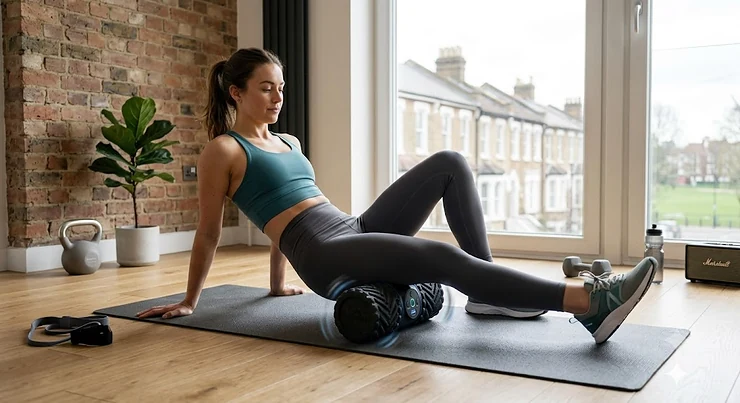
This guide walks through seven real, currently available models — from a sub-£50 starter to a £200-ish pro-grade unit — with honest analysis of what the specs actually mean in practice, not a rewrite of the Amazon listing. We’ll cover who each one suits, what reviewers consistently say once the novelty wears off, and where a plain roller might genuinely serve you just as well. So, what is a vibrating foam roller? In plain terms, it’s a battery-powered foam cylinder that pulses at adjustable frequencies (typically 1,000–3,800 vibrations per minute) to add mechanical vibration on top of standard self-massage, aiming to ease tightness with less body weight and pressure than a static roller demands.
The research on this is still catching up with the marketing, and it’s worth saying so upfront. A 2025 systematic review in the journal Healthcare notes that vibration foam rolling has become a popular recovery tool in sport and rehabilitation, while also flagging that vibration’s specific contribution is hard to separate from the pressure and friction of rolling itself. That honesty runs through this whole piece — nothing here claims a vibrating roller works miracles it can’t deliver, but plenty of real buyers do get genuine value from one, and the seven below are where that value concentrates.
Quick Comparison: Best Vibrating Foam Rollers at a Glance
Short on time? Here’s the shortlist. Full breakdowns, pros, cons, and pricing follow below.
| Category | Product | Best For |
|---|---|---|
| Best budget | PURSONIC VFR399 | First-time buyers testing the waters |
| Best all-rounder | LifePro 4-Speed Vibrating Foam Roller | Most home users wanting value |
| Best UK brand | Pulseroll VYB Pro | Battery life and next-day delivery |
| Best premium | Hyperice Vyper 3 | Serious athletes, high-intensity use |
The pattern across this shortlist is fairly consistent: spend more and you tend to get longer battery life, an app, and a sturdier motor housing, but not necessarily a “better” massage — the underlying vibration mechanics are broadly similar across price points, and it’s amplitude and build quality doing most of the differentiating, not marketing tiers. The LifePro 4-Speed Vibrating Foam Roller sits in the sweet spot where most buyers land, avoiding both the flimsiness some entry-level rollers get criticised for and the premium markup you’d pay for Bluetooth features you might barely open. Where the PURSONIC VFR399 and the Hyperice Vyper 3 genuinely earn their place is at the extremes — one for people unsure they’ll use a roller enough to justify £80-plus, the other for anyone training hard enough that a shorter battery life on a high-torque motor is a fair trade.
💬 Just one click — help others make better buying decisions too!😊
Top 7 Vibrating Foam Rollers: Expert Analysis
1. PURSONIC VFR399 — cheapest genuine entry point on this list
The PURSONIC VFR399 is where most people should start if they’ve never used a vibrating roller and aren’t sure the vibration part is worth paying for. It’s a straightforward USB-rechargeable unit that skips app connectivity, remote controls, and premium branding in favour of doing the basic job at a price that doesn’t sting if it ends up gathering dust.
Its 5 intensity levels give you a genuine spread from a gentle warm-up buzz to a firmer, knot-targeting pulse, and the motor sits inside a lightweight foam shell that keeps the whole unit easy to manoeuvre one-handed. Based on the spec sheet, this isn’t a roller built for daily heavy-duty use by a competitive athlete — the housing and internals are clearly built to a budget — but for someone rolling out tight calves two or three times a week, that’s more than sufficient.
This is a solid pick for anyone testing whether they’ll actually stick with vibrating rolling before spending three times as much, students and casual gym-goers on a tight budget, or a second roller kept at a desk for a quick break between meetings. Reviewers consistently note that the USB charging is genuinely convenient day-to-day, though several also flag that the vibration feels noticeably weaker at the top setting compared with pricier rivals — a trade-off that tracks with its position as the budget option here.
Pros:
- ✅ Lowest price point of any roller on this list
- ✅ Simple USB charging with no proprietary cable
- ✅ Five intensity levels cover light and firm use
Cons:
- ❌ Top vibration setting feels weaker than premium rivals
- ❌ No app, remote, or Bluetooth connectivity
The PURSONIC VFR399 typically sits well under £50, and at that price, it’s genuinely good value as a low-risk way to trial vibrating rolling — just don’t expect it to match the intensity of a £150+ model.
2. FITINDEX 5-Speed Vibrating Foam Roller — best for travel and targeted spots
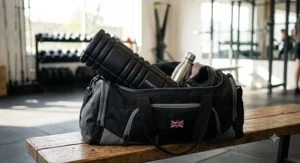
The FITINDEX 5-Speed Vibrating Foam Roller takes the budget concept and adds a genuinely useful twist: a three-density wave surface pattern instead of one uniform texture, so different parts of the roller apply slightly different pressure as you shift position. It’s also noticeably more compact than most rollers here, at around 11.4 inches long, which makes it the one most likely to actually fit in a gym bag rather than get left at home.
The 5-speed range (roughly 1,500 to 3,200 RPM) covers a sensible spread for both warm-up and cool-down use, and the USB-C charging port is a small but welcome detail — you won’t need a separate proprietary cable if you already carry one for your phone. What most buyers overlook about this model is that its shorter length trades off full-back coverage for portability; it’s built for legs, arms, and smaller muscle groups more than sweeping full-spine work.
This suits runners and cyclists who want something to throw in a kit bag for post-race calves and quads, anyone in a small flat without space for a full-length roller, or a first vibrating roller for someone who’s travelled with a standard one before and wants the same footprint with added buzz. Aggregated review sentiment describes the vibration as noticeably strong for the size and price, though a handful of users note the shorter length means two hands and some awkward repositioning are needed to cover a full thigh in one pass.
Pros:
- ✅ Compact 11.4-inch size genuinely travel-friendly
- ✅ Three-density textured surface adds variety
- ✅ USB-C charging matches most modern devices
Cons:
- ❌ Shorter length limits full-back or full-thigh coverage
- ❌ Battery life shorter than mid-range and premium rivals
Expect the FITINDEX 5-Speed Vibrating Foam Roller to sit in the £50-70 range, making it a strong value pick specifically for people who prioritise portability over raw coverage area.
3. LifePro 4-Speed Vibrating Foam Roller — best overall value for most buyers
The LifePro 4-Speed Vibrating Foam Roller is the model most home users should seriously consider first, and it earns that position through balance rather than any single standout feature. Four vibration frequencies give a clear, easily distinguishable jump between settings — unlike some 5-speed rollers where the difference between levels two and three barely registers — and the high-density foam shell holds up to regular use without the flex or creak some budget rollers develop.
Based on the spec comparison, its battery life sits comfortably ahead of the entry-level options without stretching to Pulseroll-rivalling numbers, which in practice means multiple sessions between charges for most people rather than a daily top-up routine. It ships with a drawstring carry bag as standard, a small addition that matters more than it sounds once you’re actually trying to keep gym kit organised. What the spec sheet won’t tell you, but user reports suggest, is that the vibration feels smoother and less buzzy against the skin than some rivals at a similar price, likely down to how the motor housing is dampened inside the foam.
This is the pick for anyone who wants a genuinely good vibrating roller without researching for a week first — home users building a regular recovery habit, gym-goers who want something sturdier than the cheapest options without paying premium prices, and people who’ve used a standard roller for years and are ready to upgrade. Reviewers consistently flag the price-to-performance ratio as the standout, alongside praise for the customer support LifePro offers if a unit develops a fault.
Pros:
- ✅ Four clearly distinguishable, well-spaced vibration levels
- ✅ Sturdy build that holds up to regular use
- ✅ Includes drawstring carry bag as standard
Cons:
- ❌ No Bluetooth or app-guided routines
- ❌ Bulkier to store than the more compact travel options
Pricing for the LifePro 4-Speed Vibrating Foam Roller typically lands in the £80-100 range, though it’s frequently discounted below that — worth checking the current price before assuming you’re paying full RRP.
4. TriggerPoint Grid Vibe Plus — best compact roller for deep-tissue targeting
TriggerPoint built its reputation on the original non-vibrating GRID roller, and the TriggerPoint Grid Vibe Plus carries that DNA forward: a patented multi-density surface designed to mimic a therapist’s hands, now paired with four vibration frequencies and a rechargeable, cordless build. At roughly 30cm long and a compact diameter, it’s noticeably narrower than the full-length options on this list, which concentrates pressure into a smaller contact area for more targeted work.
That compact diameter is the honest trade-off here — what most buyers overlook is that the smaller surface area means more precise pressure on specific knots, but slower coverage if you’re trying to roll out an entire hamstring in one smooth pass. High-density EVA foam construction gives it a firmer feel than the softer foam used in some budget rollers, which reviewers consistently associate with deeper, more clinical-feeling pressure rather than a gentler surface massage. Based on the spec comparison, its roughly two-hour battery life trails the Pulseroll and matches the Hyperice, positioning it firmly as a targeted-session tool rather than an all-day companion.
This is the roller for people managing a specific tight spot — a stubborn IT band, persistent calf tightness, or glute knots — rather than someone wanting broad, gentle full-body coverage. It also suits anyone who already rates the standard TriggerPoint GRID and wants the same surface pattern with vibration added, plus physio-adjacent users who prefer a firmer, more clinical feel. Aggregated review sentiment is broadly positive on effectiveness for trigger-point work specifically, with a recurring theme that first-time users initially find the four frequencies firmer than anticipated.
Pros:
- ✅ Patented multi-density GRID surface for precise pressure
- ✅ Firm EVA foam holds shape under repeated use
- ✅ Compact size ideal for targeted, not full-body, rolling
Cons:
- ❌ Shorter roller length means slower full-limb coverage
- ❌ Around two-hour battery life on the lower end for this price tier
The TriggerPoint Grid Vibe Plus generally sits in the £100-130 range, which puts it in direct competition with the Pulseroll VYB Pro — the deciding factor between the two usually comes down to whether you want targeted firmness or broader battery life and coverage.
5. Pulseroll VYB Pro — best UK brand and longest battery life
The Pulseroll VYB Pro is a UK-founded product, and that matters for more than just national pride — it typically means more straightforward returns, UK-based customer service, and consumer protection under UK law rather than navigating an overseas warranty process. Beyond the provenance, it’s also simply well specified: five modes including four standard vibration levels plus a pulse setting that alternates intensity, running from roughly 1,200 up to 3,500 RPM, controlled either on the unit itself or via a small handheld remote.
Battery life is where the VYB Pro genuinely separates itself: up to six hours of use on lower settings, dropping to around two and a half hours at maximum intensity, according to the brand’s published specifications. What most buyers overlook about that figure is how much it changes real-world habits — a six-hour runtime means you’re realistically charging it every few weeks rather than after every couple of sessions, which removes one of the most common frustrations reported with shorter-battery rivals. Its roughly 38cm length also gives noticeably more full-body coverage than the compact TriggerPoint or FITINDEX models, at a comparable price point.
This suits UK buyers who specifically want the after-sales reassurance of a domestic brand, anyone who’s been put off vibrating rollers before by constant recharging, and people wanting a genuine remote control rather than fumbling with buttons on the unit mid-massage. Reviewers consistently rate the pulse mode as a standout feature — alternating between two intensities rather than holding one constant frequency, which several describe as feeling closer to a real massage pattern than static vibration.
Pros:
- ✅ Longest battery life on this list at up to 6 hours
- ✅ UK-based brand with domestic customer support
- ✅ Remote control included for hands-free adjustment
Cons:
- ❌ Stock availability has fluctuated — worth checking before buying
- ❌ Larger and heavier than compact travel-focused rollers
Pricing for the Pulseroll VYB Pro generally sits in the £90-130 range depending on retailer and colour option (black or red), and it’s worth checking current availability directly, as UK stock levels for Pulseroll products have been known to come and go between restocks.
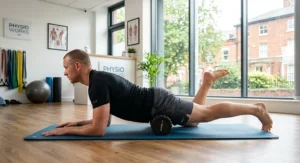
6. Therabody Wave Roller — best for app-guided recovery routines
Therabody built its name on the Theragun percussion massager, and the Therabody Wave Roller brings a similar smart-device philosophy to foam rolling: five vibration intensities controlled either on the device or through the Therabody app via Bluetooth, plus an asymmetrical wave-textured surface designed to maintain contact across curved areas like hips and the lower back that a smooth cylinder tends to skim over.
The hypo-allergenic EVA foam construction and roughly three-hour battery life put it in a similar bracket to the TriggerPoint and Hyperice on runtime, but the standout is genuinely the app integration — guided routines that talk you through a recovery session rather than leaving you to freestyle. Based on the spec comparison, this is the clearest example on this list of paying for software as much as hardware: independent reviewers have noted the roller itself performs similarly to non-connected rivals, and the premium is mostly justified by the app experience rather than a meaningfully stronger motor. That’s a legitimate value proposition for some buyers and a poor one for others, depending entirely on whether you’ll actually open the app.
This is the pick for people who respond well to structure — those who stick with habits better when an app tells them what to do next, existing Theragun or Therabody ecosystem users wanting a matching product, and anyone specifically drawn to the wave-textured surface for hip and lower-back work. Reviewers consistently praise the build quality and the app’s guided sessions, while a recurring criticism is that the roller doesn’t offer dramatically more physical benefit than cheaper alternatives once the software layer is set aside — a fair point worth weighing before paying the premium.
Pros:
- ✅ Bluetooth app with guided recovery routines
- ✅ Wave-textured surface maintains contact on curved areas
- ✅ Strong build quality and brand support network
Cons:
- ❌ Significant price premium largely reflects the app, not raw power
- ❌ Around three-hour battery trails the Pulseroll’s runtime
UK pricing for the Therabody Wave Roller varies considerably by retailer and bundle, generally sitting somewhere in the £125-180 range for the standalone roller — always worth comparing the official Therabody UK site against Amazon listings, as third-party sellers have shown notable price variation.
7. Hyperice Vyper 3 — best for high-intensity, pro-level use
The Hyperice Vyper 3 is the roller you buy once you’ve decided a gentler vibration isn’t cutting it. Hyperice built its brand partly on supplying recovery kit to professional sports teams, and the Vyper 3 reflects that: a firm, injection-moulded foam shell wrapped around a high-torque motor delivering three speeds of genuinely high-intensity vibration, paired with Bluetooth connectivity to the Hyperice app for guided sessions and progress tracking.
Three speeds might look sparse next to five-speed rivals, but based on the spec comparison and aggregated reviewer sentiment, this is a deliberate choice — each of the three levels sits at a noticeably higher amplitude than the equivalent setting on softer rollers, so Hyperice traded granularity for raw power rather than diluting the range with weaker options nobody would use. The contoured shape is specifically designed to keep pressure off the spine during back work, a genuinely useful detail that flatter rollers don’t offer. What most buyers overlook is the stated 5-hour initial charge time before first use — a longer wait than any rival here, though subsequent top-ups are quicker.
This is squarely aimed at serious athletes, people managing genuinely stubborn, dense muscle tissue that gentler rollers barely register against, and anyone who’s already outgrown a mid-range roller and wants more intensity rather than more features. Reviewers consistently describe the vibration strength as the most powerful on the market at this size, with a recurring note that newcomers to vibrating rollers often find even the lowest setting firmer than expected — worth bearing in mind if you’re coming from a standard roller with no vibration experience at all.
Pros:
- ✅ Most powerful vibration intensity of any roller here
- ✅ Contoured shell reduces pressure on the spine
- ✅ Bluetooth app with guided sessions and tracking
Cons:
- ❌ Highest price point on this list by a clear margin
- ❌ Shortest battery life relative to its premium price tag
The Hyperice Vyper 3 typically sits in the £190-210 range, making it a genuine investment — one best justified by frequent, intense use rather than the occasional post-workout roll.
Building a Home Recovery Routine With Your Vibrating Foam Roller
Buying the roller is the easy part; using it consistently is where most people fall down. A sensible starting routine is short and repeatable: two to three sessions a week, five to ten minutes each, focused on whichever muscle group took the biggest hit from your last workout, rather than trying to cover your entire body every time.
For your first few sessions, start on the lowest vibration setting regardless of which model you’ve bought — even the Hyperice Vyper 3‘s gentlest level surprises plenty of first-timers. Spend 30 to 60 seconds per muscle group rather than rushing across the whole leg in one pass; slow, deliberate movement over a tight spot does more than fast, broad strokes. A common mistake in the first month is rolling directly over a joint or bony area (knees, ankles, the spine itself) — keep the roller on muscle tissue and glide past joints without lingering.
Maintenance is minimal but not zero: wipe the foam down with a damp cloth after sweaty sessions, avoid submerging any model in water given the internal motor and battery, and store it somewhere it won’t get crushed under heavier gym bags, since the foam can develop permanent dents if compressed for long periods. Most rollers on this list, including the LifePro 4-Speed Vibrating Foam Roller and Pulseroll VYB Pro, recommend a full charge before first use even if the battery indicator shows partial charge out of the box — skipping this is a common reason early sessions feel weaker than expected.
Who Actually Needs an Electric Vibrating Roller for Muscle Recovery? Real-World Scenarios
The Tuesday-and-Thursday gym-goer. If you train a couple of times a week and mostly deal with general tightness rather than acute pain, an electric vibrating roller for muscle recovery like the LifePro 4-Speed Vibrating Foam Roller or FITINDEX 5-Speed Vibrating Foam Roller covers you well. You don’t need six-hour battery life for twice-weekly use, and the lower price point matches a lower-frequency habit.
The half-marathon-training runner. Someone logging 20-plus miles a week, with recurring calf and IT band tightness, benefits more from a roller with genuine coverage and stronger vibration — the Pulseroll VYB Pro‘s length and battery life suit this pattern well, since sessions may happen most days during peak training blocks and a roller that needs charging every other day becomes a genuine annoyance.
The desk-bound office worker with lower back tension. If your main issue is stiffness from sitting rather than post-workout soreness, the Therabody Wave Roller‘s wave-textured surface and guided app routines are built precisely for this — shorter, structured sessions targeting the lower back and hips, with the app prompting consistency that willpower alone often doesn’t deliver.
Your Vibrating Foam Roller Buying Decision Framework
If budget is your main constraint and you’re unsure you’ll stick with rolling, choose the PURSONIC VFR399 because the low entry cost removes the risk of an expensive habit that doesn’t take.
If you want one roller that does most things well without research fatigue, choose the LifePro 4-Speed Vibrating Foam Roller because it balances build quality, battery life, and price better than anything cheaper or more expensive on this list.
If you train intensely enough that gentle vibration doesn’t register, choose the Hyperice Vyper 3 because its three settings are tuned for amplitude over range, and softer rollers may simply underdeliver for dense, well-conditioned muscle tissue.
If structure and reminders matter more to your consistency than raw power, choose the Therabody Wave Roller because the app-guided routines address adherence, which is arguably the bigger barrier to recovery than roller strength for most people.
How to Choose a Rechargeable Foam Roller
Picking a rechargeable foam roller comes down to seven practical criteria, roughly in order of importance for most buyers:
- Battery life versus your session frequency. A two-hour battery is fine for occasional use but frustrating if you’re rolling daily — match runtime to how often you’ll actually reach for it.
- Vibration range and intensity. More speed settings aren’t automatically better; check whether the top setting is strong enough for your muscle density, not just how many levels exist.
- Length and coverage. Full-length rollers (30cm-plus) suit broad muscle groups like hamstrings and backs; compact rollers suit targeted spot work.
- Charging method. USB-C is increasingly standard and convenient; older micro-USB or proprietary cables are worth checking before buying, especially if you travel.
- Build material and firmness. EVA foam tends to hold shape and firmness longer than softer foam blends, particularly under regular use.
- App or remote functionality. Genuinely useful for some buyers, entirely unnecessary for others — be honest about whether you’ll use it before paying the premium.
- Brand support and warranty. UK-based brands like Pulseroll generally offer more straightforward returns than importing a warranty claim from overseas.
Working through these in order, most buyers can eliminate at least half the seven models above before comparing price at all — which tends to produce a better decision than starting with budget and working backwards.
Common Mistakes When Buying a Vibrating Foam Roller
The most frequent mistake is buying based on the highest number of speed settings advertised, rather than checking whether the top setting is actually strong enough — as the comparison table above shows, the three-speed Hyperice Vyper 3 outperforms several five-speed rivals on raw intensity.
A second common error is ignoring battery life until after purchase. Reviewers consistently flag a roller that needs recharging after every single session as a major annoyance, yet this detail is easy to overlook when comparing rollers primarily on price and speed count.
Buyers also frequently assume a vibrating roller will replace, rather than supplement, other recovery habits. A 2019 meta-analysis published in Frontiers in Physiology found that foam rolling’s effects on performance and recovery are generally modest, useful in some cases but not a substitute for adequate sleep, hydration, and gradual training progression. Treating any roller, vibrating or not, as a cure-all rather than one tool among several sets buyers up for disappointment.
Finally, people often overlook return policies on electrical fitness equipment specifically — some retailers apply different rules to opened electronics than to standard gym gear, so it’s worth checking before assuming a 30-day trial period applies unconditionally.
Vibrating Roller vs Standard Roller: Which Actually Works Better?
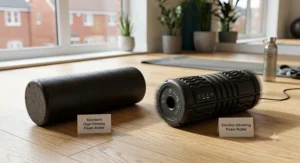
This is the question that decides half the purchases on this list, and the honest answer is: it depends what problem you’re solving. A standard, non-vibrating roller relies entirely on your body weight and movement to apply pressure — cheaper, simpler, and with decades of use behind it in physiotherapy and sports settings, but more physically demanding to use effectively, especially for anyone with limited strength or mobility in the areas they’re targeting.
A vibrating roller adds mechanical pulsation on top of that same pressure mechanism, which several reviewers describe as making it easier to relax into a tight spot rather than tensing against discomfort. The evidence base leans cautiously positive but not conclusively so: a 2022 systematic review and meta-analysis in Sports Medicine – Open concluded that vibration foam rolling shows potential for improving jump performance, agility, and recovery, while also noting the underlying physiological mechanism remains unclear and further research is needed to confirm the effect size.
In practical terms, a vibrating roller vs standard roller decision often comes down to comfort and adherence rather than pure physiological superiority. If a standard roller feels too intense to use consistently, or if you simply won’t bother without some added incentive to pick it up, the vibration genuinely helps — not because the physics are dramatically different, but because you’re more likely to actually use it. If you already roll consistently and effectively with a plain roller, the upgrade is a comfort and convenience purchase rather than a necessity.
Percussion vs Vibration Recovery: What’s the Real Difference?
It’s easy to lump percussion massage guns and vibrating foam rollers together as “buzzy recovery gadgets,” but the mechanisms differ meaningfully. A percussion device (like a Theragun) delivers rapid, deep, single-point strikes into a small area of muscle, generally at a higher force but lower frequency spread than roller vibration. A vibrating foam roller spreads a gentler, broader vibration across a wider surface area while you roll, combining it with the sustained pressure and gliding motion of traditional foam rolling.
In practice, this makes them better suited to different jobs. Percussion tools excel at pinpointing a specific, small knot — a tight spot in the upper trap, for instance — with intense, localised pressure over a short burst. Vibrating rollers suit broader muscle groups where you want sustained pressure across a larger area, like full-length hamstrings or the entire lower back, alongside the stretching and gliding motion percussion tools don’t replicate.
Neither replaces the other completely, and plenty of serious athletes own both, reaching for percussion for targeted problem spots and a vibrating roller for broader pre- or post-session prep. If you’re choosing between the two rather than budgeting for both, consider which describes your typical soreness more often: isolated knots point toward percussion, while general tightness across larger muscle groups points toward a roller.
Electric Vibrating Roller for Muscle Recovery: Matching the Roller to the User
Beginners to foam rolling of any kind generally do best starting with a lower vibration intensity and a full-length roller that’s forgiving of imperfect technique — the PURSONIC VFR399 or LifePro 4-Speed Vibrating Foam Roller both fit this brief without overwhelming a first-timer.
Intermediate gym-goers who’ve used a standard roller before and want to add vibration without a big financial leap tend to get the most out of mid-range options like the TriggerPoint Grid Vibe Plus or Pulseroll VYB Pro, where the step up in intensity and features is noticeable without demanding pro-level spending.
Advanced athletes and anyone managing genuinely dense, well-conditioned muscle tissue often find gentler rollers simply don’t register, which is precisely the gap the Hyperice Vyper 3 is built to fill — reviewers consistently note that lower-intensity rollers “feel like nothing” once training volume reaches a certain point.
Older adults or anyone with joint sensitivity should generally favour lower vibration settings regardless of which roller they choose, and may benefit from the more contoured, spine-conscious shell design found on the Hyperice Vyper 3, even if they don’t need its maximum intensity — it’s the shape, not just the power, that matters for comfort here.
Safety, Charging & UK Regulations for Vibrating Foam Rollers
Every roller on this list runs on a rechargeable lithium-ion battery, which means a handful of sensible precautions apply regardless of brand. Avoid leaving any unit on charge unattended overnight on a regular basis, don’t submerge the roller in water for cleaning (a damp cloth is sufficient), and stop use immediately if you notice the casing becoming unusually hot, swelling, or emitting an odd smell — all standard advice for any lithium-battery consumer device, not specific to any single manufacturer here.
When it’s time to dispose of a roller that’s reached the end of its life, it shouldn’t go in general household rubbish. As a battery-powered electrical item, it falls under the UK’s Waste Electrical and Electronic Equipment regulations, and Material Focus’s electrical recycling guidance confirms that anything with a plug, battery, or cable — foam rollers included — should be taken to a designated recycling point rather than binned, both to prevent fire risk from damaged batteries and to recover the materials inside.
On the injury side, it’s worth remembering that a vibrating foam roller is a recovery and comfort tool, not a treatment for acute injury, sharp pain, or swelling. Continued or worsening pain after use warrants a chat with a GP or physiotherapist rather than more intense rolling — general tightness and delayed-onset soreness are the appropriate use case, not anything that feels like an actual injury.
Frequently Asked Questions
❓ Is a vibrating foam roller worth it over a standard one?
❓ How often should I use a vibrating foam roller?
❓ Can a vibrating foam roller help with back pain?
❓ What's the difference between a vibrating foam roller and a massage gun?
❓ How long do vibrating foam rollers last on a single charge?
Conclusion
Across seven genuinely different rollers, the honest takeaway is that no single model wins outright — the right choice depends heavily on how often you’ll use it, how intensely you train, and whether app-guided structure actually changes your habits or just sits unused on your phone. For most people reading this without a specific reason to go premium, the LifePro 4-Speed Vibrating Foam Roller remains the most defensible all-round buy: sturdy, sensibly priced, and free of features you’d never touch.
If you’re still unsure, the safest starting point is the cheapest one that still has genuinely good reviews — the PURSONIC VFR399 does that job without asking you to commit £150-plus to a habit you haven’t built yet. And if you’re already convinced vibration helps and you train hard enough to feel the difference, the Hyperice Vyper 3 and Pulseroll VYB Pro represent the two strongest arguments at the premium end, for slightly different reasons: raw intensity versus battery life and UK support.
Whichever you land on, remember the research is genuinely mixed on how much vibration itself adds beyond standard rolling — so buy for the version of recovery you’ll actually stick with, not the one with the most impressive spec sheet.
Recommended for You
- High Density Foam Roller: 7 Best Picks for Athletes (2026)
- Compact Foot Massager: 7 Brilliant Picks for UK Homes (2026)
- Under-Desk Foot Massager: 7 Quiet Picks for WFH (2026)
Disclaimer: This article contains affiliate links. As an Amazon Associate, I earn from qualifying purchases. If you purchase products through these links, we may earn a small commission at no additional cost to you.
✨ Found this helpful? Share it with your friends! 💬🤗
