In This Article
Picture the scene. It’s Monday, your quads feel like wet cement after Sunday’s long run, and someone online is swearing by a cupping set for muscle recovery that costs less than a single sports massage. Tempting? Absolutely. Straightforward? Not quite.

Here’s the honest picture for 2026. A home cupping therapy kit uses suction to lift skin and the soft tissue beneath it. Plenty of gym-goers, runners and therapists like the way it feels. The research, though, is still thin: reviews of trials in sporting populations stop short of a firm recommendation either way. So this guide treats a cupping set for muscle recovery as what it realistically is, a low-cost, low-tech self-care tool that some people enjoy, rather than a miracle fix.
Below you’ll find seven real sets compared on what actually matters: cup material, pump design, cup sizes and how well they cope with knobbly joints. You’ll also get straight talk about cupping marks, a safety checklist for UK buyers, and a practical routine so your first month isn’t wasted. We’ll cover how the technique connects to myofascial decompression, what it means for athletes, and where it sits among the ancient recovery techniques people keep rediscovering.
One note on money: prices wobble constantly, so you’ll see ranges rather than exact figures. Always check the current price before you buy.
Quick Comparison: 7 Picks for a Cupping Set for Muscle Recovery
Here’s the whole field at a glance before we dig into the detail. Price bands are indicative, based on UK retailer listings for comparable sets at the time of research, and they may vary.
| Product | Cups & Material | Method | Indicative Price | Best For |
|---|---|---|---|---|
| KS Premium 19-Cup Set | 19 plastic | Hand pump + extension tube | £30-£50 | Best all-rounder |
| Hansol HS-CV-17 | 17 plastic | Pump handle + case | £40-£55 | Proven classic |
| AIKOTOO 12-Cup Kit | 12 plastic (2 curved) | Hand pump + extension tube | £20-£30 | Tight budgets |
| Lure Essentials 4-Cup Set | 4 silicone | Squeeze, no pump | £15-£30 | First-timers |
| ELERA 7-Cup Set | 7 silicone | Squeeze, no pump | £15-£25 | Gentle sessions |
| Myofascial Releaser 18-Cup Pro Set | 18 plastic + magnets | Two hand pumps | £25-£40 | Value seekers |
| Hansol Professional 30-Cup Set | 30 plastic | Pump handle + extension tube | £60-£90 | Shared or clinic use |
Reading across the table, the KS Premium 19-Cup Set and Hansol HS-CV-17 offer the broadest cup ranges for the money, which matters if you want to treat back, thighs and calves in one session. If you’re nervous about suction, the two silicone options, Lure Essentials 4-Cup Set and ELERA 7-Cup Set, let you control pressure with your fingers instead of a pump. Budget buyers should note that the AIKOTOO 12-Cup Kit is the only low-cost pick with curved cups designed for knees and elbows.
💬 Just one click — help others make better buying decisions too!😊
What Is a Cupping Set for Muscle Recovery?
A cupping set for muscle recovery is a kit of suction cups, usually plastic or silicone, that you place on the skin over tight or tired muscle. The vacuum gently lifts skin and the tissue beneath it. People use it after training or long desk days to ease stiffness, either leaving cups in place or gliding them over oiled skin.
That’s the modern, fire-free version. Traditional fire cupping heats a glass cup to create the vacuum, which carries a burn risk and isn’t something to attempt at home. Today’s home cupping therapy kit swaps flame for a hand pump or a squeezable silicone body. A peer-reviewed overview of cupping from a modern medicine perspective notes that the practice appears in the Ebers Papyrus from around 1550 BC and features in Chinese, Unani, Korean and Tibetan traditions.
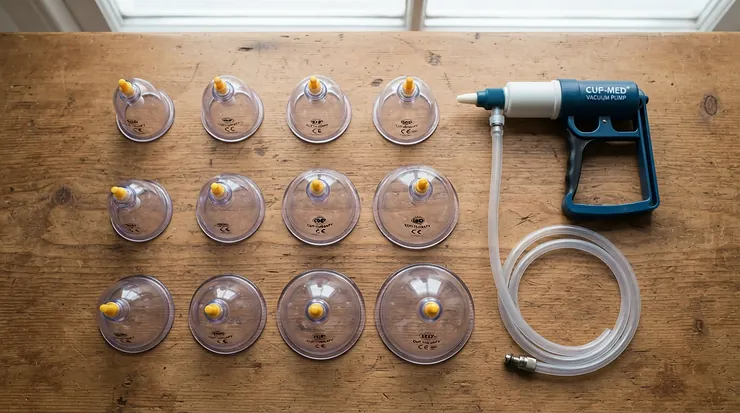
Three main formats exist for home buyers:
- Pump-action plastic cups: a hand pump removes air, so you dial in the suction yourself.
- Squeeze-to-use silicone cups: flexible cups you pinch and press on, with no pump needed.
- Electric or heated devices: battery-powered units with adjustable suction, which cost more.
Each suits a different temperament. Pump sets reward patience and precision, silicone sets reward spontaneity, and electric devices reward people who like gadgets. The seven picks below cover the first two formats, because they’re where the best value currently sits.
Top 7 Cupping Sets for Muscle Recovery: Expert Analysis
Before the picks, a reality check on what you’re buying. A systematic review by Mohamed and colleagues rated the evidence for cupping in musculoskeletal and sports rehabilitation as moderate for improving soft-tissue flexibility, low to moderate for low back and neck pain, and very low to low for other conditions. So treat these sets as comfort-and-mobility tools, not treatments, and pick the one that fits how you’ll genuinely use it.
1. KS Premium 19-Cup Set — best all-round pump set
The headline here is range. You get 19 plastic cups across five diameters: thirteen at 2 inches, one at 1.8, two at 1.6, two at 1.3 and one at 1.1 inches. That’s paired with a hand pump, an extension tube and a carry case.
In practice, the thirteen large cups cover big muscle bellies like glutes, hamstrings and the long muscles beside your spine. The tiny 1.1 and 1.3 inch cups fit around the neck, shoulders and forearms. The extension tube is the unsung hero, because it lets you apply cups to your own lower back without contorting yourself into a pretzel. Roundups also note the cups can be boiled, which makes cleaning simple.
Based on the spec comparison, this is the sensible default for anyone who wants one kit to handle a whole body’s worth of tension. Reviewers consistently praise the variety and the sturdy case, and one roundup credits it with more than 14,000 reviews on its main listing. Those counts come from listings outside the UK, so UK feedback may differ.
Pros:
- ✅ Widest practical cup range in this price band
- ✅ Extension tube enables self-application on the back
- ✅ Boil-safe cups make hygiene easy
Cons:
- ❌ Rigid cups seal poorly on bony joints
- ❌ Manual pump takes practice for even suction
Expect to pay roughly £30-£50. For a first full kit, it’s strong value.

2. Hansol HS-CV-17 — the long-running Korean classic
Hansol has been selling pump sets for years, and the HS-CV-17 is the one many home users meet first. It contains 17 plastic cups, made in South Korea: thirteen at 5 cm, then single cups at 4.5, 4, 3.5 and 3 cm. A pump handle and carry case complete the kit.
The size spread tells you the intent. Thirteen big cups make this a back-and-legs workhorse, while the four small ones handle tight spots. What the spec sheet won’t tell you, but buyers note, is that the small-cup selection is modest. One long-term owner wished for more small cups for working behind the neck, and others mention cups occasionally popping off awkward areas like the shoulder blade.
Review sentiment is warm. The listing mirrored by international resellers shows roughly 4.6 out of 5 across around 3,500 ratings, with themes of strong suction and sensible sizing. Several buyers say the suction is intense enough to leave marks lingering about a week, so start gently. This suits you if you’ve cupped before, or had it done by a therapist, and want to replicate it at home.
Pros:
- ✅ Strong, controllable suction from the pump
- ✅ Sensible size range for a 17-cup kit
- ✅ Long track record among home users
Cons:
- ❌ Few small cups for neck work
- ❌ Cups can loosen on awkward areas
UK specialist retailers list comparable sets in the £40-£55 range, though Amazon pricing may differ. Good value if you want a proven name.
3. AIKOTOO 12-Cup Kit — budget pick with curved joint cups
The standout is two curved cups designed to hug knees, elbows and shoulders, the places flat cups fail to seal. The set has 12 plastic cups in six sizes, a hand pump and an extension tube, with the cups marketed as anti-crack and drop-resistant.
Why does that matter? Cheap plastic cups crack when dropped on a bathroom floor, and flat rims leak air on curved joints. This kit tackles both problems directly. Roundup reviewers say it delivers solid suction at a fraction of the cost of premium sets, and the curved cups are described as a thoughtful inclusion rather than a gimmick.
Be realistic about the trade-offs. Twelve cups means you can’t blanket both legs at once, and a plastic ABS pump won’t feel as robust as pricier handles. For most people treating one area at a time, that’s no hardship. It’s an ideal first kit for a student or a casual gym-goer who wants to test whether cupping suits them before spending properly.
Pros:
- ✅ Two curved cups seal on joints
- ✅ Drop-resistant cups suit clumsy handling
- ✅ Very low cost of entry
Cons:
- ❌ Only 12 cups limits multi-area sessions
- ❌ Plastic pump feels less premium
Expect roughly £20-£30. A low-risk way to find out whether you like cupping.
4. Lure Essentials 4-Cup Set — easiest option for first-timers
The hook is simplicity: squeeze the silicone cup, press it onto oiled skin, release. No pump, no tubes, no learning curve. The cups use BPA-free silicone, and the brand says it has sold over a million units.
Because you control suction with your fingers, it’s naturally forgiving. Squeeze less for a light pull, more for a firmer one. That makes it brilliant for gliding techniques over calves and forearms, though it won’t hold the same fierce static grip as a pump cup. One roundup credits it with over 12,000 reviews and roughly a 4.4-star average.
Reviewers consistently describe the cups as durable, easy to clean and good with massage oils. A common caveat is that they’re best for moving cupping and less impressive for long static holds. With only four cups, it’s a targeted tool rather than a full-body system, which suits someone treating a single sore calf or shoulder after training.
Pros:
- ✅ No pump needed, ready in seconds
- ✅ Durable silicone that cleans easily
- ✅ Great for gliding over oiled skin
Cons:
- ❌ Weaker static suction than pump cups
- ❌ Only four cups in the pack
Expect roughly £15-£30. The friendliest on-ramp to cupping.
5. ELERA 7-Cup Set — gentle, professional-style silicone
The standout is a seven-cup silicone range sold as medical-grade silicone, giving more size choice than the four-cup rivals without needing a pump. For small households, it’s a comfortable midpoint.
On paper, that extra size variety lets you use bigger cups on thighs and smaller ones on forearms or around the ankle. A roundup flags the main compromise: suction is gentler than some other silicone cups. Is that a flaw? Not necessarily. Gentle pull is exactly what some people want, particularly those with sensitive skin or anyone who bruises easily and worries about cupping marks.
So the honest read is that this suits cautious beginners and anyone prioritising comfort over intensity. If you crave the deep, pulling sensation of a pump set, you’ll likely find it underwhelming. Review data specific to UK buyers is limited, so check recent customer feedback on the listing before ordering.
Pros:
- ✅ Seven silicone cups in multiple sizes
- ✅ Soft, flexible, easy to handle
- ✅ Gentle on sensitive skin
Cons:
- ❌ Lighter suction than some silicone rivals
- ❌ Limited UK-specific review evidence
Expect roughly £15-£25. A comfortable choice if you favour a lighter touch.
6. Myofascial Releaser 18-Cup Pro Set — value kit with two pumps
Eighteen cups, two hand pumps and a set of magnets: it’s a big box for modest money, and one roundup tags it “best value”.
The second pump is the practical bonus. If one fails, or you’re working with a partner, you have a spare. The magnets are the part to treat with scepticism. Magnetic inserts are marketed as an acupressure add-on, but the sporting-recovery evidence discussed in this guide concerns suction itself, not magnets, so consider them optional extras rather than a selling point.
Here’s what to weigh: you’re buying quantity at a keen price, with less of the brand reputation behind Hansol HS-CV-17 or KS Premium 19-Cup Set. If you ignore the magnet marketing and focus on cup count and pumps, it’s a sensible value purchase for a household of two. Check the latest reviews for cup consistency before committing.
Pros:
- ✅ Two pumps give you a spare
- ✅ 18 cups for a modest outlay
- ✅ Good for two people sharing
Cons:
- ❌ Magnet claims lack strong evidence
- ❌ Smaller brand track record
Expect roughly £25-£40. Good value if you skip the magnet hype.
7. Hansol Professional 30-Cup Set — premium full-clinic kit
Thirty cups, a pumping handle, an extension tube and an English manual make this the most comprehensive set here, again made in South Korea.
Do you need 30 cups? Honestly, probably not for solo home use. It makes sense for a shared household, a small sports club physio room or a hobbyist who loves experimenting with multi-cup layouts. Roundup reviewers do flag one gap: it lacks curved-lip cups for joints, a weakness against the budget AIKOTOO 12-Cup Kit.
Think of it as buying a full toolbox when most jobs need three spanners. The depth is genuinely handy if several people train in your home, but for one person, a mid-priced set delivers about the same practical benefit. Where it earns its keep is durability and a recognised maker’s name.
Pros:
- ✅ 30 cups cover every sizing need
- ✅ Extension tube and manual included
- ✅ Recognised, long-established maker
Cons:
- ❌ Priciest plastic set in this round-up
- ❌ No curved cups for joints
Expect roughly £60-£90. Worth it only if several people will share it.
How to Choose a Cupping Set for Muscle Recovery
Not sure which one fits? Work through these six checks in order.
- Decide your format first. Pump sets give precise suction, while silicone sets give simplicity. Choosing the format narrows everything else.
- Count the cups you’ll actually use. Most people use 4-6 cups per session, so 17+ cups is a convenience, not a necessity.
- Check for small and curved cups. Necks, knees and elbows need small or curved rims, otherwise the seal fails.
- Look for an extension tube. If you’ll treat your own back, this is the difference between usable and frustrating.
- Judge the material. Boil-safe plastic and silicone both clean easily, but cheap brittle plastic cracks.
- Be honest about your skin and health. If you bruise easily or take blood thinners, speak to your GP or pharmacist first (see the safety section).

How to Use a Home Cupping Therapy Kit Safely
A good home cupping therapy kit is only half the equation. Technique matters.
Setup. Wash the cups, check your skin is intact, and apply a thin layer of massage oil if you plan to glide.
First sessions. Choose a fleshy muscle belly, never bone, joints or the front of the neck. Pump once or twice for a light pull. The skin should lift gently, never pinch painfully. Most practitioner guidance keeps stationary cups on for short periods, so follow your set’s leaflet and err on the shorter side initially.
Release properly. Use the valve or press beside the cup rim to break the seal. Never yank a cup off.
Aftercare. Wipe cups with warm soapy water and let them dry. Many practitioners suggest avoiding alcohol and intense training on the treated area for the rest of the day.
Common first-month mistakes:
- Pumping far too hard, then wondering why the marks look dramatic
- Working over the same spot daily without letting skin recover
- Cupping over tattoos, broken skin, sunburn or varicose veins
- Skipping hygiene between sessions
Start low, go slow, and treat each cup as a trial rather than a test of endurance.
Cupping Marks: What They Are and How Long They Last
Let’s talk about the round, purple elephant in the room. Cupping marks are the circular discolourations that often follow a session, and they alarm first-timers. They’re not identical to bruises from impact: suction draws blood towards the surface and tiny capillaries leak into surrounding tissue.
How long do cupping marks last? Practitioner sources generally say a few days up to about two weeks, with one consent form noting that rare cases can run to around three weeks. Colour usually moves from red or purple towards yellow as they fade, much like a bruise.
Here’s a myth worth busting: darker cupping marks don’t mean the session worked better. They simply show more blood was drawn to the surface. A gentler pull often means fainter marks, which is why silicone sets like the Lure Essentials 4-Cup Set and ELERA 7-Cup Set suit people who dislike visible evidence.
To help marks settle:
- Avoid very hot baths or saunas immediately afterwards
- Skip alcohol for 24 hours
- Don’t scratch or pick at itchy skin
- Seek medical advice for blisters, severe pain or marks that don’t fade
Public attention to cupping marks surged after swimmer Michael Phelps appeared with them at the 2016 Olympics, which is partly why home kits boomed. If you have an event, wedding or beach holiday coming, schedule cupping well in advance.
Cupping Set for Athletes: What the Evidence Says
Elite swimmers made cupping famous, so is a cupping set for athletes actually worth it? Honestly, the evidence is unsettled.
A systematic review of randomised trials found eleven trials involving 498 athletes, including footballers, handball players, swimmers, gymnasts and track athletes. Cupping was reported as beneficial for perceived pain and disability, range of motion and reductions in creatine kinase, mostly compared with untreated groups. However, the authors reported a high risk of bias and concluded that no explicit recommendation for or against cupping in athletes could be made.
So what does that mean for you? Reading between the lines, cupping looks plausible as a comfort-and-mobility add-on, but it shouldn’t replace the unglamorous basics: sleep, protein, hydration, progressive loading and rest days. Think of a cupping set for athletes as a seasoning, not the meal.
Practical advice for athletes: use it on non-competition days, avoid cupping immediately before a race or heavy session while you learn how your skin and muscles respond, and keep a note of how you feel at 24 and 48 hours. If it doesn’t help your recovery after a few weeks, you’ve lost very little money.
Myofascial Decompression: How It Relates to Cupping
You’ll hear physios and coaches say myofascial decompression, so what is it? In sports rehab, the term usually describes using suction to lift skin, fascia and underlying soft tissue, sometimes while the person moves the limb. The idea is that creating space and tension changes in the tissue may ease stiffness and improve movement.
Does that make a cupping set a decompression device? Loosely, yes. The same cups used for stationary or gliding cupping are used for myofascial decompression, with the “decompression” label referring to the clinical intent rather than special equipment. That’s worth knowing because it means you don’t need a separate gadget.
What should you expect? Cupping with movement, such as slowly flexing a calf while a cup sits on it, can feel like deep release. Pump sets like the KS Premium 19-Cup Set suit this stationary-with-movement style, while silicone cups like the Lure Essentials 4-Cup Set suit gliding.
A word of caution: myofascial decompression is best learned from a qualified professional. The mechanisms are still debated, and the research on outcomes is limited, so be wary of anyone promising dramatic results or claiming to “break up” fascia.
Cupping Set for Sore Muscles: What to Expect in Real Life
You’ve done a brutal leg session and now stairs are the enemy. Will a cupping set for sore muscles fix delayed-onset soreness? Probably not in a single go, but here’s the realistic experience.
During a session, expect a firm pulling or tightness, sometimes warmth. It shouldn’t hurt sharply. Afterwards, some people feel looser and others feel nothing in particular. Because the evidence base is mixed, your response is individual.
A sensible approach for a cupping set for sore muscles:
- Wait for the worst of soreness to pass, or use light suction only on very tender areas.
- Target the muscle belly, like quads or calves, rather than the sore tendon or joint.
- Combine with movement: gentle mobility after cupping helps you judge any change in range.
- Reassess at 24 hours, and stop if sensitivity increases.
If soreness is sharp, swollen, one-sided in the calf or accompanied by dark urine, don’t cup. Get medical advice instead. Persistent or severe pain deserves professional assessment, not a suction cup.
Real-World Scenarios: Which Kit Suits Which Buyer?
Matching the kit to your life is where the real value sits. Here are three profiles.
The weekend runner on a tight budget. She trains four times a week and mainly gets tight calves and hips. A £20-£30 outlay makes sense, so the AIKOTOO 12-Cup Kit gives her curved cups for knees and enough cups for single-area sessions.
The gym lifter with a desk job. He wants to ease upper-back and shoulder tension after long days and lifts. The KS Premium 19-Cup Set with its extension tube lets him treat his own back, and the small cups handle the neck and shoulder line.
The cautious beginner with sensitive skin. She bruises easily and wants gentle exploration. The ELERA 7-Cup Set or Lure Essentials 4-Cup Set lets her control suction by hand and glide over oiled skin.
For a couple or shared household, the Myofascial Releaser 18-Cup Pro Set with two pumps is the practical choice, while a physio room or club might justify the Hansol Professional 30-Cup Set.
✨ Ready to build your recovery routine?
🔍 Choose the kit that matches your budget, skin and training habits, then click any highlighted product to check current pricing and availability. A well-chosen set can make your post-workout wind-down something you’ll genuinely look forward to!

Ancient Recovery Techniques: Where Cupping Fits
Cupping belongs to a crowded family of ancient recovery techniques, from hot-stone massage and gua sha to Roman bathing and Ayurvedic oil work. Its roots stretch deep. The Ebers Papyrus mentions it around 1550 BC, Hippocrates described applications, and Chinese, Unani and Korean traditions all kept it alive.
Yet a healthy dose of scepticism helps. One sceptical history points out that cupping seems to have evolved independently in several places and that “ancient” isn’t the same as “proven”. It’s a fair point. Long use shows a technique was popular, not that it works for the reasons claimed.
So how should a modern buyer treat ancient recovery techniques? Respect the tradition, test the practice against your own experience, and stay realistic about the evidence. Cupping can sit comfortably alongside more conventional recovery: a warm shower, mobility work, a foam roller, proper sleep.
There’s also something to be said for ritual. Setting aside ten quiet minutes to wind down after training probably helps you relax regardless of the suction. That’s not a trivial benefit, but it’s worth being honest about.
Cupping Set vs Foam Roller, Massage Gun and Sports Massage
How does a cupping set compare with the alternatives you’re probably also considering? Costs below are rough UK ballparks at the time of research.
| Option | Typical Cost | Sensation | Learning Curve | Best For |
|---|---|---|---|---|
| Cupping set (e.g. AIKOTOO 12-Cup Kit) | £20-£90 one-off | Pulling, lifting | Moderate | Low-cost experimenters |
| Foam roller | £10-£30 one-off | Compressive pressure | Low | Daily general rolling |
| Massage gun | £40-£150 one-off | Percussive | Low | Quick warm-ups |
| Sports massage | £40-£70 per session | Hands-on pressure | None | Persistent problem areas |
Looking at the table, a foam roller and a cupping set work in opposite ways: one presses in, the other pulls up. That’s why some people like having both. A massage gun is faster but louder and costs more, while sports massage remains the best option when something feels genuinely wrong, since a trained therapist can assess you. For anyone curious but cost-conscious, KS Premium 19-Cup Set or Hansol HS-CV-17 deliver the widest versatility, while the silicone options suit a lighter approach.
Common Mistakes When Buying a Cupping Set
After reading dozens of buyer comments across listings, the same errors repeat.
Buying by cup count alone. Thirty cups sounds impressive, yet most sessions use a handful. Spend on quality and the right sizes instead.
Ignoring joint cups. If you plan to treat knees, elbows or shoulders, check for curved rims. The Hansol Professional 30-Cup Set is large but lacks them, which catches people out.
Trusting magnet claims. Magnetic inserts are an add-on. They shouldn’t drive your decision.
Forgetting aftercare. Poor cleaning and rushed removal cause more trouble than weak suction.
Expecting miracles. The best-supported claims relate to flexibility and comfort. Anyone promising to “detox” you or cure conditions should be treated warily.
Buying a fire cupping set. Glass cups with flame carry burn risks and are best left to trained practitioners.
A final tip: read recent reviews for failures, such as cups cracking or valves leaking. A single bad batch can sour an otherwise good set.
Safety, Regulations and Who Should Avoid Cupping
Safety first. Even a gentle home cupping therapy kit isn’t suitable for everyone.
Practitioner sources commonly advise avoiding cupping, or speaking to a doctor first, if you:
- Take blood thinners such as warfarin or aspirin
- Have a bleeding disorder
- Are pregnant
- Have eczema, psoriasis, open wounds or skin infections
- Have a pacemaker, other implant or cardiovascular disease
- Are undergoing cancer treatment
If any of those apply, speak to your GP or pharmacist before buying. You can also call NHS 111 for non-emergency advice. If you’d rather have a professional apply cups, look for a therapist registered with a recognised UK body such as the Complementary and Natural Healthcare Council.
On regulation, many cupping sets are sold as massage accessories rather than clinically validated medical devices, so don’t assume a marketing claim has been independently tested. Where a listing mentions CE or UKCA marking, check that the packaging backs it up. An umbrella review of cupping for musculoskeletal pain found that insufficient data and methodological flaws prevent a definitive recommendation, a useful reminder to stay cautious.
Stop immediately if you feel faint, experience sharp pain or notice blistering.
Long-Term Cost and Value Analysis
What does a set really cost per use? Assume two sessions a week for a year, about 104 sessions, and spread the purchase price across them.
| Tier | Example | Indicative Price | Approx. Cost Per Session | Best For |
|---|---|---|---|---|
| Budget | AIKOTOO 12-Cup Kit, ELERA 7-Cup Set | £15-£30 | About 15-30p | Testing the waters |
| Mid-range | KS Premium 19-Cup Set, Hansol HS-CV-17 | £30-£55 | About 30-55p | Regular home users |
| Premium | Hansol Professional 30-Cup Set | £60-£90 | About 60-90p | Shared or clinic use |
Set against a sports massage at roughly £40-£70 per visit, even the premium kit pays for itself quickly, though of course it isn’t a like-for-like substitute for professional assessment. If you use a set only occasionally, a budget option makes more sense. Frequent users benefit from sturdier pumps and wider cup ranges.
Running costs are small: massage oil, a little soapy water, and occasionally replacement cups. The real hidden cost is time, so be honest about whether you’ll build the habit.

FAQ
❓ Can I use a cupping set on my own back?
❓ How often can I use a home cupping therapy kit?
❓ Are silicone or plastic cups better for beginners?
❓ Can I train or swim after using a cupping set?
❓ Is a cupping set worth buying in the UK?
Conclusion
So, where does this leave you? A cupping set for muscle recovery is an inexpensive, low-tech tool with a long history and a modest evidence base. It may help some people feel looser, and it won’t harm most healthy adults when used sensibly, but it isn’t a substitute for sleep, good training or professional care.
For most readers, the KS Premium 19-Cup Set is the best all-rounder, thanks to its cup range and extension tube. The Hansol HS-CV-17 is the proven classic, and the AIKOTOO 12-Cup Kit is the smart budget entry with curved joint cups. If you want zero fuss, the Lure Essentials 4-Cup Set is the friendliest start, with the ELERA 7-Cup Set a gentler alternative. Households or clubs might consider the Myofascial Releaser 18-Cup Pro Set or the Hansol Professional 30-Cup Set.
Whatever you pick, start gently, respect cupping marks as a sign to slow down, check the safety list and judge the results honestly after a few weeks. That’s the grown-up way to use ancient recovery techniques in a modern routine.
✨ Don’t Miss These Carefully Selected Picks!
🔍 Take your recovery routine to the next level. Click any highlighted product to check current pricing and availability, and find the set that fits your training, your skin and your budget. Your tired muscles will thank you! 💪
Recommended for You
- Percussion Massage Gun: 7 Proven Best Picks For UK (2026)
- Stainless Steel Muscle Scraper: 7 Best Picks For UK Pros (2026)
- IASTM Tool Set For Physiotherapy: 7 Best Picks For UK Clinics (2026)
Disclaimer: This article contains affiliate links. As an Amazon Associate, I earn from qualifying purchases. If you purchase products through these links, we may earn a small commission at no additional cost to you.
✨ Found this helpful? Share it with your friends! 💬🤗
