In This Article
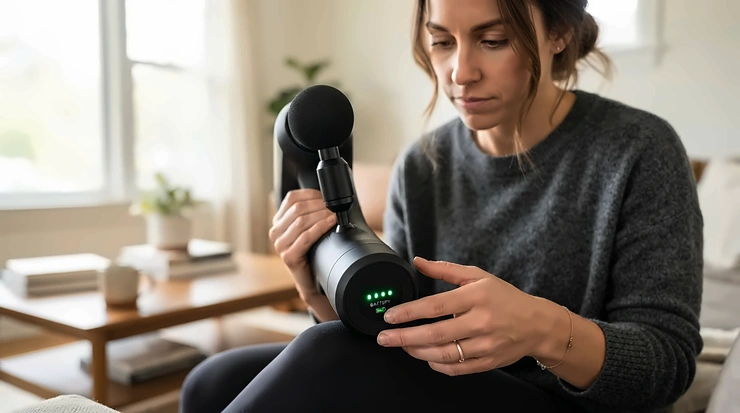
A percussion massage gun is a handheld, battery-powered device that drives a padded attachment head back and forth in rapid, short strokes to press into muscle tissue. Unlike a simple vibration pad, it combines speed (percussion frequency) with depth (amplitude). The result is a deep-tissue-style massage you can give yourself, at home, in the gym or on the train platform.
Ten years ago, this was physio-clinic kit. Today you can pick one up at Boots, Argos or Currys on the same trip as your shopping. Prices run from the cost of a pub lunch to the cost of a weekend break, and the spec sheets read like rocket science. Stroke length. Stall force. Percussions per minute. Meanwhile the marketing promises that a few minutes of buzzing will “unlock” your hamstrings.
This percussion massage gun buying guide is here to cut through that. Independent testers such as Which? have put models from Homedics, Theragun, Renpho and others in front of a panel of testers. The consensus: your personal needs for power, battery life and adjustability decide the winner, so there is no single “best” for everyone.
One honest note before we start. Everything below is built from manufacturer specifications, retailer listings and published third-party reviews, not claimed hands-on testing. Where sources disagree (and they do, often), I’ll say so. Along the way we’ll cover the massage gun features to look for, how percussion frequency really works, which attachment heads earn their place, and how battery run-time claims stack up against reality. If you want a massage gun for home use, the picks are sorted by who they suit.
Percussion Massage Gun Quick Comparison: Which One Fits Your Needs?
Short on time? This table matches the most common buyer needs to a model. Prices are approximate ranges at the time of research and may vary, so check current price before buying.
| Your Priority | Pick | Approx. Price Range | Best For |
|---|---|---|---|
| Pocket-sized portability | Theragun Mini 3.0 | Mid £100s to low £200s | Commuters and travellers |
| Balanced all-rounder | Theragun Prime | Low to mid £200s | Gym-goers wanting depth |
| Longest battery, low cost | Hypervolt Go 2 | Around £100-£130 | Beginners and desk workers |
| Maximum deep-tissue power | Bob and Brad D6 Pro | Roughly £250-£350 | Heavy lifters and athletes |
| Heat and cold in one device | Homedics Novo+ Hot & Cold | Around £100-£130 | Home recovery routines |
Looking at the comparison above, the Hypervolt Go 2 is the lowest-risk way into the category, while the Bob and Brad D6 Pro is the one to consider if you genuinely need more depth. The Homedics Novo+ Hot & Cold is the only pick here whose main selling point isn’t raw power at all, so it suits people who value comfort over punch. Most casual users overspend chasing power they will never use at full tilt.
💬 Just one click — help others make better buying decisions too!😊
Top 7 Percussion Massage Gun Picks for UK Homes in 2026: Expert Analysis
Every model below is a real product with a real spec sheet. Prices are shown as ranges only and change often, so check the current listing on amazon.co.uk before you decide. Each entry covers what the numbers mean in practice, plus the themes that recur in published reviews.
1. Theragun Mini 3.0 — pocket-sized power for travellers
The headline here is size. Therabody pitches the latest Theragun Mini 3.0 as 20% smaller and 30% lighter than its predecessor, and retailer sheets put it at well under half a kilo.
It offers three speeds (1750, 2100 and 2400 percussions per minute), a 12mm amplitude and up to 150 minutes of battery run-time over USB-C. The 12mm stroke is middling by massage gun standards. In plain English, you’ll press a little harder to reach dense muscle than you would with a 16mm machine, which suits calves, forearms and necks better than glutes. It also accepts 4th and 5th generation Theragun attachment heads, which means you can upgrade the heads later.
Based on the spec comparison, this is a “second device” for many people: the one that lives in a gym bag or desk drawer. Reviews of earlier Mini generations consistently praise the portability and note that the shorter stroke asks for more pressure. Which? included the Mini 3.0 in its 2026 test line-up, but as scores sit behind its member paywall, check there for the verdict.
Pros:
- ✅ Genuinely pocketable for gym bags and handbags
- ✅ Three heads in the box, upgradeable later
- ✅ Around 150 minutes of claimed battery run-time
Cons:
- ❌ 12mm stroke needs more pressure for big muscles
- ❌ Premium price for a three-speed device
Expect to pay roughly the mid £100s to low £200s. Worth it if portability is the priority, but overkill if the gun never leaves your lounge.

2. Theragun Prime — deep 16mm stroke without the flagship price
The Theragun Prime is the model most roundups treat as the sensible middle of Therabody’s range. Its standout feature is a 16mm amplitude, which the manufacturer says reaches 60% deeper than typical consumer massagers.
Five built-in speeds run from 1750 to 2400 percussions per minute, and the app can set any speed in that range. The battery gives about 120 minutes, and the whole unit weighs roughly 1kg. That 16mm stroke is the real differentiator. Dense areas such as quads, glutes and the upper back respond to depth, not just speed, so on paper this suits anyone who finds low-amplitude guns “tickly”.
What the spec sheet won’t tell you is the noise. One comparison puts it at around 65-69 dB, louder than its Hypervolt rival, which is the trade-off for that stroke. Reviewers in 2026 roundups name it the best overall pick, while noting it is bulkier and less travel-friendly than mini models. Independent testers have also flagged its 120-minute battery as modest next to some competitors.
Pros:
- ✅ Deep 16mm amplitude for dense muscle groups
- ✅ Five speeds plus app-controlled fine-tuning
- ✅ Triangle handle spreads strain across hands and wrists
Cons:
- ❌ Louder than some similarly priced rivals
- ❌ Battery run-time lags behind several competitors
Pricing sits in the low to mid £200s, so check current price. The verdict: good value if you will actually use the depth, poor value if you mostly want a gentle shoulder rub.
3. Hypervolt Go 2 — three-hour battery in a featherweight body
If battery run-time is your pet hate, the Hypervolt Go 2 is the answer. Hyperice quotes up to three hours per charge, which Tom’s Guide notes outlasts the Theragun Mini by 30 minutes.
It weighs about 0.68kg (1.5 lb), carries a brushless 40W motor and offers three speeds, which one review lists as 2200, 2750 and 3200 percussions per minute. Hyperice doesn’t publish amplitude, though independent testers estimated a range of roughly 9-11mm. So treat it as a mid-depth device: plenty for tension and warm-ups, less convincing for stubborn glute knots.
The analytical takeaway is that the Hypervolt Go 2 wins on convenience. It is light enough to hold one-handed for a few minutes without your forearm complaining, which matters more than amplitude for most home users. Only two attachment heads (flat and bullet) come in the box, and that limited head selection is the most common minor gripe in aggregated customer reviews. Buyers generally praise the battery, the compact size and the comfortable noise level.
Pros:
- ✅ Three-hour claimed battery run-time
- ✅ Light, compact and carry-on friendly
- ✅ Quiet enough to use during a TV show
Cons:
- ❌ Only two attachment heads included
- ❌ Amplitude not officially published
Expect around £100-£130. Strong value for beginners and desk workers who want a dependable first percussion massage gun.
4. Bob and Brad D6 Pro — the power pick for serious lifters
This is the heavyweight. The Bob and Brad D6 Pro pairs a 16mm amplitude with up to 85 lbs of stall force, the pressure at which the motor stalls, and that figure is far beyond most mini and mid-range models.
Six speeds cover 1,500-2,500 percussions per minute, and seven attachment heads come in the box. Battery run-time is rated at up to 180 minutes, and the unit weighs around 1.27kg. High stall force means the head keeps moving when you lean into a quad or glute, instead of bogging down. If you lift heavy or run high mileage, that is where the extra money goes.
Garage Gym Reviews scored it 4.25 out of 5, praising the stall force, seven heads and carry case, while noting it is large and not the quietest. Another reviewer observed that its design closely resembles a flagship Theragun, which tells you what it is competing with. UK availability and delivery vary by seller, so confirm the amazon.co.uk listing and warranty terms before buying.
Pros:
- ✅ 16mm amplitude with very high stall force
- ✅ Seven attachment heads and a carry case
- ✅ Up to 180 minutes of claimed battery run-time
Cons:
- ❌ Bulky and heavy for travel or small hands
- ❌ Not the quietest option available
Indicative pricing is roughly £250-£350. Excellent value per unit of power, but a poor fit if you only want a light neck massage.
5. Homedics Novo+ Hot & Cold — British-brand comfort with temperature therapy
The standout here is the powered hot-and-cold head. The Homedics Novo+ Hot & Cold offers four heat settings (about 39-45°C) and four cold settings (roughly 14-8°C), per a major UK retailer’s spec sheet.
It also provides six intensity levels, four heads (hot and cold, ball, bullet and flat), USB-C charging and a travel case, plus a three-year manufacturer guarantee. Heat before a session loosens stiff muscles. Cold afterwards suits sore ones. It is the one unit on this list where you can run a contrast routine without owning a separate heat pad and ice pack.
Here’s where to be careful: listings disagree. One retailer states up to 60 minutes of battery, others up to three hours, and quoted weights range from around 0.6kg to 915g. Always check the live listing. Testix named it best in its 2026 test, praising the hot and cold modes, though it also flagged drawbacks. It judged the Theragun Relief quieter and more comfortable than this device.
Pros:
- ✅ Heat and cold head in one device
- ✅ Three-year manufacturer guarantee
- ✅ Familiar UK brand with high-street availability
Cons:
- ❌ Battery run-time claims vary between listings
- ❌ Noisier than the quietest rivals
Around £100-£130 at the time of research. Good value if temperature therapy matters to you.

6. Renpho Active Thermacool — heated and cooled head at a friendly price
The Renpho Active Thermacool earns its place on spec-per-pound. Its heat-and-cool head runs from roughly 10°C to 47°C per Renpho, and it comes with five heads, USB-C charging and a metal body.
Specs vary by listing, so treat them as a range. Amplitude is quoted at 10mm (one page says 9mm), speeds run from about 1,800 to 3,200 rpm, noise is quoted below 55 dB, and weight is around 0.68kg. Claimed battery run-time ranges from about 140 minutes to three hours depending on the page. A 10mm stroke with a high top speed means it feels brisker than the Theragun Relief, with less depth than the Bob and Brad D6 Pro.
It appears in the Which? tested list, so check the paywalled scores. Retailer reviewers highlight battery life, fast USB-C charging and the temperature head as the draw. Because the heat-and-cool head has its own USB-C charging, remember that you’ll be charging two things.
Pros:
- ✅ Heat and cool head included as standard
- ✅ Fast 15W USB-C charging
- ✅ Quiet for its power class
Cons:
- ❌ Listings disagree on amplitude and battery
- ❌ Temperature head needs charging separately
Roughly £80-£120. A strong budget-to-mid pick for home recovery.
7. Theragun Relief — the gentle, one-button entry point
The standout is simplicity. The Theragun Relief is Therabody’s gentlest device: three speeds (1750, 2100 and 2400 per minute), one button, three heads (Standard Ball, Dampener, Thumb) and USB-C charging.
Therabody materials and independent review give it a 10mm amplitude and about 20 lbs of stall force, though some retailer pages wrongly quote 16mm. Battery is rated at 120 minutes. One reviewer found closer to 90 minutes realistic at high speed under pressure. There’s no app, which for many people is a feature rather than a flaw. Shorter stroke plus lower force means a softer feel, ideal if you are new to percussion therapy or have sensitive muscles.
Testix named it its best massage gun of 2026, saying it is quieter and more comfortable than the Homedics Novo+ Hot & Cold. As a reasoned take, it is the right choice for people nervous about “pummelling” themselves, and the wrong choice for anyone chasing deep tissue work.
Pros:
- ✅ Quiet, comfortable and simple to operate
- ✅ Backed by a respected brand and two-year guarantee
- ✅ Light enough for daily use
Cons:
- ❌ Only 10mm amplitude and modest force
- ❌ No app and just three attachment heads
Typically around £110-£130. Fair value for gentle, regular relief.
Specs at a Glance: All 7 Percussion Massage Gun Picks Compared
| Model | Amplitude | Speeds / Frequency | Claimed Battery | Attachment Heads | Best For |
|---|---|---|---|---|---|
| Theragun Mini 3.0 | 12mm | 1750 / 2100 / 2400 | Up to 150 min | 3 | Theragun Mini 3.0: travel |
| Theragun Prime | 16mm | 5 speeds, 1750-2400 | About 120 min | 4 | Theragun Prime: depth |
| Hypervolt Go 2 | Not published | 3 speeds | About 3 hrs | 2 | Hypervolt Go 2: battery |
| Bob and Brad D6 Pro | 16mm | 6 speeds, 1,500-2,500 | Up to 180 min | 7 | Bob and Brad D6 Pro: power |
| Homedics Novo+ Hot & Cold | Not published | 6 levels | 60 min to 3 hrs (varies) | 4 | Homedics Novo+ Hot & Cold: temperature |
| Renpho Active Thermacool | 9-10mm | 5 speeds, 1,800-3,200 | 140 min to 3 hrs (varies) | 5 | Renpho Active Thermacool: value |
| Theragun Relief | 10mm | 3 speeds, 1750-2400 | About 120 min | 3 | Theragun Relief: gentle use |
Ratings are left out deliberately because review scores shift constantly. Read across the table and a pattern jumps out: the 16mm machines (Theragun Prime and Bob and Brad D6 Pro) trade portability for depth, while the Hypervolt Go 2 and Renpho Active Thermacool trade depth for battery and price. If most of your use is warm-ups and tension relief, the second group is plenty. For recovery after heavy sessions, the first group is easier to justify.
How to Choose a Percussion Massage Gun: 7 Steps
Short on patience? Work through these in order, because each step narrows the field for the next.
- Decide where it will live. A bedside drawer tolerates a heavy unit, a gym bag does not, and weight is the first filter.
- Set a realistic budget. Around £80-£130 buys sound mid-depth performance, while £200-plus pays for deeper amplitude and app features.
- Check amplitude honestly. Roughly 10-12mm suits tension and warm-ups, and 16mm suits dense muscle.
- Look at percussion frequency range. A wider spread of speeds lets you start gently, which matters for beginners.
- Count attachment heads, then ask which you’d use. Two good heads beat seven you never touch.
- Read the battery run-time, then discount it. Claims are measured without pressure, so assume real use is shorter.
- Check warranty and charging. USB-C and a multi-year guarantee save hassle later.
Treat these steps as a filter, not a formula. If two models tie, pick the one you can hold comfortably for five minutes in a shop.
Massage Gun Features to Look For (And Those That Don’t Matter)
The massage gun features to look for sit in two tiers. First tier: amplitude, stall force, noise, ergonomics and battery run-time. These change how the device feels every single session.
Ergonomics is the unsung hero. A handle that lets you reach your upper back without contorting your shoulder will be used. One that doesn’t will live in a cupboard. The triangle-style grip on the Theragun Prime exists for exactly this reason, and weight matters just as much, which is why the featherweight Hypervolt Go 2 appeals to people with sore forearms.
Second tier: app connectivity, OLED displays, guided routines and wireless charging stands. These are pleasant, but I’d hesitate to pay a large premium for them. The Theragun Relief has no app at all and still tops Testix’s 2026 ranking, which says something about how much the extras matter.
Ignore marketing language like “medical grade” or “scientifically calibrated” unless it is backed by a published number. A good rule: if a manufacturer won’t publish amplitude, assume it is average. The Hypervolt Go 2 is a fair example, since Hyperice leaves it out and testers estimated it themselves.
Percussion Frequency and Amplitude: What the Numbers Mean
Percussion frequency is simply how many times per minute the head strikes. Amplitude is how far it travels each time. Together they decide whether a massage feels deep and slow or light and fast.
Think of it as a hammer and a drumstick. A hammer (high amplitude, lower speed) delivers weight. A drumstick (lower amplitude, high speed) delivers rapid taps. Therabody’s range sits at roughly 1750-2400 percussions per minute with long strokes, while the Renpho Active Thermacool goes up to around 3,200 with shorter strokes.
Why does this matter? A higher percussion frequency with a short stroke tends to feel buzzy and surface-level. A lower percussion frequency with a longer stroke feels like deep pressure. Many beginners assume faster is stronger, but with a long stroke the opposite is often true.
Choose by purpose. For warming up before a run, use higher speeds briefly. For soothing a tight calf after a long day, use the lowest setting and let the Bob and Brad D6 Pro or Theragun Prime do the work with depth. Percussion frequency is a dial, not a target, and starting low is always the safer instinct.
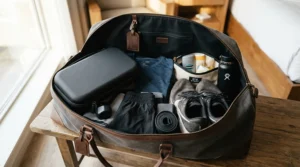
Attachment Heads: Which Do You Actually Need?
Attachment heads sound like a gimmick until you try to treat a shoulder blade with the wrong one. In practice, four shapes cover nearly everything.
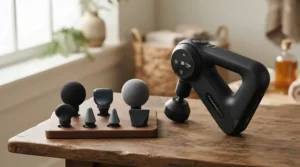
The ball head is your all-rounder for quads, glutes and backs. The flat head spreads pressure over larger areas. The bullet (or cone) targets trigger points in smaller spots such as feet and the base of the skull’s muscles. The dampener or cushion head softens impact for bony or tender areas, which is why it matters for beginners.
Seven heads, as on the Bob and Brad D6 Pro, is generous, but most people would settle into two or three favourites. The Hypervolt Go 2 ships with only flat and bullet, which covers the basics but leaves out a soft head. The Homedics Novo+ Hot & Cold includes its temperature head alongside ball, bullet and flat, giving it versatility with fewer pieces.
Practical tips: wipe heads clean after every session, never mix incompatible heads between brands, and remember that the Theragun Mini 3.0 accepts fourth and fifth generation Theragun heads. That cross-compatibility is a quiet money-saver when you want to expand later.
Battery Run-Time: Claims vs Reality
Battery run-time claims are measured under ideal conditions. Which? notes that its own battery tests are done with no load, meaning the guns aren’t pressing on anyone. Real use drains faster.
Here’s how the claimed figures compare. The Hypervolt Go 2 quotes around three hours. The Bob and Brad D6 Pro quotes up to 180 minutes. The Theragun Mini 3.0 says up to 150, and the Theragun Prime and Theragun Relief say about 120. One independent reviewer found the Theragun Relief closer to 90 minutes in real use at higher speeds.
So what does that mean for home use? If you do a ten-minute session five days a week, even 90 real minutes lasts about two weeks between charges. Battery run-time only becomes a headache for travellers, shared households and anyone using a gun for long sessions on clients or teammates.
Charging matters as well as capacity. USB-C is a convenience win because you can borrow a phone charger. The Renpho Active Thermacool supports fast charging (around 1.5-2 hours), but remember its heat-and-cool head has to be charged separately, so check both before travelling.
Percussion Massage Gun for Home Use: What Changes Compared with Gym Bags
A massage gun for home use has different priorities from one that lives in a kit bag. Weight and portability drop down the list. Comfort, noise and convenience rise.
Noise is the big one. You will be using it on the sofa or before bed, and a loud motor ruins the mood. That’s where the quietly regarded Theragun Relief and the QuietGlide-equipped Hypervolt Go 2 appeal. Heat and cold matter more too, since you have a freezer and a kettle nearby anyway.
A simple home setup helps: keep the gun on a charging shelf near where you sit in the evening, with a damp cloth for wiping the heads and a small towel under your elbow for back work. The Homedics Novo+ Hot & Cold suits this style well, and its three-year guarantee suits a device meant to stay in service for years.
Fit also depends on who shares the house. If several people will use it, a model with a softer dampener head and a wide percussion frequency range, such as the Theragun Prime, lets everyone find a comfortable setting. A single owner who simply wants an easy bedtime wind-down could save money with the Theragun Relief.

Percussion Massage Gun vs Traditional Alternatives
How does a gun compare with foam rollers, hands-on massage or a simple heat pad? The honest answer is “it depends on what you want from it”.
| Option | Convenience | Depth | Ongoing Cost | Best For |
|---|---|---|---|---|
| Percussion massage gun (e.g. Theragun Prime) | High | Medium to high | One-off purchase | Regular self-treatment |
| Foam roller | High | Medium | Very low | Large muscle groups |
| Professional massage | Low | High | Recurring | Persistent problems |
| Heat pad or hot water bottle | High | Low | Very low | General stiffness |
Research on percussion therapy is still young. A systematic review of percussive therapy concluded that massage guns can help improve acute muscle strength, explosive strength and flexibility, and reduce experiences of musculoskeletal pain. It also stressed how little specific research exists, so treat the claims with sensible caution.
The practical takeaway: a gun is a convenience tool. It will not replace a physiotherapist for a real injury, and a foam roller may do much the same job for far less money. But if you’ll use it more often because it is quick and easy, it justifies itself, especially a mid-priced option like the Hypervolt Go 2.
Safety, Regulations and Who Should Skip a Massage Gun
Percussion massage guns are generally low-risk for healthy adults, but there are firm no-go areas. Therabody’s own guidance says not to use its devices on the head, open wounds or genital area, and to start gently with 60-90 seconds per body part.
Anyone with a history of blood clots should speak to a clinician first. The NHS guidance on DVT describes symptoms such as pain and swelling in one leg, and says to get medical help promptly if you suspect it. Don’t massage a calf that is swollen, red, warm or painful on one side.
Other sensible exclusions: don’t use it directly over bruising, varicose veins, recent injuries or implanted devices, and ask your GP if you’re pregnant, on blood thinners or managing a long-term condition. Never press hard on bone, the spine or the front of the neck.
On product safety, look for UKCA or CE marking on the box or listing, a proper USB-C charger rather than a mystery lead, and a named UK seller or distributor. Be wary of ultra-cheap unbranded units with inflated “30-speed” claims and no warranty. Lithium batteries deserve respect: don’t charge them overnight on a duvet, and stop using any device that swells or overheats.
Long-Term Cost and Maintenance
The sticker price is only part of the story. A £250 unit used three times a week for four years costs about 40p per session. A £100 unit that dies after eighteen months costs roughly double that, so a longer guarantee is worth money.
Consider the Homedics Novo+ Hot & Cold, which carries a three-year manufacturer guarantee, against typical one-year cover on several rivals. For Bob and Brad D6 Pro buyers, warranty terms are worth checking because the manufacturer states a one-year warranty.
Maintenance is minimal. Wipe heads after every session with a damp cloth, store the gun in its case, and keep it out of damp bathrooms. Avoid running the battery flat repeatedly, and for long storage, Therabody advises leaving the battery fully charged.
There’s also the upgrade angle. The Theragun Mini 3.0 and Theragun Prime share attachment compatibility across generations, so a future head purchase doesn’t mean rebuying the whole kit. For total cost of ownership, the cheapest option is rarely the cheapest outcome.
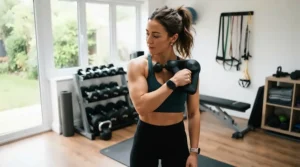
Practical Usage Guide: Your First 30 Days with a Percussion Massage Gun
Most disappointment comes from technique, not hardware. Follow this schedule to get the most from whichever model you buy.
Week 1: go gentle. Use the lowest speed and a soft head. Float the gun over the muscle for 60-90 seconds per area, letting the device do the work. Keep sessions under ten minutes in total.
Week 2: find your pressure. Add light pressure and try the ball head on quads, hamstrings and glutes. One study on eccentric-exercise soreness found that percussive massage gave immediate, temporary relief in perceived soreness but did not speed up recovery until 72 hours. So use it for comfort and range of motion, not as a magic fix.
Week 3: build a routine. Warm up for 30-60 seconds before training and cool down afterwards. Add a targeted bullet head for stubborn spots.
Week 4: review. Which speed do you use most? Which head? That tells you whether to upgrade or stick.
Common mistakes in the first 30 days: pressing too hard, staying too long on one spot, using it directly on joints, and blaming the machine for soreness caused by overuse. Slide slowly, breathe, and stop if anything feels sharp.
Real-World Scenarios: Which Percussion Massage Gun Suits You?
Let’s match three hypothetical buyers to the models above.
The desk-bound commuter. She sits eight hours a day, takes the train, and wants quick shoulder relief. Budget: around £100-£130. The Hypervolt Go 2 fits: light, quiet, long battery. The Theragun Mini 3.0 is the upgrade if she wants it in her bag daily.
The weekend footballer. He plays Sunday league, runs midweek and wants post-match quad and calf work. Budget: £200-£300. The Theragun Prime gives him depth and a manageable weight. If he’s heavier or trains harder, the Bob and Brad D6 Pro is the power option, though noisier and bulkier.
The home recovery fan. She likes a long soak, a hot water bottle and a stretch routine. She wants warmth and comfort. The Homedics Novo+ Hot & Cold or Renpho Active Thermacool add temperature therapy, while the Theragun Relief suits her if she’d rather keep things gentle and quiet.
Each scenario trades depth, noise, portability and price differently. Decide which of those four matters most to you, and the shortlist writes itself.
Problem → Solution Guide: Fixing Common Massage Gun Frustrations
“It’s too loud.” Choose a model known for quieter running, such as the Theragun Relief or Hypervolt Go 2, and use a lower speed. Noise tends to climb with amplitude, so a 16mm machine like the Theragun Prime will always be louder.
“It feels too gentle.” You may simply need more amplitude. A 10-12mm model such as the Theragun Mini 3.0 needs firmer pressure, so consider stepping up to the Bob and Brad D6 Pro if you routinely press hard.
“It hurts.” Switch to a dampener head, drop the percussion frequency and reduce pressure. Pain means stop, not push through.
“The battery dies mid-session.” Charge fully, avoid maxing the speed, and remember real use drains quicker than the claimed figure. The Hypervolt Go 2 is the most forgiving here.
“My hands ache.” Weight and grip are the culprits. A lighter unit like the Renpho Active Thermacool or a triangle-handled model can ease strain, and holding the gun at different angles shares the load.
FAQ
❓ Is a percussion massage gun worth it for home use?
❓ How long should I use a percussion massage gun on one area?
❓ What percussion frequency should a beginner start with?
❓ Are heated attachment heads worth paying extra for?
❓ How do I know a cheap massage gun is safe to buy?
Conclusion
There is no single winner, and anyone who says otherwise is selling something. The right percussion massage gun is the one that matches your muscles, your home and your patience.
If you want the safest first purchase, the Hypervolt Go 2 is hard to fault for battery, weight and price. If you want depth without a flagship bill, the Theragun Prime earns its place. If you carry your recovery with you, the Theragun Mini 3.0 is the compact choice. The Bob and Brad D6 Pro is for people who need real power, while the Homedics Novo+ Hot & Cold and Renpho Active Thermacool add temperature therapy at friendly prices. The Theragun Relief remains the gentle, quiet option for anyone starting out.
Whatever you pick, check the current listing, read the latest reviews, and treat battery and amplitude claims with a pinch of salt. Percussion therapy is a comfort and mobility tool, not a cure-all, and any persistent pain deserves a proper conversation with your GP or physio. Keep the percussion frequency low at first, use the right attachment heads, and let your routine do the heavy lifting.
✨ Ready to Find Your Perfect Match?
🏆 Compare the picks above, check current prices on amazon.co.uk and choose the percussion massage gun that fits your life. Your muscles will thank you! 💪
Recommended for You
- Stainless Steel Muscle Scraper: 7 Best Picks For UK Pros (2026)
- IASTM Tool Set For Physiotherapy: 7 Best Picks For UK Clinics (2026)
- Soft Foam Roller For Beginners: 7 Best Gentle Picks (2026)
Disclaimer: This article contains affiliate links. As an Amazon Associate, I earn from qualifying purchases. If you purchase products through these links, we may earn a small commission at no additional cost to you.
✨ Found this helpful? Share it with your friends! 💬🤗
