
In This Article
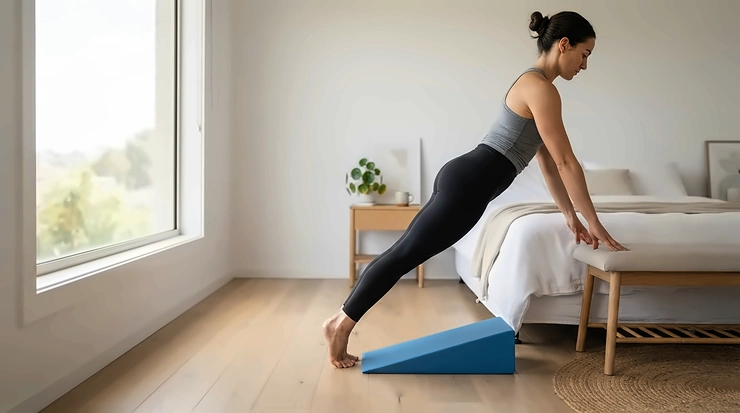
You know the feeling. Your first steps out of bed, and your heel files a formal complaint. Or you squat to pick something off the floor and your ankles lock up like rusty hinges. Often the culprit is a calf that has quietly tightened after months of desk sitting, hill walking, running, or all three. A foam wedge stretcher for tight calves is one of the cheapest, least dramatic fixes going: you stand on a slope, your toes tilt up, and gravity does the stretching for you.
Here’s the catch. Not all wedges are equal. Some are firm enough to trust with your full weight, while others squash like a marshmallow. Some give you one fixed angle, and others let you build a ramp piece by piece. The listings won’t tell you which suits sore heels and which suits stiff squats.
So this guide does the sorting. I’ve compared seven real options: six foam wedge designs plus one adjustable non-foam board as a benchmark. The comparison covers specs, aggregated review themes, and value. Where I couldn’t verify something, I say so rather than papering over it. You’ll also get practical routines, a look at what the research shows, and plain talk on ankle dorsiflexion, the plantar fascia and the Achilles tendon. The NHS plantar fasciitis page is a sensible companion read if heel pain brought you here.
One honest note: I haven’t personally tested these products. Every judgement below comes from specifications, reviewer patterns and clinical-style reasoning, which is still plenty to choose well.
Quick Comparison: The Best Foam Wedge Stretcher for Tight Calves at a Glance
| Product | Material | Angle(s) | Size / weight | Price range | Best For |
|---|---|---|---|---|---|
| OPTP PRO-Slant | Dense foam | 18° (pair) | ~11.75″ × 11.75″ × 3.75″ per wedge | Upper foam tier, check current price | Firm, stable daily use |
| Squad Goods Foam Slant Wedge | Softer foam | Check listing | Check listing | Not verified, check current price | Comfort-first, budget-minded buyers |
| NOONCRAZY 3-Piece Slant Board | EPP foam | 8.5°, 17°, 25.5°, 34° | 12″ × 6.5″ pieces, ~1 lb | Under £25 range | Beginners who want to progress |
| AOVALO 3-Piece Slant Board | Foam | 9° and 27° pieces, combinable | ~12.5″ × 6.5″, ~0.36 kg packaged | Likely under £25, check | Fine angle control |
| Inlisy 2-Piece Foam Wedge | Foam | Not verified | ~0.21 kg total | Around £15–£20 range | Light travel kit |
| Baosity EVA Foam Wedge | EVA foam | ≈9.5° (5 cm) or ≈18° (10 cm), calculated | 30 × 16.5 cm footprint | Not verified in GBP, check | Choosing gentle or steep |
| Physioworx Stretch Board PX1396 | Plastic, foldable | 15°–39° | 40 × 37 × 11 cm, 2.6 kg | Premium, check current price | Long-term adjustability |
Looking at the comparison above, the OPTP PRO-Slant and the Physioworx Stretch Board PX1396 are the “buy once” choices, one for firm foam and one for adjustability. The NOONCRAZY 3-Piece Slant Board is the smartest way to start gently and climb gradually. Budget buyers should note that the Inlisy 2-Piece Foam Wedge and the Baosity EVA Foam Wedge leave more homework for you, because key specs are thinner in the listings I could verify.
💬 Just one click — help others make better buying decisions too!😊
Top 7 Foam Wedge Stretcher for Tight Calves Picks: Expert Analysis
Prices below are ranges, not live quotes. Check the current listing before you buy.
1. OPTP PRO-Slant — best firm, clinic-style pair
The headline feature is firmness: this dense foam doesn’t mush under bodyweight, so the slope feels like a stretch instead of a wobble. Each wedge sits at an 18° incline and measures roughly 11.75″ × 11.75″ × 3.75″ (about 30 × 30 × 9.5 cm), sold as a pair. That wide, square footprint lets your whole foot land on the slope, so your calf does the work rather than your balance. Eighteen degrees is a moderate challenge, enough to bite on tight calves without ambushing most adults.
Based on the spec comparison, this is the one I’d shortlist first if you want a single fixed angle you won’t outgrow in a fortnight. Reviewers on retailer listings describe the foam as kind to the feet and the slope as well judged. One buyer picked it over pricier wooden boards, and another cheaper wedge’s reviewer treats it as the firmer benchmark their physical therapist recommended.
Pros:
- ✅ Firm foam holds shape under full bodyweight
- ✅ Wide 30 cm footprint suits larger feet
- ✅ Supplied as a pair for both legs
Cons:
- ❌ Fixed 18° leaves no room to progress
- ❌ Bulkier to pack than slim sets
I couldn’t verify a current UK price, but it sits in the upper foam tier, so check current price. Verdict: worth paying extra if firmness matters to you.
2. Squad Goods Foam Slant Wedge — softer, kinder budget alternative
Where the OPTP PRO-Slant is firm, this one leans soft, and that’s the whole story. The listing markets it for plantar fasciitis and Achilles tendonitis relief, but I couldn’t verify its exact angle or dimensions, so check the product page before ordering. Softer foam compresses under load, which feels comfortable on sore heels but gives slightly less precise angle control. That compression matters more the heavier you are.
In my read, it suits lighter users, or anyone whose first priority is a forgiving surface for gentle daily stretching. The clearest review theme is a buyer who chose it as a lower-cost alternative to the OPTP wedges their physical therapist recommended. They found it less firm, but evidently still usable.
Pros:
- ✅ Cushioned feel is kind to sore heels
- ✅ Lower-cost alternative to clinic-style wedges
- ✅ Foam construction keeps it light and storable
Cons:
- ❌ Softer foam compresses for heavier users
- ❌ Angle and size details less transparent
I couldn’t verify a current UK price, so check current price. Verdict: a sensible comfort-first option, provided you confirm the angle.
3. NOONCRAZY 3-Piece Slant Board — best for stepping up gradually
The standout is progression. The set contains three EPP foam pieces: two at 8.5° (12″ × 6.5″ × 2″) and one at 17° (12″ × 6.5″ × 4″). Stack them and you get 17°, 25.5° and 34°, all from roughly 1 lb of foam. That matters because the biggest beginner error is starting too steep and flinching away from the whole habit.
Here’s the arithmetic the listing skips. The steepest settings use all three pieces, so you’d stretch one foot at a time at 34°. Honestly, that’s no bad thing, since few people need 34° at the start.
Reviewers consistently call the foam comfortable yet firm and the pieces light but sturdy. Several mention that the multiple angles allow progression. One says it stays put and suits wide feet, and another says a leaflet of exercises is included. The 480 lb capacity is the seller’s claim, so heavier users should treat it cautiously.
Pros:
- ✅ Four stackable angles from 8.5° to 34°
- ✅ Lightweight, wipe-clean EPP foam
- ✅ Exercise leaflet mentioned by reviewers
Cons:
- ❌ Steepest settings tie up all three pieces
- ❌ Stacking takes a minute to learn
Similar sets have sat under £25 on UK reseller listings, so check current price. Verdict: excellent value for beginners.
4. AOVALO 3-Piece Slant Board — best for fine-tuning the angle
Its trick is the mix of pieces: two 9° wedges and one 27° wedge. Two small wedges together make 18°, the big one gives 27°, and a buyer describes reaching about 36° with the pieces combined. Packaged, it measures around 12.5″ × 6.5″ at roughly 0.36 kg, so it’s light enough to chuck in a gym bag.
On paper, this suits people who already know they tolerate moderate stretch. The jump from 18° to 27° is a big one, so progress by weeks rather than days. Compared with the NOONCRAZY 3-Piece Slant Board, you get coarser high-end steps but a genuinely challenging 27° single piece. I couldn’t verify enough independent reviews to summarise sentiment, so treat my take as spec-based.
Pros:
- ✅ Clean 9° steps from the two small wedges
- ✅ Single 27° wedge for advanced stretching
- ✅ Light, packable set at roughly 0.36 kg
Cons:
- ❌ Big jump from 18° to 27°
- ❌ Limited verifiable reviewer feedback
Comparable three-piece sets tend to sit under £25, though I couldn’t confirm this one, so check current price. Verdict: good for intermediate stretchers.
5. Inlisy 2-Piece Foam Wedge — lightest pair for travel
The appeal is sheer lightness: the listing gives a weight of roughly 0.21 kg for the pair. Two wedges mean both feet stretch at once, which suits symmetrical standing stretches and warm-ups for squats. It’s marketed for foot rehabilitation and physical therapy, though that’s seller language rather than proof.
Here’s what the spec sheet won’t tell you. The excerpt I could verify gives no angle, no dimensions and no firmness rating. Without those, you’re buying partly on faith. A UK reseller listing also showed no customer ratings, so there is no review pattern to summarise.
I’d treat this as a low-risk trial purchase for travel or office use. If you suffer morning heel pain, I’d pick a wedge with a published angle instead.
Pros:
- ✅ Both feet can stretch together
- ✅ Feather-light for bags and drawers
- ✅ Low price band for a matched pair
Cons:
- ❌ Angle and firmness unverified
- ❌ No verifiable review base
One UK reseller listing showed it at around £15–£20, so check current price. Verdict: acceptable gamble, but verify the angle first.
6. Baosity EVA Foam Wedge — two heights for gentle or steep
The distinguishing feature is choice of height: listings show 30 × 16.5 × 5 cm and 30 × 16.5 × 10 cm variants in EVA foam. My own calculation from those dimensions (not a manufacturer claim) puts them at about 9.5° and 18°. That’s a useful range. The 5 cm version suits very tight calves or a gentle morning routine, while the 10 cm one matches the angle of the OPTP PRO-Slant.
The long 30 cm footprint supports a full foot, and EVA is generally easy to wipe clean. The catch is that each purchase gives one fixed angle, so you’d buy twice to progress. The retailer listings I saw showed no ratings, so I can’t summarise reviewer sentiment, and UK availability through Amazon varies.
Pros:
- ✅ Height options map to roughly 9.5° and 18°
- ✅ Wipe-clean EVA foam
- ✅ Long footprint supports the full foot
Cons:
- ❌ One fixed angle per purchase
- ❌ UK availability and reviews unverified
Overseas listings suggest the budget tier, but I couldn’t verify GBP pricing, so check current price. Verdict: sensible if you know your angle.
7. Physioworx Stretch Board PX1396 — best step-up for adjustability
This is the non-foam benchmark, and its standout is range: 15° to 39°, with ankle locks and a 150 kg capacity. The foldable plastic board measures about 40 × 37 × 11 cm and weighs 2.6 kg. That extra weight is exactly why it feels planted, while foam wedges can creep on laminate.
Based on the spec comparison, this suits people who expect to use a board for years, or who want to progress beyond what a foam set offers. Be aware that 15° is the lowest setting, and a reviewer of a related Physioworx board found the lowest angle too steep for very short Achilles tendon length. Reviewers praise the build, the included exercise sheet and the stability, and several mention a podiatrist recommending it. A retailer mirror of the listing showed roughly 4.6 out of 5 from several hundred ratings at the time of research.
Pros:
- ✅ Wide 15°–39° range grows with you
- ✅ Ankle locks and non-slip surface add security
- ✅ Folds for storage, with 150 kg capacity
Cons:
- ❌ At 2.6 kg, far less travel-friendly
- ❌ Costs more than any foam wedge
It sits in the premium tier, so check current price. Verdict: pricey but proven for committed daily use.
✨ Don’t Miss These Exclusive Deals!
🔍 Take your calf mobility to the next level with these carefully selected products. Click on any highlighted item to check current pricing and availability. These tools will help you build a stretching habit your heels and ankles will thank you for!
What Is a Foam Wedge Stretcher for Tight Calves?
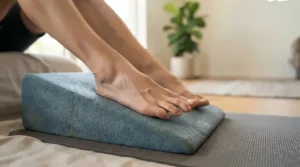
A foam wedge stretcher for tight calves is a lightweight, angled block, usually between 9° and 35°, that you stand on to tilt your toes upward, pushing the ankle into dorsiflexion and lengthening the calf muscles and Achilles tendon. It’s a low-cost, portable alternative to wall stretches and wooden slant boards.
How it works
Your calf has two main players. The gastrocnemius crosses the knee, so it stretches best with a straight leg. The soleus sits deeper and responds to a slightly bent knee. Stand on the slope and the heel stays down while the toes rise, so the whole calf complex is loaded. Foam makes this friendly: it’s light, forgiving underfoot, and cheap enough to keep one by the kettle, one in the gym bag.
Why foam rather than wood
Foam trades some adjustability and longevity for price and portability. For most people with garden-variety calf tightness, that’s a fair swap, and we’ll compare the alternatives properly below.
How to Choose a Foam Wedge Stretcher for Tight Calves
- Match the angle to your tightness. Very tight calves or sore heels usually do better starting near 8–10°. Moderately flexible people can start around 15–18°.
- Judge the firmness. Dense foam holds its shape under bodyweight, while soft foam compresses and quietly changes your angle mid-stretch.
- Check the footprint. Your heel and the ball of your foot should both land on the slope. A narrow 6.5″ piece suits average feet, while larger feet like the roomier 30 cm span of the OPTP PRO-Slant.
- Decide fixed or stackable. Fixed wedges are simpler, whereas stackable sets such as the NOONCRAZY 3-Piece Slant Board and AOVALO 3-Piece Slant Board let you progress without rebuying.
- Be sceptical of capacity claims. A 480 lb rating on a foam block is a seller’s figure. Heavier users should favour dense foam or a rigid board.
- Look at grip. Foam can skate on tiles or laminate, so a textured base or a mat underneath helps.
- Read the returns policy. A wedge you can’t tolerate is a wedge you won’t use, so make sure returns are easy.
Slant Board for Calf Stretching: What the Evidence Really Says
Product pages love to say a slant board “deepens” the stretch. Is that true? Partly, yes. A study in Annals of Rehabilitation Medicine, comparing inclined board stretching with a standard wall stretch, reported a greater increase in triceps surae length and a larger range of ankle dorsiflexion with the inclined board. Muscle activity during the stretch was also lower with the board, and the authors concluded it should be encouraged for the triceps surae. In plain English, standing on a slope lets the calf relax into the stretch rather than bracing against it.
What it doesn’t prove
Be careful with enthusiasm, though. Studies like this typically use healthy volunteers and short interventions, so they say little about whether a slant board for calf stretching cures chronic heel pain. And the advantage over wall stretching was modest. That’s good news in one sense: a wedge is a convenience and comfort upgrade, not a miracle.
The practical takeaway
If you’ll actually use it, the wedge wins on repeatability. You place it, step on it, and the angle is identical every time. Wall stretching depends on where you stand that day, and that inconsistency is its quiet weakness.
Ankle Dorsiflexion: The Mobility Number Hiding Behind Tight Calves
Ankle dorsiflexion simply means pulling the top of your foot toward your shin. You need it for squatting, climbing stairs, descending hills and running. When tight calves limit ankle dorsiflexion, the body compensates: heels lift in a squat, knees drift inward, or the foot rolls to find extra range.
A quick self-check
Try a knee-to-wall test. With your foot a short distance from a wall and your heel planted, push your knee forward toward the wall. Compare left with right. A noticeable gap between sides is worth mentioning to a physiotherapist. It won’t diagnose anything, but it shows which ankle dorsiflexion deficit deserves attention first.
Where the wedge fits
A foam wedge is a stretching tool, not a joint-mobilisation tool. Calf tightness is one possible limiter of ankle dorsiflexion, but joint stiffness and bony restrictions also exist. If stretching doesn’t improve your range after several weeks of consistent use, that’s information too. It suggests asking a professional, not buying a steeper wedge.
Incline Calf Stretcher for Heel Pain: Plantar Fascia and Achilles Tendon Explained
Heel pain is the main reason people buy an incline calf stretcher for heel pain. Please note that this isn’t medical advice. If pain is severe, follows an injury, or persists, see your GP or a physiotherapist.
The plantar fascia connection
The plantar fascia is a strong band of tissue running from the heel to the forefoot. NHS community trust leaflets commonly link tight calf muscles and a tight Achilles tendon with extra stress on the heel. One Kent community health leaflet describes an associated stiff ankle as one of the main factors in plantar fasciitis. That’s why calf stretching features so heavily in conservative treatment.
There’s a balancing note, though. One NHS trust leaflet states that strength exercises are the best-proven treatment for plantar fasciopathy, with stretching alongside. So treat the wedge as one part of a routine rather than the whole cure.
The Achilles tendon: stretch with care
The Achilles tendon joins your calf muscles to the heel bone. NHS Forth Valley estimates Achilles tendinopathy affects around 150,000 people in the UK every year, most commonly between 30 and 50. NHS Inform’s Achilles tendinopathy leaflet lists painkillers plus stretching and strengthening exercises. Insertional Achilles tendon pain, felt where the tendon meets the heel bone, is described as more complex. If that’s your pain, ask a physiotherapist before leaning into deep stretches.
Foam Wedge vs Wooden or Folding Slant Board
| Foam wedge (e.g. OPTP PRO-Slant) | Adjustable folding board (e.g. Physioworx Stretch Board PX1396) | Wall stretch | |
|---|---|---|---|
| Cost | Lowest of the three, apart from free | Highest | Free |
| Portability | Very light | Heavier, foldable | None needed |
| Stability | Good if foam is dense | Best, with ankle locks | Depends on stance |
| Adjustability | Fixed or stackable | Wide range, 15°–39° | Unlimited, but imprecise |
| Longevity | Foam compresses over time | Longest | Permanent |
| Best For | Home, travel, beginners | Daily long-term users | Quick warm-ups |
Looking at the comparison above, foam wins on price and portability, while the folding board wins on security and range. The wall stretch is the cheapest, but its angle changes every time you do it. For someone buying their first slant board for calf stretching, I’d say foam first: it’s cheap enough that a bad guess costs little. If you outgrow it, the Physioworx Stretch Board PX1396 is the natural upgrade, and the foam wedge still earns a second life as a travel option.
Wood and rigid boards also tend to feel more “locked in” under heavy squats. That’s one reason strength-focused lifters often graduate away from soft foam.
Features That Actually Matter (And Those That Don’t)
What matters
- Firmness: it decides whether your angle stays true.
- Footprint: a wedge your foot overhangs is a wedge you’ll wobble on.
- A published angle: if the listing won’t state it, be wary.
- Grip: foam sliding underfoot ruins the stretch.
What doesn’t
- Eye-catching capacity numbers. A 480 lb claim on foam says little about real-world compression.
- “Patented” and “therapist-recommended” badges. They’re marketing language, not measurements.
- Eco-friendly stickers. EPP and EVA recyclability is nice but irrelevant to stretching.
- Extra gimmicks. Bands and posters rarely change outcomes.
The sensible filter: ask what each feature does for your calf. If the answer is “nothing”, ignore it. The NOONCRAZY 3-Piece Slant Board scores well because its progression genuinely helps. The Inlisy 2-Piece Foam Wedge is light but leaves its important specs unstated.
Practical Usage Guide: Your First 30 Days on a Foam Wedge
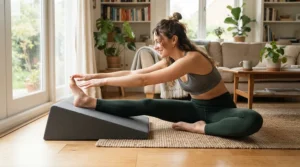
Setup: put the wedge on a non-slip surface beside a wall or counter for balance. Stretch barefoot or in thin socks. Keep your heel fully down.
Week 1: use your gentlest angle, around 8–10° for most people with tight calves. NHS trust leaflets commonly suggest holding calf stretches for 20–30 seconds and repeating about three times per leg. Stop if pain sharpens.
Week 2: extend to 30 seconds, then add a bent-knee version to target the soleus.
Week 3: step up an angle only if the stretch feels comfortable the next morning. With the NOONCRAZY 3-Piece Slant Board, that means adding one 8.5° piece. With the OPTP PRO-Slant, consider simply holding longer.
Week 4: settle into a steady routine, one or two sessions daily.
Common first-month mistakes: jumping angles too fast, locking the knee hard, bouncing, stretching on a slippery floor, and pushing through sharp pain.
Maintenance: wipe foam with a damp cloth, keep it away from radiators and hot cars, and store it flat.
Real-World Scenarios: Which Foam Wedge Fits Your Life?
The desk worker with morning heel twinges
Budget: modest. Environment: living room and a kitchen worktop for balance. Frequency: twice daily. The NOONCRAZY 3-Piece Slant Board fits because the lowest 8.5° setting is gentle. You can climb gradually as the morning stiffness eases. Pair it with a daily habit, such as boiling the kettle.
The runner returning from calf tightness
Budget: moderate. Environment: hallway before and after runs. Frequency: daily. The OPTP PRO-Slant suits steady, moderate stretching at 18°, with a firm surface and room for a whole foot. If your pain sits right where the Achilles tendon meets the heel, check with a physio first.
The lifter whose heels rise in squats
Budget: flexible. Environment: gym floor. Frequency: warm-up before every lower-body session. The Physioworx Stretch Board PX1396 brings stability under load, while the Baosity EVA Foam Wedge in the 10 cm version is a cheaper way to test whether a heel lift helps. Treat these as complementary to genuine mobility work.
Problem → Solution Guide: When Your Wedge Isn’t Working
Problem 1: The wedge slides on the floor. Put a yoga mat under it, or switch to carpet. If foam keeps creeping, the heavier Physioworx Stretch Board PX1396 stays put better.
Problem 2: It hurts in the arch, not the calf. The angle is probably too steep. Drop down a step. On a stackable set, remove a piece.
Problem 3: Your calves aren’t loosening after weeks. Be realistic. A small University of Wisconsin–La Crosse study, comparing a Prostretch device with an incline board, found no significant difference in active ankle dorsiflexion between the two devices, or against a no-stretching control group. The authors suggested the measurement method may have missed effects. It’s a reminder that no device is magic, so consistency, strength work and professional advice matter more than gadget upgrades.
Problem 4: One side is much tighter. Give the tighter calf an extra set, and keep the angle identical on both sides.
Problem 5: The foam feels squashy. Move to a firmer option such as the OPTP PRO-Slant, since compression quietly lowers your effective angle.
Long-Term Cost & Maintenance: What a Foam Wedge Really Costs You
| Tier | Examples | Indicative price range | What the money buys | Best For |
|---|---|---|---|---|
| Budget foam | Inlisy 2-Piece Foam Wedge, Baosity EVA Foam Wedge | Roughly £15–£20 where verified | Basic angle, light weight | Trying the habit |
| Mid-range sets | NOONCRAZY 3-Piece Slant Board, AOVALO 3-Piece Slant Board, Squad Goods Foam Slant Wedge | Often under £25, check | Progression and variety | Beginners |
| Premium foam | OPTP PRO-Slant | Upper foam tier, check | Firmness and a wide base | Daily, heavier use |
| Premium adjustable | Physioworx Stretch Board PX1396 | Premium, check | Range, ankle locks, longevity | Long-term users |
These ranges are indicative, so verify them before you buy. Looking at the table, the cost-per-use maths is forgiving. A wedge costing around £20 and used daily for a year works out at only about 5p a day. The real risk isn’t price but abandonment: the best wedge is the one you’ll use. Foam wedges also compress over time, so expect gradual loss of firmness, and replace any that look visibly dented. A rigid board such as the Physioworx Stretch Board PX1396 costs more upfront but spreads that cost across far more years.
FAQ
❓ Can I use a foam wedge stretcher for tight calves while brushing my teeth?
❓ Will a foam wedge help morning heel pain?
❓ Can I stack two foam wedges for a steeper angle?
❓ Are foam wedges safe on laminate or tiled floors?
❓ How do I know when a foam wedge needs replacing?
Conclusion
Choosing a foam wedge stretcher for tight calves comes down to a few honest questions. How firm is it, what angle does it give, and will you use it daily? For most people the answer is straightforward. The OPTP PRO-Slant is the firm, dependable pick for steady moderate stretching, and the NOONCRAZY 3-Piece Slant Board is the friendliest way to begin gently and progress. For a long-term, adjustable setup, the Physioworx Stretch Board PX1396 is worth the premium. The AOVALO 3-Piece Slant Board and Baosity EVA Foam Wedge suit people who know their preferred angle. The Squad Goods Foam Slant Wedge is a comfort-first option, and the Inlisy 2-Piece Foam Wedge is a light, low-risk trial.
Whichever you choose, remember what the evidence suggests: a slope helps, but consistency matters more than gadgetry. Start gently, hold for 20–30 seconds, and respect pain. If heel or Achilles tendon symptoms linger, a professional’s advice beats any wedge.
Recommended for You
- Hamstring Stretching Device For Runners: 7 Proven Picks (2026)
- Leg Stretcher For Splits At Home: 7 Best Picks For UK (2026)
- Lumbar Stretcher For Lower Back Pain Relief: 7 Honest Picks (2026)
Disclaimer: This article contains affiliate links. As an Amazon Associate, I earn from qualifying purchases. If you purchase products through these links, we may earn a small commission at no additional cost to you.
✨ Found this helpful? Share it with your friends! 💬🤗
