In This Article
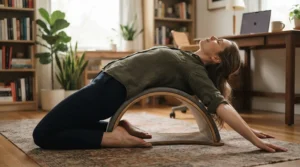
By mid-afternoon, a desk day has a sly way of turning your spine into a rusty garden gate. It still swings, but it grumbles. If that sounds familiar, a back stretcher for desk workers with stiff spines may be one of the cheapest, quietest resets you can add to a working week in 2026.
Let’s be straight about what these things are, though. A stretcher is a tool, not a cure. NHS guidance on back pain leans heavily on staying active rather than resting, and most episodes ease within weeks. So the sensible way to think about a back stretcher for desk workers with stiff spines is as a deliberate counter-move: a few minutes of gentle backward arching to offset hours of rounding forward.
This guide compares seven real products: boards, a wheel, a foam cushion and an inflatable pad. It’s built on published specifications and aggregated review data gathered at the time of research, not hands-on testing. The rating figures come from US-facing listings, so check availability and current price on amazon.co.uk before you buy. Every price below is an indicative band, never a quote.
What Is a Back Stretcher for Desk Workers with Stiff Spines?
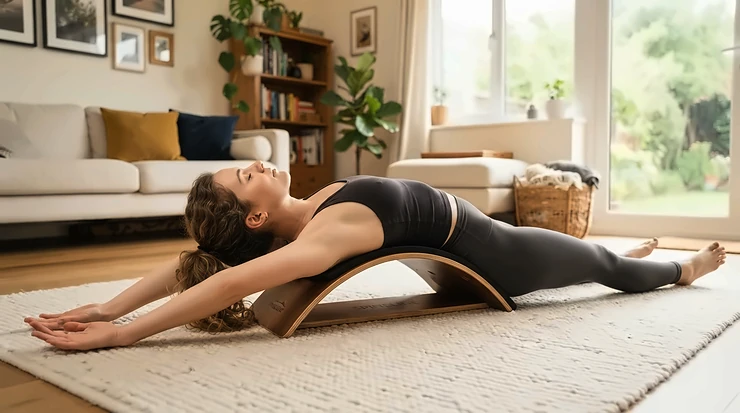
A back stretcher for desk workers with stiff spines is a compact device, usually an arched board, foam cushion, wheel or inflatable pad, that supports your back in a gentle extension (a backward arch) to briefly reverse the rounded posture of sitting. It’s a short mobility aid for stiffness, not a medical treatment or a substitute for diagnosis.
Quick Comparison: Seven Options at a Glance
| Product | Format | Standout Detail | Best For |
|---|---|---|---|
| MINOLL Back Stretcher | Arched board | 15°, 28° and 42° settings | Beginners who want fixed, predictable steps |
| Everlasting Comfort Back Stretcher | Padded arched board | 15°, 30° and 45° plus washable cover | Anyone who finds bare plastic too harsh |
| Chirp Wheel XR | Rolling wheel | 25 cm wheel, trigger-point design | Stiff mid and upper back |
| Halo Spine Stretcher | Long platform | 107 cm length, 24 massage balls | Taller users wanting full-back coverage |
| RESTCLOUD Back Stretcher | Foam cushion | C-shaped memory foam | Pressure-sensitive lower backs |
| GLYVIAN Inflatable Stretcher | Inflatable pad | Chair strap, adjustable inflation | Seated desk-side breaks |
| Thrival Arch Back Stretcher | Targeted arch tool | Five positions per side | Tight hip flexors and glutes |
Looking at the table, the real dividing line isn’t price. It’s how each product creates the stretch: fixed arch, soft cushion, rolling pressure or inflatable support. If your stiffness lives low in the back, the boards and cushion make sense, while Chirp Wheel XR and Halo Spine Stretcher are the better fits for the mid-back. Treat the “Best For” column as a starting filter, then read the individual analysis below.
💬 Just one click — help others make better buying decisions too!😊
Top 7 Back Stretcher for Desk Workers with Stiff Spines Picks: Expert Analysis
Ratings and review counts below come from third-party roundup data on US listings at the time of research. They’re a guide to sentiment, not a guarantee, and UK listings may differ. Price bands are indicative; check current price before buying.
1. MINOLL Back Stretcher — best value fixed-arch board for beginners
The big draw here is predictability: three preset arches mean you always know how much curve your lower back is being asked to accept.
The settings are 15°, 28° and 42°. The lowest is a sensible gentle start after a long sitting day, while the highest is a “later, once you’re used to it” option. At roughly 390 g and about 38 × 25 cm, it slides under a bed or into a desk drawer. The stated 181 kg capacity is the highest in this line-up, which matters because a board that flexes under load changes the arch you think you’re getting. The 102 contact points add an acupressure-style texture that some people like and others find sharp through a thin top, so wear a t-shirt at first.
On the spec comparison, this is the board for anyone who wants clear intensity steps without paying for extras. It’s lumbar-focused, so it suits low-back stiffness better than an upper-back problem.
Reviewers consistently describe a welcome stretch after long sitting, and a recurring theme is that it takes a few sessions to get used to. The 4.2 average across roughly 4,700 reviews, with about 7% one-star, tells you it won’t suit every back.
Pros:
- ✅ Three clear arch settings for gradual progression
- ✅ Light, slim and easy to store
- ✅ Highest stated weight capacity here
Cons:
- ❌ Firm plastic surface feels harsh to some
- ❌ Lumbar-focused, so limited help for the upper back
Indicative band: around £15-£25. Excellent value for a first back stretcher, provided you start on the lowest setting.
2. Everlasting Comfort Back Stretcher — padded board with a washable cover
Think of this as the MINOLL idea with a softer handshake: the same fixed-arch format, but with a foam pad and traction strip between you and the frame.
The settings are 15°, 30° and 45°, with 88 nodes across a board of about 42 × 26 cm weighing roughly 590 g. The stated capacity is 159 kg, and the cover is machine washable, which sounds trivial until it’s been used daily for months. A chair strap is also listed, though I’d treat that as short-term posture support rather than a licence to sit motionless for hours.
Here’s what the spec sheet won’t tell you, but user reports suggest: on the higher settings the stretch is strong, and a few reviewers note the plastic arch can shift or flex under heavier loads. That’s a good reason to begin low and to use it on a firm, flat floor rather than a sofa.
The 4.0 average from roughly 4,000 reviews is based on a big sample, but it’s the lowest rating in this group. Read it as broad real-world experience, not universal approval.
Pros:
- ✅ Foam pad and traction strip add comfort
- ✅ Washable cover keeps it hygienic
- ✅ Three angles up to a deep 45°
Cons:
- ❌ Lowest average rating of the seven
- ❌ Fixed board, so no mobile pressure control
Indicative band: around £15-£25. Strong value if comfort matters more to you than ultra-light portability.
3. Chirp Wheel XR — best for targeted upper-back rolling
A wheel flips the logic of a board: instead of you lying on a fixed curve, you decide where the pressure lands.
The wheel is about 25 cm across and weighs roughly 1.4 kg, with a trigger-point design and supportive cushioning. In practice, that diameter lets you roll slowly along the mid-back, pausing on tight segments, which is exactly where a hunched laptop posture tends to leave you stiff. The trade-off is coverage: it won’t hold your entire back in one comfortable arch, so it rewards slow, deliberate movement rather than passive lying.
For anyone whose main complaint is the mid-back, the case for Chirp Wheel XR is strong. It also suits people who already do mobility work and want one tool to join that routine.
The 4.5 average across roughly 1,800 reviews is the strongest rating here. User discussions often flag that mid-back pressure can feel intense, so start light and keep sessions short.
Pros:
- ✅ You control exactly where pressure lands
- ✅ Highest average rating in this group
- ✅ Compact enough to store after a break
Cons:
- ❌ Limited full-back coverage in a single position
- ❌ Needs floor access, which won’t suit everyone
Indicative band: around £40-£60. A premium-leaning price, but sensible if the upper back is your problem area.
4. Halo Spine Stretcher — best full-length platform for taller users
Most boards stop at the lumbar curve. Halo Spine Stretcher keeps going.
It measures about 107 × 23 × 6.6 cm, weighs roughly 520 g and lists a 150 kg capacity. That length reaches both the lower and upper back, and the 24 massage balls add firm, acupressure-style contact. A QR code links to video tutorials, which is genuinely useful for a device with more than one way to lie on it. For taller users, or anyone who wants to address more than the lumbar region in one lying-down session, length is the headline advantage.
Be realistic about the pressure, though. A bigger contact area doesn’t automatically mean gentler contact. The listing is aimed at people comfortable with firm pressure, so a short first session is wise.
The 4.3 average from about 165 reviews is encouraging but a smaller sample than the big boards, so I’d weigh the design more than the rating.
Pros:
- ✅ Full-length support for lower and upper back
- ✅ Light for its size
- ✅ Video tutorials included via QR code
Cons:
- ❌ Firm pressure from 24 massage balls
- ❌ Takes more storage space than compact boards
Indicative band: around £30-£45. Good value if you want one device to cover lumbar and thoracic regions.
5. RESTCLOUD Back Stretcher — memory-foam comfort before intensity
If hard plastic sounds unappealing, this C-shaped foam cushion is the gentle on-ramp.
It measures about 32 × 31 × 10 cm and weighs roughly 815 g. The curve is intended to follow the natural shape of the lower spine, with eight nodes, 16 massage bars and a removable adjustable massage ball so you can change the feel. The practical meaning: you get cushioning and a softer lumbar arch rather than a steep, fixed angle, so it’s easier to relax into.
On analysis, it makes sense as a bridge between a rolled towel behind the lower back and a dedicated board. It’s lumbar-focused, so it won’t give you a long, full-back stretch.
The 4.3 rating from roughly 600 reviews is a decent feedback base. Remember that any listing language about specific conditions is marketing, not an individual treatment plan.
Pros:
- ✅ Padded memory foam surface
- ✅ Removable massage ball changes the feel
- ✅ Sensible review base of around 600
Cons:
- ❌ Compact shape limits full-back coverage
- ❌ Moderate rating compared with the top performers
Indicative band: around £20-£30. A fair price for a comfort-first option.

6. GLYVIAN Inflatable Stretcher — the most desk-specific design
This is the only product here built around the chair you’re probably sitting on.
An inflatable airbag with a chair strap, it measures about 36 × 20 × 5 cm, weighs roughly 680 g, includes acupressure nodes and lists a 136 kg capacity. Inflation lets you adjust the support level more finely than a board with preset notches. Use it as a short-break and posture-support tool, not something to leave inflated at maximum all day, because no device replaces changing position.
Here’s the catch: the listing has only 24 reviews at 4.1. That’s enough to describe the design, but not enough to treat its sentiment as seriously as a product with thousands of ratings.
If floor space is scarce, or you work in a shared office, this is the logical candidate. If a proven long-term track record matters more, pick MINOLL or Everlasting Comfort Back Stretcher instead.
Pros:
- ✅ Chair strap keeps it positioned while you work
- ✅ Adjustable inflation fine-tunes support
- ✅ Portable and quick to stash
Cons:
- ❌ Only 24 reviews, so limited evidence
- ❌ Inflatable parts can’t be judged for long-term durability
Indicative band: around £15-£25. Cheap enough to try, but treat the thin review base with caution.
7. Thrival Arch Back Stretcher — best for tight hip flexors and glutes
Sitting doesn’t just stiffen your spine; it shortens the front of your hips, which then tug on your lower back. This tool targets exactly that.
It measures about 43 × 15 × 15 cm, weighs roughly 950 g, and offers five positions per side. Its placement options cover the psoas, hip flexor, glute, iliacus and back, and a step-by-step manual is included. That narrow footprint makes it a focused tool rather than a broad, passive relaxer. It also asks the most of you in terms of learning where to put it.
For desk workers who feel tight at the front of the hips after prolonged sitting, that makes sense. For anyone wanting a simple first back stretcher, a basic board is easier.
The 4.4 rating comes from only 31 reviews, so I’d give the design more weight than the number.
Pros:
- ✅ Five placement positions per side
- ✅ Targets hips and glutes, not just the spine
- ✅ Instruction manual included
Cons:
- ❌ Only 31 reviews behind the rating
- ❌ Steeper learning curve than a simple board
Indicative band: around £25-£40. Reasonable if hip tightness is part of your problem.
Top 7 Compared: Specs, Ratings and Price Bands
| Product | Format | Size / Weight | Rating (listing data) | Indicative Price Band | Best For |
|---|---|---|---|---|---|
| MINOLL Back Stretcher | Board | ~38 × 25 cm / ~390 g | 4.2 (~4,700 reviews) | £15-£25 | First-time buyers |
| Everlasting Comfort Back Stretcher | Padded board | ~42 × 26 cm / ~590 g | 4.0 (~4,000 reviews) | £15-£25 | Comfort-seekers |
| Chirp Wheel XR | Wheel | ~25 cm wheel / ~1.4 kg | 4.5 (~1,800 reviews) | £40-£60 | Mid and upper back |
| Halo Spine Stretcher | Long platform | ~107 cm / ~520 g | 4.3 (~165 reviews) | £30-£45 | Full-back coverage |
| RESTCLOUD Back Stretcher | Foam cushion | ~32 × 31 cm / ~815 g | 4.3 (~600 reviews) | £20-£30 | Gentle lumbar support |
| GLYVIAN Inflatable Stretcher | Inflatable pad | ~36 × 20 cm / ~680 g | 4.1 (24 reviews) | £15-£25 | Seated desk breaks |
| Thrival Arch Back Stretcher | Targeted tool | ~43 × 15 cm / ~950 g | 4.4 (31 reviews) | £25-£40 | Hip flexor release |
Reading across the rows, MINOLL Back Stretcher and Everlasting Comfort Back Stretcher combine the biggest review bases with the lowest price bands, which is why they’re the safest starting points. Chirp Wheel XR earns its higher band with the best average rating, but only if you’ll actually use it on the upper back. Be wary of reading GLYVIAN Inflatable Stretcher or Thrival Arch Back Stretcher ratings as equivalent to the big-sample boards; 24 and 31 reviews simply can’t carry the same weight.
✨ Ready to Loosen Up Your Desk Days?
🔍 Click any highlighted product name to check current pricing and availability on amazon.co.uk. Choose the format that matches where your stiffness lives, then build up gently!
Practical Usage Guide: Your First 30 Days
Most people fumble the first month. They go too steep, too long, too soon, then blame the product. Here’s a calmer schedule.
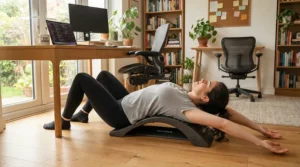
Week one: use the shallowest setting for one to two minutes on a firm, flat floor (a yoga mat is ideal), never on a sofa or soft chair. For a board, the arch should sit at the small of your back, roughly at belt level. Lower yourself slowly, breathe out, and stand up gradually afterwards.
Week two: if you felt looser, extend to three to five minutes. If you felt worse, stay where you are or stop.
Weeks three and four: build towards five to ten minutes only if every session feels comfortable, and move up one setting at most. A stronger arch is not a better arch.
Common first-month mistakes include jumping straight to the top angle, lying on the device for as long as a favourite podcast episode, using it right after a heavy lifting session, and treating it as a substitute for getting up and walking around. Use it once or twice a day, ideally off the clock, then take a minute’s walk afterwards and note honestly how your back feels.
Real-World Scenarios: Three Desk Workers, Three Different Picks
These are illustrative profiles, not real people, designed to show how the reasoning plays out.
The hybrid worker with a stiff lower back. Three days a week at the kitchen table, two in the office, mostly lumbar tightness by evening, budget under £25. MINOLL Back Stretcher on its 15° setting is the logical start: predictable, light, and easy to stash. If the plastic feels harsh, Everlasting Comfort Back Stretcher adds padding for a similar spend.
The laptop-hunched mid-back. Eight hours at a laptop, shoulders curled forward, the stiffness sitting between the shoulder blades rather than the waist. A lumbar board misses the target. Chirp Wheel XR gives controlled mid-back rolling, while Halo Spine Stretcher suits someone taller who prefers lying still on a long platform.
The open-plan office worker. No floor space, no private room, but a chair and ten spare minutes. GLYVIAN Inflatable Stretcher is the only option here designed for the seat itself. Keep inflation modest and treat it as support between standing breaks.
Problem-to-Solution Guide
“My mid-back feels locked solid.” A fixed lumbar arch won’t reach it. Try Chirp Wheel XR for slow rolling, or Halo Spine Stretcher for a longer surface, and support your head with your hands.
“The board digs in through my shirt.” That’s the contact-point texture. Switch to RESTCLOUD Back Stretcher or Everlasting Comfort Back Stretcher, or start at the lowest setting with a thicker top.
“I can’t lie on an office floor.” Use GLYVIAN Inflatable Stretcher strapped to your chair, and keep sessions short.
“I stand up and my hips feel jammed.” Hip-flexor tightness is a classic desk side-effect. Thrival Arch Back Stretcher is built for hip and glute placement, but spend the first sessions with its manual open.
How to Choose a Back Stretcher for Desk Workers with Stiff Spines
- Locate your stiffness. Low back points towards a board or cushion; mid back points towards a wheel or long platform. Buying the wrong format is the most common error.
- Check the arch range. A lower setting around 15° is a gentle start, while 42-45° is deep. Having both means you can progress.
- Match capacity to your body. A stated capacity well above your weight reduces the chance of flexing or shifting under load.
- Judge the surface. Bare plastic, foam or textured nodes feel very different. Sensitive skin or tender muscles favour padding.
- Consider storage and portability. If it lives under a bed, a slim board wins. If it must go in a bag, weigh up size and weight.
- Weigh the review base. Thousands of reviews at 4.0-4.2 tell you something different from 24 reviews at 4.1.
- Ask whether it’s safe for you. Recent surgery, fractures or diagnosed spinal conditions mean checking with a clinician first.
Thoracic Extension: The Missing Move in a Desk Day
The thoracic spine is the rib-bearing middle section of your back, and it’s where the typical slump lives. Thoracic extension simply means your ability to arch that section backwards. Sitting trains the opposite, hour after hour.
An Australian cross-sectional study of young, asymptomatic adults found thoracic extension range is small when measured from habitual standing, and noticeably greater in unloaded positions like lying face down or on all fours than in standing or sitting. The practical takeaway is modest but useful: lying-based positions make extension easier to access than trying to arch while upright. The study measured healthy adults, not stretcher users, so it doesn’t prove any device improves anything.
In practice, a compact board like MINOLL Back Stretcher is built for the lumbar curve, not the ribs, and shouldn’t be pressed against the ribcage. For thoracic extension, Chirp Wheel XR and Halo Spine Stretcher are the better matches. Support your head with your hands, make small movements, and avoid forcing your neck backwards. Short, comfortable sessions beat heroic ones.
Spinal Stretcher for Sitting All Day: What to Expect in Real Life
Be realistic and you’ll be happier. A spinal stretcher for sitting all day typically offers a loosening sensation afterwards, sometimes accompanied by a pop or crack that is common in reviews but isn’t a measure of success. Expect the first sessions to feel odd, and some reviewers report it takes time to get used to.
Movement is the stronger lever. In a Korean study of 58 seated VDT workers, a thoracic exercise programme was followed by reduced kyphosis angle and lower pain scores compared with a control group. That was an exercise programme, not a device, which is the point: consistent movement matters more than any gadget. A stretcher works best as one part of that, not a replacement.
So treat a spinal stretcher for sitting all day like a good coffee break for your back. Pleasant, useful, and no excuse to skip the stand-up-and-walk part of the working day.
Arched Back Stretcher for Office Posture: Does the Curve Matter?
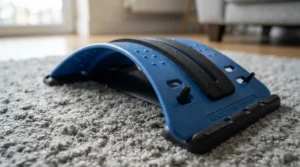
An arched back stretcher for office posture relies on a simple idea: if sitting rounds you forward, lying over a curve nudges you the other way. The degrees matter. Around 15° is a mild arch, 28-30° moderate, and 42-45° deep. The MINOLL Back Stretcher and Everlasting Comfort Back Stretcher both span that gentle-to-deep range.
Be sceptical of “posture correction” language. Posture is less a pose to hold than a habit of changing position, so the realistic benefit of an arched back stretcher for office posture is a brief reduction in stiffness that makes varied sitting easier. It won’t permanently “reset” your spine.
Pick the curve that feels comfortable and leave the steepest setting for later, if ever. Strong arches aren’t automatically better, and a gentle stretch you’ll repeat beats a deep one you dread.
Back Stretcher vs Alternatives: Rollers, Movement Breaks and Physio
| Option | What It Does | Typical Cost | Limits | Best For |
|---|---|---|---|---|
| Arched back stretcher (e.g. MINOLL Back Stretcher) | Passive backward arch | Low (about £15-£30) | Lumbar-focused, not a treatment | Quick lower-back resets |
| Foam roller | Rolling pressure along muscles | Low | Can be intense; technique-dependent | Active, mobile users |
| Scheduled movement breaks | Changes posture and loading | Free | Needs discipline | Everyone, as the foundation |
| Physio-led programme | Assessment and tailored advice | Higher, varies | Appointments and cost | Persistent or unclear pain |
The table makes one thing clear: movement breaks are the foundation, and a stretcher is an accessory. A stretcher beats a roller for people who want a passive, low-effort reset, while a roller beats it for anyone who wants control over where pressure lands. If pain is persistent, spreading, or unexplained, a clinician’s assessment is worth more than any gadget, however well reviewed.
Features That Actually Matter (And Those That Don’t)
Matter: arch range, stable capacity, comfortable surface, a size you’ll actually store, and a decent review base. These shape whether you’ll use the thing next Tuesday.
Matter less than marketing suggests: the number of acupressure contacts. 102 nodes versus 88 is a texture difference, not a therapeutic one, and many people will prefer fewer or softer points. Claims about “decompression”, scoliosis or spinal realignment are marketing language, and I’d treat them as claims to be sceptical of rather than outcomes to expect.
A chair strap sounds clever, but check whether you’ll genuinely use it. A device you strap to your chair and never loosen defeats the purpose of changing position. GLYVIAN Inflatable Stretcher is the most chair-centred option, but even then short sessions are the sensible approach.
Common Mistakes When Buying a Back Stretcher
- Buying by node count. More contact points can mean more discomfort, not more benefit.
- Ignoring the format. A lumbar board won’t solve upper-back stiffness. Match the tool to the problem.
- Trusting a rating without the review count. A 4.4 from 31 reviews isn’t the same as 4.2 from thousands.
- Skipping capacity. A board that shifts under you won’t deliver the arch it promises.
- Starting at maximum. Every product here supports a gentle start. Use it.
- Expecting a cure. If a listing promises to fix scoliosis or realign your spine, move on.
- Using it when you shouldn’t. Recent surgery, a fracture or osteoporosis all call for medical advice first.
Long-Term Cost and Maintenance
The upfront cost of most options here is modest, which makes the cost-per-use sums friendly. A board in the £15-£25 band used for five minutes most days across a year works out to pennies per session, and a single private physio appointment can cost more than a whole board.
Maintenance is minimal but not zero. Wipe plastic boards occasionally and inspect them for cracks, especially at the arch hinge points. The washable cover on Everlasting Comfort Back Stretcher is a genuine plus. Foam on RESTCLOUD Back Stretcher will compress with use, and GLYVIAN Inflatable Stretcher should be checked for slow leaks, since inflatable parts can’t be judged for long-term durability on 24 reviews. Store everything flat, away from heat and direct sunlight.
Over the long run, the cheapest option isn’t necessarily the best value. A £20 product you use daily beats a £50 one gathering dust.
Safety Guide: When to Skip the Stretcher
A back stretcher is not a medical device that clears you for use, and nothing here is personal medical advice. Skip it, and speak to a GP, pharmacist or NHS 111, if you have a recent spinal fracture or surgery, diagnosed osteoporosis (get a clinician’s guidance first), or any ongoing radiating pain. Stop and seek advice if you notice numbness, tingling, weakness, bowel or bladder changes, fever, or pain following a fall or accident.
Your employer has duties too. Under the Health and Safety (Display Screen Equipment) Regulations 1992, employers must plan work so there are breaks or changes of activity for regular screen users. The HSE’s guidance on work routine and breaks says short, frequent breaks are better than longer, less frequent ones. A stretcher doesn’t replace a proper workstation assessment, a well-adjusted chair or standing up regularly.
FAQ
❓ Is a back stretcher for desk workers with stiff spines worth buying?
❓ How long should I use a spinal stretcher for sitting all day?
❓ Can an arched back stretcher for office posture help my upper back?
❓ Which back stretcher is best for thoracic extension?
❓ Can I use a back stretcher on my office chair?
Conclusion: Small Arch, Big Reset
The best back stretcher for desk workers with stiff spines is the one that matches where your stiffness lives and that you’ll actually use. For most beginners, MINOLL Back Stretcher is the sensible, value-led starting point, and Everlasting Comfort Back Stretcher is the softer alternative. If the trouble is between the shoulder blades, Chirp Wheel XR and Halo Spine Stretcher fit better. RESTCLOUD Back Stretcher suits anyone who wants cushioning before intensity, GLYVIAN Inflatable Stretcher is the desk-side option, and Thrival Arch Back Stretcher targets the hips that sitting tends to tighten.
Whichever you choose, start gently, keep sessions short, and let movement breaks do the heavy lifting. If anything feels wrong, a conversation with a clinician is worth more than another gadget.
Recommended for You
- Portable Stretching Machine For Small Flats: 7 Best Buys (2026)
- Percussion Therapy Device For Athletes: 7 Essential Picks (2026)
- Massage Cupping Kit For Beginners: 7 Easy, Safe Picks (2026)
Disclaimer: This article contains affiliate links. As an Amazon Associate, I earn from qualifying purchases. If you purchase products through these links, we may earn a small commission at no additional cost to you.
✨ Found this helpful? Share it with your friends! 💬🤗
