In This Article
There’s a very specific kind of ache that shows up after a long run, a heavy leg day, or simply an entire week hunched over a laptop — that dull, deep tightness sitting somewhere between your shoulder blades or camped out along one hamstring, refusing to shift no matter how you stretch. The best body roller for that particular problem isn’t always the most expensive one, and it definitely isn’t always a plain foam cylinder either. The market has genuinely diversified: foam rollers, textured deep-tissue rollers, dual ball rollers, handheld sticks, and battery-powered vibrating rollers all claim the same territory, and picking the wrong shape for your specific tight spot means an expensive tool gathering dust in a cupboard.

Here’s the short version: a body roller is a self-massage device you use by applying your own body weight (or hand pressure, in the case of handheld sticks and balls) against a firm or textured surface, rolling it slowly across a muscle to ease tightness and encourage blood flow to the area. It’s worth being upfront about the science here too — research on self-myofascial release is genuinely mixed, and reviewers of the underlying evidence note it works better as a comfort and mobility tool than as a guaranteed fix for pain. That’s not a reason to dismiss it; it’s a reason to pick sensibly and keep expectations realistic. For anyone dealing with back pain specifically rather than general post-exercise stiffness, it’s worth first reading the NHS guidance on back pain, since a roller is a maintenance tool, not a diagnosis or a substitute for proper assessment.
This guide covers seven genuinely different, currently available body rollers — from a basic budget cylinder through to an app-connected vibrating roller — spanning foam, textured, stick, dual ball, and powered categories, so you can match the shape to your actual problem area rather than buying whatever’s cheapest on page one of the search results.
Quick Comparison Table
| Roller | Best For | Type | Weight/Portability | Price Range |
|---|---|---|---|---|
| ProsourceFit High Density Foam Roller | Tightest budget | Solid foam | Light, bulky | £15-£25 |
| TriggerPoint GRID 1.0 | All-round versatility | Ridged foam | Light, compact | £35-£45 |
| RumbleRoller Original Textured | Deep tissue intensity | Bumped foam | Light, bulky | £45-£60 |
| Tiger Tail 18in Massage Stick | Rolling massage tool for back, solo use | Handheld stick | Very portable | £25-£35 |
| RAD Roller Peanut | Dual ball roller for spine-adjacent knots | Dual ball | Pocket-sized | £25-£35 |
| Pulseroll Vyb Pro | UK-made vibrating power | Vibrating foam | Light, needs charging | £80-£100 |
| Therabody Wave Roller | App-guided routines | Vibrating foam | Light, needs charging | £140-£180 |
Looking at the spread, the jump from £25 to £180 isn’t really about “better” in a linear sense — it’s about added technology (vibration, an app, guided routines) layered onto the same basic mechanical principle. A £20 solid foam cylinder and a £160 app-connected vibrating roller both work by applying sustained pressure to a muscle; the expensive one just does it with more settings and considerably more marketing.
💬 Just one click — help others make better buying decisions too!😊
Top 7 Best Body Rollers: Expert Analysis
Seven real, currently purchasable rollers, spanning budget to premium and covering the main shape categories you’ll actually encounter when shopping — because “best” genuinely depends on which muscle group and which kind of tightness you’re targeting.
1. ProsourceFit High Density Foam Roller — the cheapest genuinely firm option worth buying
The standout here is simple: proper high-density EPP foam construction at a price point where most rivals cut corners with softer, quicker-collapsing material. The ProsourceFit High Density Foam Roller holds its shape under a rated 300lb load, which in practice means it won’t develop a permanent dent down the middle after a few months of regular use, unlike the cheapest hollow-core alternatives on the market.
On paper, “high density” and “firm” sound interchangeable with “better,” but that’s not universally true — firmer isn’t automatically more effective, it’s simply more intense, and a genuinely firm roller can be uncomfortable rather than useful for a beginner rolling out a hamstring for the first time. Based on the spec comparison against softer alternatives, this roller sits toward the firmer end, which suits people already comfortable with deeper pressure rather than complete newcomers to rolling.
Reviewers consistently note the water-resistant, easy-to-wipe-down surface as a practical plus for anyone using it post-workout in a gym bag rotation, and the smooth (non-textured) surface makes it a sensible starting point before graduating to something like the ridged TriggerPoint GRID 1.0 further down this list.
Pros:
- ✅ Genuinely high-density foam that resists compression over time
- ✅ Water-resistant surface, easy to clean after gym use
- ✅ Strong value at the lowest price point in this guide
Cons:
- ❌ Smooth surface offers less targeted texture than ridged rivals
- ❌ Firmness may feel intense for complete beginners
At around £15-£25, the ProsourceFit High Density Foam Roller is the sensible first purchase for anyone testing whether foam rolling suits their routine before spending more.

2. TriggerPoint GRID 1.0 — the most tested, most versatile all-rounder
If there’s a default answer to “best body roller” for general use, this is usually it. The TriggerPoint GRID 1.0 uses a hollow, multi-density core wrapped in a distinctive grid-patterned exterior, combining a firmer inner layer for structural support with a softer outer layer that distributes pressure more evenly than a solid foam block.
What most buyers overlook about this design is that the varied surface pattern isn’t purely cosmetic — the raised and recessed sections are engineered to mimic the feel of a therapist’s hands moving across different muscle depths, rather than delivering one uniform pressure the way a plain cylinder does. At roughly 13 inches, it’s compact enough for a gym bag while still offering enough rolling surface for backs, quads, and calves without constantly repositioning.
Aggregated review sentiment across more than a decade of this product’s various iterations is strongly positive, with the recurring praise being genuine durability — many long-term users report years of regular use without the core collapsing, a common failure point on cheaper hollow rollers. The main critique that surfaces repeatedly is that newcomers sometimes find even the “standard” density more intense than expected on already-sore muscles.
Pros:
- ✅ Multi-density design mimics varied hand pressure
- ✅ Compact 13-inch size travels well without sacrificing coverage
- ✅ Long track record of durability across repeated iterations
Cons:
- ❌ Standard density can feel intense for first-time users
- ❌ Hollow core means less floor stability than solid foam on hard surfaces
Typically priced around £35-£45, the TriggerPoint GRID 1.0 earns its reputation as the roller most people should default to if they only want to own one.
3. RumbleRoller Original Textured Foam Roller — deepest tissue penetration via raised bump texture
This is the roller for anyone who’s tried a standard foam cylinder and come away thinking “that didn’t really get into the knot.” The RumbleRoller Original Textured Foam Roller uses raised, flexible bumps across its surface specifically engineered to displace soft tissue around bones and press deeper into localised tight spots than a smooth or lightly ridged surface can manage.
Here’s what the spec sheet won’t tell you, but user reports suggest: those bumps are genuinely intense, and reviewers who are new to foam rolling consistently describe an initial “is this actually helping or just hurting” reaction before adjusting to the sensation over a few sessions. The closed-cell, heat-molded foam construction is built for durability under that kind of repeated, concentrated pressure, and independent testers note it holds its shape notably better over time than softer rollers subjected to the same use.
Based on the spec comparison against the smoother TriggerPoint GRID 1.0, the RumbleRoller trades broad, gentle coverage for narrow, targeted intensity — it’s the better tool for someone who already knows exactly where their knot is and wants to work directly on it, rather than someone doing a general full-body warm-up roll.
Pros:
- ✅ Raised bump texture targets deep, localised knots directly
- ✅ Durable closed-cell foam resists shape loss over time
- ✅ Side-to-side rocking motion intensifies pressure further
Cons:
- ❌ Genuinely intense; not recommended for complete rolling beginners
- ❌ Less comfortable than smoother rollers for broad, gentle coverage
Generally found in the £45-£60 range, the RumbleRoller Original Textured Foam Roller is the pick for experienced users chasing specific trigger points rather than general muscle maintenance.
4. Tiger Tail 18in Massage Stick — best rolling massage tool for reaching your own back solo
This is the rolling massage tool for back specifically, in a way floor-based rollers genuinely aren’t — because you’re not lying on it, you’re holding it and controlling exactly where the pressure goes. The Tiger Tail 18in Massage Stick features a firm, non-flexing shaft with a smooth-spinning cushioned centre section and two 4-inch cushioned grip handles, letting you apply pressure standing, sitting, or even at a desk without getting down on the floor at all.
The 10-inch working surface between the handles is enough to cover the length of a calf or forearm in one pass, and the spinning action means the roller moves independently of your grip, which reduces friction on the skin compared with simply dragging a static object across a muscle. Reviewers consistently rate it highly for portability specifically — it fits in a gym bag, a desk drawer, or a suitcase in a way that a full-length foam roller never will.
What most buyers overlook about stick-style rollers generally is that they’re actually better than floor rollers for reaching your own upper back and shoulders precisely because you control the leverage with your arms rather than relying on gravity and body positioning — genuinely useful for anyone whose main complaint is desk-related shoulder and mid-back tension rather than leg soreness after exercise.
Pros:
- ✅ Reach your own back and shoulders without lying on the floor
- ✅ Highly portable; fits easily in a bag or desk drawer
- ✅ Firm, non-bending design allows precise, controlled pressure
Cons:
- ❌ Narrower working surface than full-length foam rollers
- ❌ Requires more active arm effort than passive body-weight rolling
At roughly £25-£35, the Tiger Tail 18in Massage Stick is the single most practical pick in this guide for anyone whose tension is concentrated in hard-to-reach upper back and shoulder areas.
5. RAD Roller Peanut — precision dual ball roller for spine-adjacent tension
For anyone specifically searching for a dual ball roller, this peanut-shaped tool is the category standard rather than a generic imitation. The RAD Roller Peanut uses two joined spheres with a channel between them, designed so the gap straddles the spine while the two balls apply pressure to the muscle on either side — solving a problem flat rollers genuinely can’t, since a solid cylinder pressing directly on the spine is uncomfortable rather than therapeutic.
Available in multiple densities from soft through stiff, the RAD Roller lets buyers match intensity to sensitivity rather than being stuck with a single fixed firmness, which matters considerably more for a small, concentrated tool like this than for a broad foam roller where your body weight is distributed across a wider surface. Reviewers consistently praise it for suboccipital release — working the base of the skull where tension headaches often originate — a use case few other rollers in this guide are genuinely well-suited to.
Based on the spec comparison against the broader RumbleRoller, what most buyers overlook is that the RAD Roller Peanut trades coverage area for precision entirely — this is not a full-body warm-up tool, it’s a targeted device for the neck, spine-adjacent back muscles, and feet, and buying it expecting quad or hamstring coverage will lead to disappointment.
Pros:
- ✅ Spine-safe channel design avoids direct pressure on vertebrae
- ✅ Multiple density options match sensitivity to user needs
- ✅ Genuinely effective for suboccipital and neck-base tension
Cons:
- ❌ Narrow coverage area, not suited to large muscle groups
- ❌ Requires learning correct placement to use safely and effectively
Typically priced around £25-£35 depending on density, the RAD Roller Peanut is the smartest pick in this guide for anyone whose tension sits specifically along the spine or at the base of the skull rather than in the major leg muscles.

6. Pulseroll Vyb Pro — UK-made vibrating roller with a genuinely useful finger remote
Stepping into powered territory, the Pulseroll Vyb Pro is a British-brand vibrating foam roller offering five settings — four fixed vibration speeds plus a pulsing mode — controlled via a small remote that clips onto a finger, letting you change intensity mid-roll without breaking position or fumbling for a button on the roller itself.
The vibration motor runs on a rechargeable 7.2V lithium-ion battery rated for up to six hours at lower speeds, dropping to roughly 2.5 hours at the most intense setting, and independent testing consistently ranks it competitively against pricier rivals on vibration smoothness specifically — a genuinely important quality metric, since a buzzy, uneven motor is more irritating than helpful during a rolling session. As a UK-based brand, buyers also get more straightforward warranty and support access than with US-manufactured alternatives.
What most buyers overlook about vibrating rollers generally is that the vibration itself doesn’t replace correct technique — it’s an addition, not a substitute, and the theoretical benefit (helping muscles relax faster than static pressure alone) is genuinely still an area of ongoing research rather than settled fact. Reviewers describe the physical effect as making sessions feel more effective without necessarily being able to prove that objectively, which is a fair characterisation of vibrating recovery tools generally.
Pros:
- ✅ Finger-mounted remote allows on-the-fly speed changes
- ✅ Five vibration settings including a distinct pulse mode
- ✅ UK brand means simpler warranty and support access
Cons:
- ❌ Battery life drops sharply at the highest vibration setting
- ❌ Vibration benefit over static rolling remains scientifically unproven
Usually listed in the £80-£100 range, the Pulseroll Vyb Pro is the strongest mid-premium pick for UK buyers wanting powered rolling without paying for an app ecosystem they may never use.
7. Therabody Wave Roller — app-guided routines for a genuine self-massage device experience
At the top of this list sits the roller built by the same company behind the well-known Theragun percussive massage guns. The Therabody Wave Roller pairs a distinctive wave-textured, high-density EVA foam surface with Bluetooth connectivity to the Therabody app, which offers guided routines specifying exactly which muscles to target, at what vibration frequency, and for how long.
The “wave” surface itself is deliberately non-aggressive — no sharp ridges or bumps, just a gently contoured texture that Therabody describes as “penetrative,” meaning the vibration does the mechanical work rather than the shape of the roller digging in. This makes it noticeably more comfortable for broad muscle group coverage than a textured roller like the RumbleRoller, though correspondingly less targeted for hunting a specific small knot.
Here’s what most buyers overlook: the real differentiator isn’t the roller hardware at all, it’s the guided programming — if you already own a Theragun percussive device, the app sequences both tools into a single structured recovery routine, which has genuine value for anyone following a structured training programme rather than rolling out muscles at random. Reviewers consistently note that buyers without a Theragun, or without much interest in app-guided routines, are paying a substantial premium for software they may rarely open.
Pros:
- ✅ App-guided routines with specific target, duration, and intensity
- ✅ Wave texture offers broad, comfortable coverage over large muscles
- ✅ Integrates with Theragun massage guns for combined recovery routines
Cons:
- ❌ Highest price point in this guide by a significant margin
- ❌ Core value depends on actually using the companion app
Generally priced around £140-£180, the Therabody Wave Roller makes most sense as a genuine self-massage device for buyers already invested in the Therabody ecosystem rather than a first purchase for casual use.
Top 7 at a Glance: Spec Comparison
| Roller | Vibration? | Coverage | Best For |
|---|---|---|---|
| ProsourceFit High Density Foam Roller | No | Broad | Budget entry point |
| TriggerPoint GRID 1.0 | No | Broad | General all-round use |
| RumbleRoller Original Textured | No | Targeted | Deep, specific knots |
| Tiger Tail 18in Massage Stick | No | Targeted | Solo back and shoulder reach |
| RAD Roller Peanut | No | Narrow | Spine-adjacent and neck tension |
| Pulseroll Vyb Pro | Yes | Broad | Powered rolling, UK support |
| Therabody Wave Roller | Yes | Broad | App-guided structured recovery |
The clearest pattern: vibration is purely a premium-tier feature here, and every non-vibrating option in this guide costs under £60. If budget is tight, that’s not a compromise on the core mechanism — it’s simply skipping the motor, not the massage.
✨ Don’t Miss These Exclusive Deals!
🔍 Take your recovery routine to the next level with these carefully selected rollers. Click on any highlighted pick to check current pricing and availability, and find the shape that actually matches where your tension lives.
Setting Up Your Self-Massage Device: A Practical Usage Guide
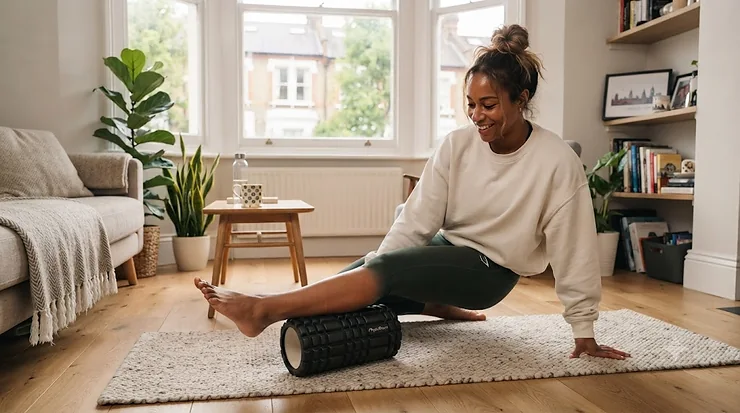
Getting genuine value from any self-massage device comes down to technique more than the tool itself. Start slowly: for a first session on any muscle group, roll gently for 30-60 seconds rather than immediately hunting for the most painful spot and pressing hard — muscles that are already tight tend to guard against sudden intense pressure, which can make the session counterproductive rather than helpful.
When you do find a genuinely tender spot, the common approach is to pause and hold light-to-moderate pressure on it for roughly 20-30 seconds rather than continuously rolling back and forth over it, allowing the muscle time to release rather than repeatedly re-triggering the same guarding response. Breathing steadily through this matters more than people expect — holding your breath while pressing into a knot tends to increase overall muscle tension rather than reduce it.
A common first-month mistake is rolling directly over joints, bones, or the lower back’s bony processes rather than the surrounding muscle tissue — tools like the RAD Roller Peanut exist specifically because a flat roller pressed directly onto the spine is uncomfortable rather than therapeutic. Finally, budget a couple of minutes after each session to wipe down foam surfaces, particularly textured ones like the RumbleRoller, since sweat and grip residue accumulate in the grooves faster than on smooth rollers.
Real-World Scenarios: Which Body Roller Fits Your Situation
The desk worker with recurring shoulder and mid-back tightness: floor-based rolling is awkward without a gym mat and privacy, and the tension itself often sits in a spot that’s genuinely hard to reach lying down. The Tiger Tail 18in Massage Stick solves this directly, letting you work standing at a desk during a break, while the RAD Roller Peanut handles the base-of-skull tension that often accompanies long screen sessions.
The runner or gym-goer managing weekly post-workout soreness: broad coverage across quads, calves, and glutes matters more than pinpoint precision here, and a firm, durable roller earns back its cost through regular use. The TriggerPoint GRID 1.0 is the sensible default, with the RumbleRoller as a step-up option once you’re comfortable with more intense pressure on specific tight spots.
The structured-training athlete already invested in a recovery routine: if you’re tracking training load and want recovery to be equally programmatic rather than intuitive, the Therabody Wave Roller‘s app-guided sessions genuinely add value here in a way they wouldn’t for occasional users — pairing a data-driven training plan with an equally structured recovery protocol rather than rolling at random.
How to Choose a Body Massage Roller for Tension
Choosing the right tool for genuine muscle tension relief comes down to five checkable steps:
- Identify where your tension actually sits. Broad muscle groups (quads, back, calves) suit foam rollers; narrow, specific areas (spine-adjacent muscles, neck base, feet) suit dual ball rollers and handheld sticks far better.
- Match intensity to experience level. Beginners generally do better starting with a smooth, moderate-density roller like the ProsourceFit before progressing to textured or bumped options.
- Consider your available space and privacy. Floor rollers require lying down on a mat; stick and handheld options work standing at a desk or in a shared office, which matters more than people initially assume.
- Decide whether vibration justifies the price jump. The mechanical benefit of static versus vibrating rolling remains genuinely under-researched, so this is more a comfort and convenience preference than a proven necessity.
- Factor in how consistently you’ll actually use it. The most expensive, most feature-rich roller has zero value sitting unused in a cupboard — a £20 roller used three times weekly outperforms a £160 roller used once a month.
Self-myofascial release using rollers falls under the broader umbrella of foam rolling as a recovery technique, and it’s worth reading a balanced overview of the underlying evidence before assuming any specific roller shape offers a dramatically different physiological effect from another — in practice, consistency of use tends to matter more than the specific tool.
Back Massage Roller vs Rolling Massage Tool for Back: What’s the Difference
These two phrases get used almost interchangeably in product listings, but they describe genuinely different tools. A back massage roller typically refers to a floor-based foam cylinder you lie on, using your own body weight to apply pressure as you shift position — the TriggerPoint GRID 1.0 and RumbleRoller both fall into this category.
A rolling massage tool for back, by contrast, usually describes a handheld device like the Tiger Tail 18in Massage Stick, which you actively hold and manoeuvre yourself rather than lying on. The practical difference matters more than the naming confusion suggests: floor rollers rely on gravity and are genuinely difficult to use on your own upper back and shoulders without contorting into an awkward position, while handheld stick tools let you reach precisely where you want with direct arm control, at the cost of requiring more active effort since you’re generating the pressure yourself rather than letting body weight do the work.
For lower back and glute tension, floor-based rollers generally win on comfort and coverage. For upper back, shoulder, and neck tension specifically — the areas hardest to reach with your own body weight on a mat — handheld rolling tools consistently prove more practical, which is exactly why owning one of each category, rather than assuming one tool covers every use case, tends to be the more sensible long-term approach.
Dual Ball Roller Explained: When Two Balls Beat One
A dual ball roller, sometimes called a peanut roller, solves a specific problem that flat and single-ball tools genuinely can’t: pressing directly on the spine itself is uncomfortable and not something any credible source recommends, yet the muscles running immediately alongside the spine are exactly where a lot of back tension concentrates. The peanut shape — two connected spheres with a channel between them — lets the balls apply pressure to the muscle tissue on either side of the spine while the gap straddles the vertebrae themselves, avoiding direct bony contact entirely.
This design also works well for the base of the skull, where the same problem applies on a smaller scale — flat pressure there is uncomfortable, while the peanut shape’s channel accommodates the spine’s natural curve at the neck. The RAD Roller Peanut in this guide is available across multiple densities specifically because this precision use case benefits more from matched firmness than broad rollers do, where body weight naturally moderates the pressure regardless of the roller’s density.
What most buyers overlook about dual ball rollers is that they’re a poor substitute for a full-length foam roller on large muscle groups like quads or hamstrings — the narrow contact area that makes them so effective for spine-adjacent work is precisely what makes them inefficient for covering a broad muscle in reasonable time. Own one alongside a standard roller rather than instead of one.
Common Mistakes When Using a Body Roller
The most common mistake is rolling directly and repeatedly over the lower back’s bony processes or any joint rather than the surrounding soft tissue — this applies pressure to structures that simply aren’t designed to be rolled and can cause discomfort without any genuine benefit. Stick to muscle tissue, and use a dual ball roller specifically for anything spine-adjacent.
A close second: assuming more pressure always equals more benefit. Reviewers of textured, intense rollers like the RumbleRoller consistently note that pushing straight to maximum intensity as a beginner tends to trigger a protective muscle-guarding response rather than genuine relaxation — working up gradually over several sessions produces better results than one aggressive first attempt.
Buyers also frequently roll for far longer than necessary, assuming extended time on a single spot compounds the benefit. Most guidance suggests roughly 30-90 seconds per muscle group is sufficient; beyond that, returns diminish and prolonged pressure on the same spot can occasionally leave temporary bruising, particularly with firmer or textured tools. Finally, many people skip rolling entirely when muscles feel their tightest, when in fact gentle, low-intensity rolling during acute soreness (rather than aggressive rolling) is generally the more appropriate approach — see the safety section below for when to stop entirely and seek professional advice instead.
Features That Actually Matter (And Those That Don’t)
Cutting through the marketing: roller density, surface texture, and shape (broad cylinder versus targeted dual ball versus handheld stick) are the three factors that determine whether a roller actually suits your specific tension — everything else is refinement layered on top. Vibration is a genuine comfort and convenience upgrade, but the underlying evidence that it meaningfully outperforms static rolling remains limited, so it’s reasonable to treat it as a nice-to-have rather than essential.
Features that generate significant marketing copy but deliver comparatively little for most buyers: heat or cooling functions built into some premium rollers (a pleasant sensation, but not something independent evidence strongly supports as adding therapeutic value beyond the rolling itself), and elaborate multi-colour LED displays on powered rollers, which add nothing functional. App connectivity, similarly, only adds real value if you’ll genuinely use guided routines rather than simply rolling by feel.
One feature worth genuinely prioritising that’s easy to overlook in spec sheets: surface material durability. A textured or ridged roller that loses its shape within months, common among the cheapest imported options, becomes a smooth, ineffective cylinder faster than the marketing copy suggests — checking for high-density or closed-cell foam construction, as seen on the RumbleRoller and TriggerPoint GRID 1.0, is a more reliable predictor of long-term value than the number of settings a powered roller offers.
Foam Roller vs Massage Gun vs Self-Massage Device
| Factor | Foam Roller | Massage Gun | Dual Ball / Stick Roller |
|---|---|---|---|
| Coverage | Broad muscle groups | Broad and targeted | Narrow, precise |
| Effort required | Body weight does the work | Minimal, motor-driven | Active arm effort |
| Typical price | £15-£60 | £80-£300+ | £25-£35 |
| Best for | General maintenance, warm-up | Deep, motorised pressure | Spine-adjacent, hard-to-reach spots |
The core distinction worth understanding: a massage gun applies rapid percussive pressure via a motor, requiring almost no physical effort from the user, while a roller — vibrating or not — still requires you to position and move it yourself. Neither category is objectively superior; a foam roller offers broader coverage per session and no battery to charge, while a massage gun offers more targeted, adjustable intensity at the cost of a considerably higher price point and a device to keep charged. Many people who use rollers regularly eventually add a massage gun rather than replacing one with the other, since they solve overlapping but not identical problems.
Long-Term Cost & Maintenance
Thinking in cost-per-use rather than upfront price changes the calculation considerably. A £40 TriggerPoint GRID 1.0 used three times weekly for a year works out to roughly 25p per session — genuinely comparable to replacing a £15 budget roller every few months once its foam core inevitably compresses under frequent heavy use, which several reviewers of the cheapest imported rollers report happening within a single season of regular training.
That said, the premium tier doesn’t automatically justify itself the same way a premium office chair might. A £160 Therabody Wave Roller only earns back its price if the app-guided routines genuinely change how consistently you use it — the underlying rolling mechanism isn’t meaningfully more durable or effective than a £40 foam roller used with equal discipline. For most buyers, the sensible long-term spend sits in the £35-£60 range: durable enough to last years, without paying a substantial premium for software features that may go unused.
Maintenance costs are minimal across this entire category compared with other recovery tools — no replacement parts, no consumables, and the main failure point (foam shape loss) is a slow, gradual process rather than a sudden breakdown. Vibrating rollers do carry one additional long-term cost: rechargeable batteries degrade over years of charge cycles, and neither the Pulseroll Vyb Pro nor the Therabody Wave Roller currently offers a user-replaceable battery, meaning eventual reduced runtime is a realistic expectation after several years of regular use.
Safety and When to See a Professional
Body rollers are broadly low-risk tools for healthy adults managing ordinary muscle tightness, but a few sensible precautions apply. Avoid rolling directly over varicose veins, recent injuries, broken skin, or areas of acute swelling, and stop immediately if a sensation shifts from “uncomfortable but bearable” to sharp or genuinely painful — that shift is a signal to stop, not push through.
If you’re managing an existing musculoskeletal condition, pregnancy, or a diagnosed circulatory issue, it’s sensible to check with a GP or physiotherapist before starting a new rolling routine, since individual contraindications vary considerably and a generic buying guide can’t account for personal medical history. For structured, evidence-based stretching and mobility exercises specifically for back tension, the Versus Arthritis exercise sheet is a genuinely useful free resource that complements rather than replaces rolling.
It’s also worth remembering that a body roller addresses symptoms, not underlying causes — if your tension consistently stems from desk posture, revisiting your workstation setup matters at least as much as any recovery tool. The HSE’s guidance on good posture at a display screen is a useful starting point if recurring shoulder and neck tightness traces back to hours spent at a desk rather than exercise.
Frequently Asked Questions
❓ What is the best body roller for beginners?
❓ Do vibrating body rollers actually work better than standard foam rollers?
❓ How long should I use a body roller for each muscle group?
❓ What's the difference between a dual ball roller and a regular foam roller?
❓ Can a body roller replace a massage gun?
Conclusion
There’s no single best body roller, because the category genuinely spans several different tools solving different problems — a foam cylinder, a textured deep-tissue roller, a handheld stick, a dual ball peanut, and increasingly, a vibrating powered version of any of the above. What matters more than brand or price is matching the shape to where your tension actually sits: broad muscle groups call for a standard or textured foam roller, spine-adjacent and neck tension calls for a dual ball roller, and hard-to-reach upper back and shoulder tightness calls for a handheld stick rather than anything you lie on.
If you’re starting out or working with a tight budget, the ProsourceFit High Density Foam Roller or TriggerPoint GRID 1.0 cover the fundamentals without overspending. For targeted spine and neck relief, the RAD Roller Peanut solves a problem broad rollers genuinely can’t. And if you’re already committed to a structured recovery routine and want the technology to match, the Pulseroll Vyb Pro and Therabody Wave Roller both deliver — provided you’ll actually use the extra features rather than paying for them to sit idle.
Whichever you choose, remember a roller is a maintenance and comfort tool rather than a medical treatment — persistent or worsening pain deserves a proper assessment rather than more aggressive rolling.
✨ Don’t Miss These Exclusive Deals!
🔍 Take your recovery routine to the next level with these carefully selected rollers. Click on any highlighted pick above to check current pricing and availability, and give your tightest muscles the attention they’ve been asking for.
Recommended for You
- Best Percussion Massager 2026: 7 Proven Picks Reviewed
- Tapping Massage Device 2026: 7 Best Picks for Sore Muscles UK
- 7 Best Vibrating Handheld Massagers in 2026
Disclaimer: This article contains affiliate links. As an Amazon Associate, I earn from qualifying purchases. If you purchase products through these links, we may earn a small commission at no additional cost to you.
✨ Found this helpful? Share it with your friends! 💬🤗
