
In This Article
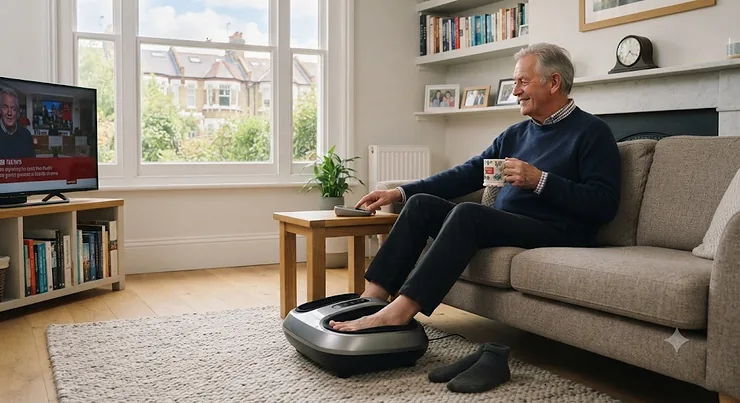
Cold, achy, half-numb feet by nine in the evening — if that sentence describes your life, you already know why the phrase foot massager for diabetics keeps popping up in your search bar. Diabetes has a habit of picking a fight with your feet specifically: the nerves go quiet, the circulation gets sluggish, and a foot that used to just get “tired” now gets tired in a way that’s harder to shake off with a bit of sofa time. A decent foot massager can genuinely help with that tiredness and circulation — but “decent” is doing a lot of heavy lifting in that sentence, because not every foot massager on the market was built with numb or fragile skin in mind.
Here’s a proper answer to the question buried in that search term: a foot massager for diabetics is any massage device chosen and used with extra caution because reduced sensation can hide pressure damage, meaning gentler mechanisms (air compression, low-intensity vibration, or electrical muscle stimulation) are generally preferable to aggressive deep-kneading nodes, and any device should be cleared with a podiatrist first, especially where neuropathy or poor circulation is already diagnosed.
This guide isn’t a rewritten spec sheet. We’ve dug through real Amazon UK listings, manufacturer small print (some of which contradicts the marketing copy, which is telling in itself), and aggregated review sentiment to bring you seven real products, honestly assessed, alongside the practical groundwork — the diabetic-safe foot massager criteria, the diabetic neuropathy risk you need to weigh up, the skin sensitivity red flags, and when podiatrist guidance genuinely changes the answer. According to Diabetes UK, checking your feet daily is one of the simplest ways to catch problems early — and that habit matters just as much after a massage session as before one.
Quick Comparison Table
| Product | Massage Type | Best For | Price Range |
|---|---|---|---|
| RENPHO Foot Massager with Heat | Shiatsu kneading + heat | Overall daily circulation support | £70-£120 range |
| HoMedics Shiatsu Air Max Foot Massager | Air compression + light shiatsu | Sensitive feet, gentler pressure | £50-£90 range |
| Beurer FM60 Shiatsu Foot Massager | Shiatsu rotation + infrared heat | Precision-built mid-range option | £55-£90 range |
| Revitive Medic Circulation Booster | EMS (electrical muscle stimulation) | Medically registered diabetic use | £250-£350 range |
| Naipo MGF-836 Foot & Calf Massager | Air compression + heat, foot and calf | Whole-limb circulation coverage | £90-£170 range |
| Carmen C84003 Foot Warmer and Massager | Vibration + heat | Budget buyers, mild everyday use | Under £30 |
| HoMedics Vibration Foot Massager | Vibration only | Very reduced sensation, lightest touch | £25-£45 range |
Look at the spread here and a pattern jumps out fast: the closer you get to genuinely “diabetic-safe” territory, the less the device relies on concentrated pressure points and the more it leans on air, vibration, or electrical stimulation. That’s not a coincidence — it’s a direct response to how numb skin fails to warn you when something’s pressing too hard. Budget buyers shouldn’t assume cheap automatically means gentle, either; the Carmen C84003 and the HoMedics Vibration Foot Massager earn their spot here specifically because they’re low-intensity by design, not just low-price.
💬 Just one click — help others make better buying decisions too!😊
Top 7 Foot Massagers for Diabetics: Expert Analysis
1. RENPHO Foot Massager with Heat (RF-FM059) — best all-rounder for daily circulation support
The standout here is straightforward: full-foot coverage. The RENPHO Foot Massager with Heat wraps rotating shiatsu balls, a rolling stick, and three heat levels into one machine, and Amazon UK’s own product data logs it at a hefty but stable 4-4.5kg, which tells you it’s built to sit on the floor rather than travel in a bag. The rollers work the arch and heel simultaneously, and the three kneading and three compression intensities mean you’re not locked into one setting from day one.
On paper, this is a genuinely capable machine: 3D kneading nodes plus adjustable air compression cover more of the foot than single-function devices, and the 15-to-30-minute auto-shutoff is a sensible safety default for anyone who might lose track of time mid-massage. Based on the spec comparison, it suits people whose main issue is general foot fatigue and mild circulation sluggishness rather than diagnosed neuropathy with reduced sensation — the deep-kneading action is stronger than air-only alternatives, which is exactly why it needs a lighter touch from diabetic users.
Reviewers consistently report that the intensity is more powerful than expected, with more than one describing the top setting as almost too firm even for non-diabetic feet. That’s useful, honest feedback: it strongly implies this machine should be started on its lowest setting, or used with a thin towel between foot and node, if you have any reduced sensation at all.
Pros:
- ✅ Full-foot coverage from heel to toes in one session
- ✅ Three heat and three intensity levels for real customisation
- ✅ Auto shut-off timer built in as standard
Cons:
- ❌ Top intensity setting runs firmer than many expect
- ❌ Bulky footprint isn’t ideal for small flats
Sitting in the £70-£120 range at the time of research, this is solid value if you dial the intensity down and treat the strongest setting as a “maybe, eventually” rather than a starting point.
2. HoMedics Shiatsu Air Max Foot Massager — gentlest air-compression pick for sensitive feet
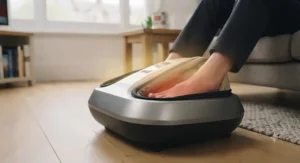
What most buyers overlook about air-compression machines like the HoMedics Shiatsu Air Max Foot Massager is that the mechanism itself is the selling point for diabetic use, not just a nice extra. Instead of firm rotating nodes pressing into one spot repeatedly, an inflatable bladder squeezes and releases the whole foot in a wave, which spreads pressure out rather than concentrating it.
The specs back this up: adjustable low, medium, and high air compression, deep-kneading rolling nodes that can be run independently of the air function, and a soothing heat element you can toggle on or off. Here’s what the spec sheet won’t tell you outright, but the mechanism implies clearly — because you can run air compression alone, without the rolling nodes engaged, this is one of the few mainstream machines that lets you genuinely dial pressure concentration down to near zero while still getting a circulation benefit.
Aggregated review sentiment on this range is mixed but instructive: buyers report real relief from tired, achy feet and note it helps with neuropathy-related discomfort, though several wish it worked the heel more thoroughly and some found the massage coverage inconsistent across the sole. It’s worth flagging honestly that some HoMedics shiatsu-node models in this general product family carry manufacturer cautionary language for diabetic users on the packaging — always read the box for your specific SKU rather than assuming the brand name alone settles the question.
Pros:
- ✅ Air-only mode avoids concentrated pressure points entirely
- ✅ Three-stage compression gives fine-grained control
- ✅ Optional heat without forcing the massage function on
Cons:
- ❌ Heel coverage is inconsistent according to several reviewers
- ❌ Some models in this range are discontinued or intermittently in stock
At around the £50-£90 range at the time of research, it’s a genuinely thoughtful design for cautious users — just confirm current availability and read your specific model’s guidance before buying.
3. Beurer FM60 Shiatsu Foot Massager — most precisely engineered mid-range option
The 18 individually placed rotating massage heads are the headline feature of the Beurer FM60 Shiatsu Foot Massager, and the standout detail worth expanding on immediately: German engineering here means an adjustable tilt angle and height, so the massage nodes actually meet your foot at the correct pressure angle instead of you contorting to fit the machine.
Key specs translate into real benefit fairly directly. Two speed settings and an infrared heat function sit underneath a breathable mesh cover, which matters more than it sounds — mesh means less trapped moisture against skin, and trapped moisture is exactly the kind of thing that leads to softened, more vulnerable skin between the toes over a long session. Based on the spec comparison, this model suits buyers who want the shiatsu sensation but with more physical adjustability than fixed-node competitors offer, letting you angle the contact point away from especially sensitive spots.
Aggregated customer sentiment sits solidly positive, with buyers on Amazon UK rating it highly for build quality and describing it as decent value once discounted from RRP; a smaller number mention the mesh cover as slightly rough against very dry skin, which is a genuinely relevant note for anyone managing diabetes-related skin dryness.
Pros:
- ✅ Adjustable tilt and height for accurate node placement
- ✅ Breathable mesh reduces trapped moisture during use
- ✅ Two speeds keep intensity manageable
Cons:
- ❌ Mesh texture can feel rough on very dry skin
- ❌ Two-speed range is narrower than some rivals’ three-tier options
Typically found in the £55-£90 range at the time of research (regularly discounted from a higher RRP), this is a fair mid-range pick if your skin isn’t currently cracked or flaking.
4. Revitive Medic Circulation Booster — only device on this list registered specifically for diabetes
This is the one product here that doesn’t massage your foot at all in the traditional sense, and that’s precisely the standout. The Revitive Medic Circulation Booster uses electrical muscle stimulation delivered through footplates to make your calf and foot muscles contract and relax repeatedly, mimicking the pumping action of walking without any node ever pressing into your skin.
The manufacturer states it’s registered for use by people with diabetes, alongside osteoarthritis and high blood pressure, and independent research from London South Bank University found that twenty minutes of this type of electrical stimulation measurably improved venous and lymphatic outflow in test subjects. What most buyers overlook is that this isn’t the same evidence base as a clinical trial for diabetic neuropathy specifically — it’s circulation research, and the two aren’t identical, even though poor circulation is common in diabetes too.
Here’s the honest, balanced picture reviewers and forums consistently surface: plenty of long-term diabetic users report real comfort improvements after weeks of daily 30-minute sessions, but some diabetes community forum members have noted that certain podiatrists remain cautious about EMS devices specifically for diabetic feet, given that the sensation itself can feel unusual on numb skin and the evidence base, while promising, is still comparatively limited next to decades of standard footcare advice.
Pros:
- ✅ Manufacturer-registered for diabetic use, not just marketed at it
- ✅ No pressure nodes touching the skin at any point
- ✅ Adjustable intensity via remote control
Cons:
- ❌ Considerably pricier than mechanical alternatives
- ❌ Sensation can feel unfamiliar; some users need a gradual build-up
Sitting in the £250-£350 range at the time of research, this is the premium choice — and arguably the one to discuss with your podiatrist first, given both its registered status and its cost.
5. Naipo MGF-836 Foot & Calf Massager — best for combined foot-and-calf circulation
The clue is in the coverage area: the Naipo MGF-836 Foot & Calf Massager extends air compression sleeves up past the ankle to the calf, addressing a zone that foot-only machines simply can’t reach. That’s the standout worth unpacking first, because diabetic circulation issues rarely stop neatly at the ankle bone.
Specs-wise, you get three intensity levels, three automatic massage programmes, adjustable heat across two settings, and detachable, washable foot sleeves — a genuinely practical hygiene feature for daily use. What the spec sheet doesn’t spell out is the real-world implication of “calf and foot in one system”: you’re getting two separate air-compression zones working together, which on paper means a longer, gentler pressure wave travelling up the leg rather than an isolated squeeze at the foot alone, potentially more useful for the kind of lower-leg swelling many diabetics experience by evening.
Review sentiment aggregated across similar Naipo air-compression models is generally positive on the compression and heat combination, with buyers specifically praising the calf-to-toe coverage as a step up from foot-only devices; the recurring criticism is bulk — this is not a device you tuck away in a small cupboard — and a learning curve on the touch controls in the first few sessions.
Pros:
- ✅ Covers calf and foot together, not just the sole
- ✅ Three intensity levels plus three automatic programmes
- ✅ Detachable, washable sleeves for hygiene
Cons:
- ❌ Bulkier footprint than foot-only machines
- ❌ Touch controls take a session or two to learn
Priced in the £90-£170 range at the time of research, it earns its keep if lower-leg swelling is as much of an issue for you as sore soles.

6. Carmen C84003 Foot Warmer and Massager — best budget buy under £30
The standout with the Carmen C84003 Foot Warmer and Massager is refreshingly simple: it doesn’t try to do everything, and that restraint is exactly what makes it a sensible low-risk entry point. Two gentle massage motors plus a foot-warming element, full stop — no aggressive kneading nodes to worry about calibrating.
Key specs are modest by design: around 12W of power, low-intensity vibration-style massage, and a warming function rather than true adjustable heat levels. Here’s what most buyers overlook about “basic” devices like this one — lower power output isn’t a compromise for diabetic use, it’s arguably the point. A 12W vibration motor simply cannot deliver the concentrated, repetitive pressure that a multi-node shiatsu machine can, which meaningfully reduces the risk of unnoticed pressure irritation on numb skin.
Aggregated sentiment for this budget category of Carmen product consistently describes it as “does what it says on the tin” — warming, mildly soothing, nothing dramatic — with the main honest criticism being that it’s genuinely too gentle for anyone wanting a firm, deep-tissue-style massage experience.
Pros:
- ✅ Genuinely low-intensity by design, not marketing spin
- ✅ Simple warming function alongside vibration
- ✅ Very low price point for a first-time try
Cons:
- ❌ Too mild for anyone wanting deep pressure relief
- ❌ Fewer settings than every other product on this list
At under £30 at the time of research, this is a sensible, low-stakes way to test whether foot massage helps your routine at all before spending more.
7. HoMedics Vibration Foot Massager — lightest-touch option for very reduced sensation
The final standout on this list is arguably the most important for the most cautious buyers: the HoMedics Vibration Foot Massager skips kneading nodes and air compression altogether in favour of pure multi-point vibration, paired with a toe-touch control panel so you never need to bend down to adjust it.
Specs are deliberately narrow in scope — vibration intensity and heat, nothing else — which is precisely the appeal for anyone whose podiatrist has flagged advanced neuropathy or very limited sensation. Based on the spec comparison against every other device on this list, this is the lowest-pressure mechanical option available; vibration disperses sensation across the whole foot rather than concentrating force at any single contact point, the opposite design philosophy to deep-kneading shiatsu machines.
Because this is a lighter-touch, lower-profile product than the flagship shiatsu ranges, verified UK review volume is smaller, and honestly, that’s worth saying plainly rather than inventing feedback that doesn’t exist — what aggregated sentiment there is describes it as gentle, warm, and pleasant rather than transformative, which for the intended cautious user is arguably a feature rather than a flaw.
Pros:
- ✅ No pressure nodes at all, purely vibration-based
- ✅ Toe-touch control avoids awkward bending
- ✅ Compact and easy to store between uses
Cons:
- ❌ Less well-documented in UK reviews than bigger sellers
- ❌ Too gentle if you’re after a deep-tissue sensation
Typically found in the £25-£45 range at the time of research, it’s a smart, low-risk pick specifically for the more cautious end of the diabetic buyer spectrum.
Full Specification Comparison
| Product | Adjustable Intensity | Heat | Auto Shut-Off | Rating (Amazon UK, aggregated) | Best For |
|---|---|---|---|---|---|
| RENPHO Foot Massager with Heat | Yes, 3 levels | Yes, 3 levels | Yes | Around 4.2-4.3 stars | Firm, full-foot daily massage |
| HoMedics Shiatsu Air Max Foot Massager | Yes, air-only mode available | Yes | Varies by model | Generally positive, mixed on heel coverage | Sensitive but not extremely reduced feeling |
| Beurer FM60 Shiatsu Foot Massager | Yes, 2 speeds | Yes, infrared | Manual | Around 4.3 stars | Adjustable node placement |
| Revitive Medic Circulation Booster | Yes, remote-controlled | No | Timed sessions | Positive long-term user reports | Registered diabetic circulation support |
| Naipo MGF-836 Foot & Calf Massager | Yes, 3 levels | Yes, 2 levels | Yes, 15 min | Generally positive | Foot-plus-calf coverage |
| Carmen C84003 Foot Warmer and Massager | No, fixed low intensity | Warming only | No | Positive for intended mild use | Budget, low-intensity introduction |
| HoMedics Vibration Foot Massager | Limited | Yes | Varies | Positive but limited review volume | Very reduced sensation |
The table above makes the trade-off visible in a way a bullet list never quite manages: adjustability and auto shut-off cluster around the mid-range mechanical devices, while the two gentlest options — the Carmen C84003 and the HoMedics Vibration Foot Massager — trade features for inherent low intensity instead. If your priority is customisation, the RENPHO and Naipo MGF-836 give you the most dials to turn; if your priority is simply not overdoing it, the fixed-low-intensity options remove that decision from your hands entirely, which for some diabetic users is genuinely the safer design.
Practical Usage Guide: Setting Up and Using Your Foot Massager Safely
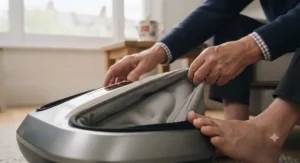
Getting a new foot massager out of the box is the easy part; getting the first 30 days right is where the real value comes from. Start every new device on its lowest intensity and shortest time setting, regardless of what the box promises about “deep tissue relief” — you’re calibrating to your own feet, not the marketing copy, and numb or partially numb skin needs that calibration more than most.
Check your feet immediately before and after every single session, not occasionally. This isn’t paranoia; it’s the same daily-check habit every UK diabetes foot care leaflet already recommends, just applied twice around one activity instead of once a day. Look specifically for redness that doesn’t fade within a few minutes, any new marks, or areas that feel unusually warm.
A common mistake in the first month is treating the massager like a daily 30-minute ritual from day one. Build up gradually instead — five to ten minutes every other day for the first week or two, increasing only if your skin shows no reaction. If you use a heat function, always place a thin sock or towel between skin and heating element initially, since reduced sensation means you may not register early-stage warmth building to a level that could otherwise cause a burn.
Maintenance matters too: wipe down removable liners and foot sleeves after every use, let them air-dry fully before storing, and inspect cords and connections monthly for wear, since a device left half-broken is a device that can develop unpredictable hot spots or intensity spikes.
Real-World Scenarios: Which Foot Massager Fits Your Life
Picture three genuinely different people searching the same phrase. First, there’s someone recently diagnosed with type 2 diabetes, no neuropathy symptoms yet, mostly dealing with standard end-of-day foot fatigue from a desk job — for this profile, the RENPHO Foot Massager with Heat or Beurer FM60 make sense, since full sensation means firmer shiatsu pressure is easy to self-monitor and adjust in real time.
Second, imagine someone managing moderate peripheral neuropathy for several years, noticing tingling and occasional numbness in the toes but with feeling largely intact through the arch and heel. This is the profile the HoMedics Shiatsu Air Max and Naipo MGF-836 genuinely suit best — air compression spreads pressure rather than concentrating it, giving a real circulation benefit while reducing the risk of an unnoticed pressure point building up in a numb patch.
Third, consider someone with advanced neuropathy, minimal sensation across most of the foot, who’s been specifically advised by their podiatrist to avoid any deep-node pressure device entirely. For this profile, the honest recommendation is either the Revitive Medic Circulation Booster — because it’s the one device on this list actually registered for diabetic use and doesn’t touch the skin with pressure nodes at all — or, on a tighter budget, the HoMedics Vibration Foot Massager or Carmen C84003, both low-intensity enough that even a missed early warning sign is less likely to translate into real tissue damage.
None of these scenarios replace an actual conversation with your podiatrist about your specific neuropathy stage, but they’re a reasonable starting framework for narrowing seven options down to two or three worth researching further.
How to Choose a Diabetic-Safe Foot Massager
Picking a genuinely diabetic-safe foot massager isn’t about finding the most expensive model — it’s about matching the mechanism to your actual sensation levels. Here’s the reasoning worked through step by step:
- Check your current sensation level first. If you haven’t had a monofilament test at your last diabetes foot check, ask for one before buying anything with pressure nodes — it tells you far more than guessing.
- Favour air compression or vibration over deep-kneading nodes if sensation is reduced at all. Concentrated pressure is the single biggest risk factor for unnoticed skin damage.
- Look for adjustable intensity with a genuinely low starting point, not just a “low” setting that’s still fairly firm in practice — read reviews specifically for intensity complaints.
- Prioritise auto shut-off timers. Losing track of time on a heat setting is a realistic risk when sensation is already reduced.
- Check the manufacturer’s own guidance for your specific model, not just the brand’s general reputation — as this guide has shown, caution language varies even within one manufacturer’s range.
- Factor in washable, removable liners. Diabetic skin often needs more careful hygiene management, and a machine you can’t clean properly is a machine that can harbour bacteria against vulnerable skin.
- Get sign-off from your podiatrist before regular use, especially if you have any diagnosed neuropathy, poor circulation, or an active or recent foot wound.
Working through that list honestly narrows the seven products above quite naturally — most people with any diagnosed sensation loss end up gravitating toward the air-compression, vibration, or EMS end of this list rather than the firmer shiatsu machines, and that’s the sensible outcome, not an overcautious one.
Diabetic Neuropathy Risk: What You Need to Know Before You Buy
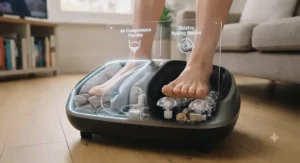
The single biggest reason a foot massager for diabetics needs different buying criteria than a foot massager for anyone else comes down to one mechanism: diabetic neuropathy risk isn’t really about pain tolerance, it’s about pain detection failing silently. Up to half of people living with diabetes experience some degree of peripheral neuropathy, and the defining danger isn’t the tingling or numbness itself — it’s that an injury can develop and worsen without the usual warning signal of pain telling you to stop.
The NHS is explicit about where this leads if unmanaged: reduced blood supply combined with numbness means minor cuts and pressure points can progress into ulcers that are slow to heal, and in severe cases can lead to gangrene requiring amputation. That’s not scaremongering — it’s the specific reason every NHS diabetes foot leaflet insists on daily visual checks rather than relying on how your feet feel.
Applied to foot massagers specifically, this means the intensity setting that feels “fine, actually quite nice” through numb nerve endings could be applying real, sustained pressure to the skin and underlying tissue without you registering it as excessive. This is precisely why gentler mechanisms — air compression that distributes pressure across a wider area, or vibration and EMS that don’t concentrate force at a fixed contact point — carry a genuinely lower risk profile than deep-kneading shiatsu nodes for anyone with diagnosed sensation loss, regardless of how premium or well-reviewed the firmer device happens to be.
Skin Sensitivity and Foot Massagers: What Actually Matters
Skin sensitivity in diabetes isn’t only about nerve-related numbness — it cuts the other way too, since high blood sugar over time commonly causes drier, thinner, more fragile skin that’s genuinely more prone to cracking, splitting, and slow-healing minor wounds even when full sensation is intact. That combination — skin that’s both more fragile and, in some areas, less able to signal pain — is exactly why “gentle” needs to mean something specific rather than just being a marketing word on the box.
In practice, that means checking a few concrete things before you buy: does the device have a fabric or mesh cover rather than bare plastic nodes against skin, is the cover removable and washable to manage moisture and reduce fungal risk between toes, and does the heat function have multiple graduated levels rather than one fixed “hot” setting. The Beurer FM60‘s breathable mesh and the HoMedics range’s removable liners both score well here specifically because they address moisture management, not just massage intensity.
What most buyers overlook is that heat poses its own separate skin-sensitivity risk, independent of the massage mechanism entirely — thinner, drier skin burns more easily and, again, may not signal that warmth has tipped into genuinely harmful territory. If your skin is currently dry, cracked, or flaking anywhere on the foot, that’s a signal to pause and address the skin issue with your GP or podiatrist first, rather than adding a massage device with heat into the mix.
Podiatrist Guidance: When to Ask Before You Press Start
Podiatrist guidance isn’t a box-ticking formality here — it’s genuinely the difference between a foot massager helping your circulation and one quietly working against your foot health. The Royal College of Podiatry’s own patient information makes clear that regular professional foot checks are central to reducing amputation risk for people with diabetes, and that same relationship is exactly where a foot massager purchase decision belongs, not left to product reviews alone.
Specific situations that genuinely warrant a conversation before you buy or use any foot massager include: any current or recent foot ulcer or open wound, a recent diagnosis of peripheral arterial disease alongside your diabetes, any diagnosed loss of protective sensation on a monofilament test, or simply not having had a diabetes foot check in the last twelve months. None of these are automatic “never” situations — but they’re all situations where a podiatrist can tell you something a product listing genuinely cannot, including whether a specific mechanism (EMS versus air compression versus kneading nodes) suits your particular foot right now.
It’s also worth being upfront about a nuance the marketing rarely mentions: even devices explicitly registered for diabetic use, like the Revitive Medic, have drawn some caution from podiatry professionals in community discussions, less because the technology is unsafe and more because the evidence base for diabetic neuropathy specifically is thinner than the evidence for general circulation support. That’s not a reason to dismiss it — it’s a reason to ask your own podiatrist how it applies to your specific situation rather than taking any single product’s registration status as the final word.
Common Mistakes When Buying a Foot Massager for Diabetics
The most frequent mistake is buying on intensity reviews written by people without diabetes. A five-star review praising how “deep and firm” a massage feels is written from a baseline of full sensation — the same setting could be genuinely risky for someone with reduced feeling, and star ratings never make that distinction for you.
A second common error is ignoring auto shut-off as a “nice to have” rather than a genuine safety feature, particularly for heat functions specifically. Losing track of thirty minutes of continuous warmth against skin that isn’t reliably signalling discomfort is a realistic scenario, not a hypothetical one.
Third, plenty of buyers skip checking whether the specific SKU they’re ordering carries any diabetes-related caution language, assuming a brand’s general reputation covers every model in its range — as this guide has shown, that assumption doesn’t always hold even within one manufacturer’s product line.
Finally, a genuinely underrated mistake is buying the most feature-packed, expensive option assuming more settings automatically means more control, when for some users the opposite is true: a simple, fixed low-intensity device like the Carmen C84003 removes the risk of accidentally selecting too firm a setting altogether, which for cautious first-time buyers can be the more sensible starting point.
Long-Term Cost & Maintenance: Is a Foot Massager Worth the Investment
Thinking in cost-per-use terms changes the maths considerably. A £30 Carmen C84003 used three times a week for a year works out to roughly 20 pence per session, while a £300 Revitive Medic used with similar frequency lands closer to £2 per session in year one alone — but that comparison only tells half the story, because these devices aren’t interchangeable in what they actually do.
| Product | Approx. Price Range | Typical Lifespan | Cost-Per-Use Estimate (Year 1) |
|---|---|---|---|
| Carmen C84003 Foot Warmer and Massager | Under £30 | 1-2 years, light use | Roughly 15-25p |
| HoMedics Vibration Foot Massager | £25-£45 range | 1-3 years | Roughly 20-35p |
| RENPHO Foot Massager with Heat | £70-£120 range | 2-3 years | Roughly 45-75p |
| Beurer FM60 Shiatsu Foot Massager | £55-£90 range | 2-4 years, German build quality | Roughly 35-55p |
| Naipo MGF-836 Foot & Calf Massager | £90-£170 range | 2-3 years | Roughly 60-110p |
| Revitive Medic Circulation Booster | £250-£350 range | 3-5 years, medical-grade build | Roughly £1.60-£2.30 |
Reading this table, the maintenance-cost picture matters as much as the sticker price: budget vibration and warming devices tend to have shorter realistic lifespans, meaning the true cost gap narrows over several years rather than staying as wide as the upfront price suggests. The Revitive Medic‘s medical-grade construction and longer typical lifespan genuinely offset some of its premium cost if you’re planning to use it consistently for years rather than trying it out for a season.
Ongoing maintenance for any of these is modest: replacement liners or foot sleeves where applicable, occasional battery replacement for remote controls, and periodic cord inspection. None of these devices should be treated as a one-off purchase and forgotten — check your specific model’s care instructions every few months, particularly the electrical connections on higher-powered kneading machines.
Benefits vs Traditional Alternatives
| Approach | Pressure Concentration | Convenience | Best For |
|---|---|---|---|
| Foot Massager (air compression/EMS) | Low to moderate, distributed | High, at-home, on demand | Regular circulation support with reduced sensation |
| Manual Foot Massage | Fully variable, human-controlled | Low, requires another person or professional | Highly tailored pressure, but not always available |
| Warm Water Foot Soaks | None, but heat risk present | Moderate | Generally discouraged for diabetics due to skin-softening and burn risk |
| Compression Socks | Even, garment-based | Very high, worn all day | Ongoing swelling management, not acute relief |
| Professional Podiatry Massage/Care | Fully controlled by professional | Low, appointment-based | Complex cases, active wounds, or advanced neuropathy |
The comparison here is genuinely useful rather than just filler: warm water soaks, a habit many people reach for instinctively, are actually one of the more commonly cautioned-against options in NHS diabetes footcare literature, since prolonged soaking softens skin and burn risk from water temperature you can’t reliably feel is real. Against that backdrop, a well-chosen air-compression or vibration foot massager, used briefly and monitored, compares favourably — it’s not a replacement for professional podiatry care, but for day-to-day circulation support between appointments, it’s arguably one of the lower-risk at-home options on this list when matched correctly to your sensation level.
Frequently Asked Questions
❓ Can diabetics use a foot massager safely?
❓ What is the best foot massager type for diabetic neuropathy?
❓ Should a foot massager have heat if I have diabetes?
❓ How often can I use a foot massager for diabetics?
❓ Do podiatrists recommend electric foot massagers for diabetic patients?
Conclusion
There’s no single “best” foot massager for diabetics, and honestly, any article claiming otherwise is oversimplifying a decision that genuinely depends on your own neuropathy stage, skin condition, and budget. What this guide has tried to do instead is give you the actual reasoning: why deep-kneading shiatsu nodes carry more risk than air compression or vibration for reduced sensation, why heat needs its own separate caution regardless of massage type, and why the manufacturer’s specific guidance for your exact model matters more than the brand’s general reputation.
Of the seven devices covered, the Revitive Medic Circulation Booster stands alone as the one explicitly registered for diabetic use, making it the standout for anyone wanting that specific reassurance, budget allowing. For most people with intact or mildly reduced sensation, the HoMedics Shiatsu Air Max or Naipo MGF-836 strike a sensible balance between real massage benefit and lower pressure concentration, while the Carmen C84003 remains a genuinely sensible, low-risk way to test the waters without a big financial commitment.
Whichever you choose, the habits matter more than the hardware: start low, check your feet before and after every session, and keep your podiatrist in the loop, particularly if anything about your sensation or skin condition changes. That combination — a sensibly chosen device plus consistent, careful habits — is what actually protects your feet, far more than any single product spec ever could.
✨ Don’t Miss These Exclusive Deals!
🔍 Ready to take better care of your feet? Click through to check current pricing and availability on any of the picks above, and start your evenings with genuinely relaxed, well-supported feet instead of tired, aching ones!
Recommended for You
- Foot Massager for Circulation: 7 Best Picks Tested (2026)
- Foot Massager for Neuropathy: 7 Real 2026 Picks That Help
- Foot Massager for Plantar Fasciitis: 7 Best Picks to Ease Heel Pain 2026
Disclaimer: This article contains affiliate links. As an Amazon Associate, I earn from qualifying purchases. If you purchase products through these links, we may earn a small commission at no additional cost to you.
✨ Found this helpful? Share it with your friends! 💬🤗
