In This Article
Picture this: It’s 4 PM on a Wednesday, you’ve been hunched over spreadsheets since half-eight, and your lower back is staging a full rebellion. Sound familiar? You’re certainly not alone. According to the Health and Safety Executive (HSE), an estimated 470,000 UK workers suffered from work-related musculoskeletal disorders in 2022/23, accounting for 27% of all workplace ill health cases. That’s rather a lot of discomfort that could be avoided.
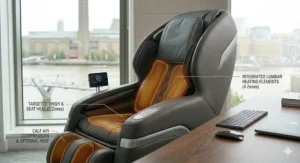
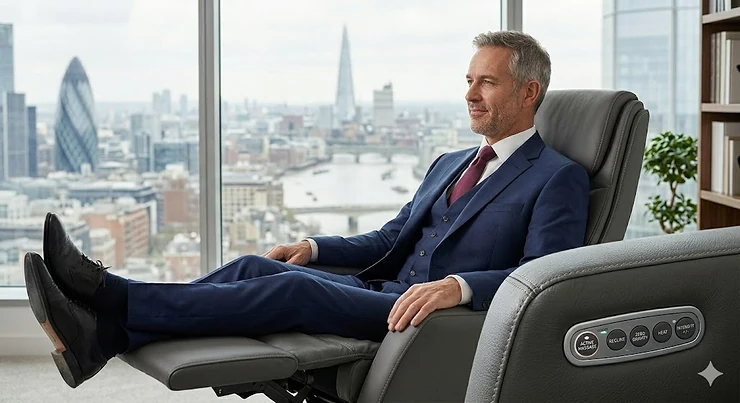
Enter the office massage chair for executives – not just another piece of furniture, but a genuine investment in your physical wellbeing and professional performance. These aren’t your grandmother’s office chairs; they’re sophisticated pieces of wellness technology designed to combat the physical toll of modern desk work. By combining ergonomic excellence with therapeutic massage features, these chairs provide more than just a place to sit – they deliver active relief from tension, improved circulation, and enhanced productivity throughout your working day.
What makes an executive massage chair different from a standard office chair? It’s the integration of targeted vibration massage systems, lumbar heating functions, and premium ergonomic design that addresses the specific needs of professionals who spend 8-10 hours daily at their desks. Whether you’re running board meetings from your Canary Wharf office or managing a team from your converted spare bedroom in Manchester, the right massage chair can transform those long working hours from endurance tests into comfortable, productive sessions. In this comprehensive guide, we’ll examine seven outstanding options available on Amazon.co.uk, helping you find the perfect match for your workspace, budget, and body.
Quick Comparison: Top Executive Massage Chairs at a Glance
| Model | Massage Points | Heat Function | Recline | Price Range | Best For |
|---|---|---|---|---|---|
| HOMCOM 6-Point Executive | 6 points | Lumbar heating | 120° | £110-£150 | Budget-conscious professionals |
| Vinsetto Microfiber Premium | 6 points | 3-level heating | 125° | £150-£200 | All-day comfort seekers |
| ELFORDSON 8-Point Luxury | 8 points | Dual heating zones | 150° | £200-£280 | Premium experience |
| YJ-1 3D Massage Recliner | 8 points (3D) | Full back heating | 135° | £250-£350 | Tech enthusiasts |
| Vinsetto Footrest Model | 6 points | Lumbar heating | 135° | £170-£220 | Nap-friendly executives |
| HOMCOM Big & Tall | 6 points | Seat & back heating | 130° | £180-£240 | Larger individuals (up to 180 kg) |
| Hbada X7 Smart | 8 points | Heat + cooling | 160° | £1,100-£1,300 | Ultimate luxury seekers |
💬 Just one click — help others make better buying decisions too! 😊
Top 7 Office Massage Chairs for Executives: Expert Analysis
1. HOMCOM 6-Point Executive Massage Chair – Best Value Entry Point
The HOMCOM 6-Point Executive Massage Chair has earned its reputation as the gateway option for professionals exploring massage seating without breaking the bank. With over 148 verified reviews averaging 4.4 stars on Amazon.co.uk, this chair proves you needn’t spend a fortune to gain genuine wellness benefits.
Key specifications: Six vibration massage points (two shoulder, two lower back, two seat), single-zone lumbar heating, 120° recline angle, PU leather upholstery, adjustable height range 45-54 cm, 360° swivel base, weight capacity 120 kg. In practical terms, that height range suits most UK professionals between 5’4″ and 6’2″, whilst the 120 kg limit comfortably accommodates the majority of users – though larger individuals should look towards the Big & Tall variant.
Expert perspective: What British users particularly appreciate about this chair is its traditional executive styling that wouldn’t look out of place in a Mayfair corner office. The faux leather design combines classic aesthetics with modern comfort technology, creating a chair that impresses clients during video calls whilst pampering you during marathon work sessions. The massage system targets six strategic points, addressing the full spectrum of desk-work discomfort from tension headaches originating in the shoulders to lower back strain from poor posture. The chair’s 360° swivel wheels move smoothly across both carpet and hard flooring, whilst the adjustable seat height accommodates various desk configurations.
However, let’s be frank about limitations: the single heating zone focuses solely on lumbar support (no seat heating), and the massage intensity isn’t adjustable – you get one vibration strength. Some UK reviewers note the PU leather can feel slightly sticky during warm summer months, and the remote control cable is rather short at approximately 1 metre, which means keeping it within reach requires tucking it into the side pocket.
Customer feedback summary: British buyers praise the straightforward assembly (15-20 minutes average), the reliable massage function that genuinely eases end-of-day tension, and the excellent value proposition. Common criticisms include the fixed massage intensity and occasional squeaking from the reclining mechanism after 6-12 months of daily use.
Pros:
✅ Outstanding value in the £110-£150 range
✅ Six-point massage coverage hits major tension zones effectively
✅ Classic executive appearance suits professional video calls
Cons:
❌ Single massage intensity setting lacks customisation
❌ PU leather can feel sticky in warm weather
Price & verdict: Typically found around £120-£140 on Amazon.co.uk, this chair offers exceptional value for professionals making their first foray into massage seating. It’s not the most sophisticated option, but it delivers genuine relief where it counts.
2. Vinsetto Microfiber Premium Executive Chair – Best All-Day Comfort
The Vinsetto Microfiber Premium represents a thoughtful evolution from basic massage chairs, addressing the most common complaints about entry-level models whilst remaining accessible to mid-range budgets.
Key specifications: Six vibration massage points, three-level adjustable heating (low, medium, high), 125° recline, breathable microfiber upholstery, three massage modes, three intensity levels, 15/30/60-minute timer, adjustable height 45-52 cm, weight capacity 120 kg. The crucial upgrade here is the three-level heating control – you’re no longer stuck with a single temperature that’s either too hot in July or barely noticeable in January.
Expert perspective: The microfiber upholstery is where this chair distinguishes itself from cheaper alternatives. Unlike PU leather which can feel clammy during British summer months (admittedly brief), microfiber breathes considerably better whilst maintaining a premium appearance. For professionals working from converted spare bedrooms or garden offices without climate control, this proves invaluable during our increasingly warm summers. The three massage modes (full back, lower back, targeted) allow you to address specific discomfort zones, whilst the intensity adjustment means you can opt for gentle relief during conference calls or aggressive kneading after a particularly stressful day. What most buyers overlook about this model is the timer function – set it for 30 minutes, and it automatically switches off, preventing that “I fell asleep with the massage on and now my muscles feel over-worked” scenario.
From a UK perspective, this chair handles our typical workspace challenges well: the castors glide smoothly across the laminate flooring common in modern flats, and the compact footprint (62 cm width) fits comfortably in smaller home offices. The remote control features clear labelling rather than cryptic icons, which sounds trivial until you’re fumbling for the heating button without your reading glasses.
Customer feedback summary: UK reviewers consistently highlight the superior comfort during extended sitting sessions, with several noting they’ve reduced their reliance on over-the-counter pain relief for back tension. The main criticism centres on the assembly instructions, which some find less than crystal clear, though most manage completion within 20-30 minutes.
Pros:
✅ Breathable microfiber prevents summer stickiness
✅ Three-level heating and intensity control offers genuine customisation
✅ Timer function prevents over-massage
Cons:
❌ Assembly instructions could be clearer
❌ Slightly higher price than basic models
Price & verdict: Generally priced around £160-£190 on Amazon.co.uk, this chair justifies the premium over basic models through superior materials and genuinely useful customisation options. For professionals spending 40+ hours weekly at their desks, the investment pays dividends in comfort and reduced muscle tension.
3. ELFORDSON 8-Point Luxury Executive Chair – Best Premium Features
The ELFORDSON 8-Point Luxury enters territory where massage chairs transition from “nice to have” to “spa-like indulgence,” offering features typically reserved for significantly pricier models.
Key specifications: Eight massage points (shoulders, mid-back, lower back, thighs), dual-zone heating (lumbar and seat), 150° recline, premium PU leather with extra padding, five massage modes, three intensity levels, adjustable height 44-53 cm, weight capacity 135 kg. That 150° recline is genuinely impressive – you can achieve a near-horizontal position for midday power naps without leaving your office.
Expert perspective: What justifies the ELFORDSON’s premium positioning is the additional massage coverage and dual heating zones. The eight-point system includes thigh massage nodes, which prove surprisingly effective for professionals who sit cross-legged during focused work or experience circulation issues in their legs during long sitting sessions. The dual heating zones – both lumbar and seat – create an enveloping warmth particularly welcome during British autumn and winter months when home office heating bills encourage setting thermostats a few degrees lower than ideal. The spec sheet won’t tell you this, but the extra-thick padding (approximately 10 cm versus 7 cm on budget models) makes a genuine difference during marathon work sessions. You’ll notice the quality gap around hour six or seven, when cheaper chairs start feeling unforgiving whilst the ELFORDSON remains comfortable.
For UK buyers, the higher weight capacity (135 kg versus the typical 120 kg) provides welcome headroom, and the chair’s construction feels notably sturdier than entry-level alternatives – less flex in the armrests, quieter mechanisms, smoother recline action. The trade-off is footprint: at 68 cm width, it demands more floor space than compact models, which could prove challenging in smaller flats or converted box rooms serving as home offices.
Customer feedback summary: British purchasers highlight the luxurious feel and the noticeable step-up in build quality. Several reviewers mention using the 150° recline for actual naps during long work days. Criticisms focus on the substantial box size upon delivery and the chair’s overall bulk, which can overwhelm smaller spaces.
Pros:
✅ Eight massage points provide comprehensive coverage including thighs
✅ Dual heating zones (lumbar + seat) offer superior warmth
✅ 150° recline enables comfortable power naps
Cons:
❌ Larger footprint unsuitable for compact home offices
❌ Premium pricing places it beyond casual buyers
Price & verdict: Typically ranging from £220-£280 on Amazon.co.uk, the ELFORDSON occupies that interesting middle ground between mid-range and luxury. For executives with dedicated home offices or traditional workplace settings, it delivers genuinely premium experiences without approaching four-figure territory.
4. YJ-1 3D Massage Recliner – Best for Tech Enthusiasts
The YJ-1 3D Massage Recliner brings sophisticated massage technology more commonly found in dedicated massage chairs into the office seating realm, appealing to professionals who appreciate technical innovation.
Key specifications: Eight-point 3D massage system, full-back heating coverage, 135° recline, genuine leather upholstery option, multi-dimensional massage motion (not just vibration), adjustable lumbar support, height adjustment 46-55 cm, weight capacity 130 kg. The “3D” designation isn’t marketing fluff – unlike basic vibration systems, this employs actual massage nodes that move in multiple dimensions, mimicking human massage techniques.
Expert perspective: The technical sophistication here lies in the 3D massage mechanism, which employs rotating nodes rather than simple vibration motors. In practice, this means the massage feels less like sitting on a vibrating platform and more like having actual fingers kneading your muscles. The difference becomes apparent during longer sessions: whilst vibration-based systems can feel numbing after 20-30 minutes, the 3D system’s varied motion patterns maintain effectiveness throughout hour-long massage cycles. The full-back heating coverage (rather than just lumbar zones) proves particularly effective for professionals battling the tight shoulders and neck tension that accumulate during stressful work periods.
From a UK buyer’s perspective, this chair addresses a common complaint about massage chairs in British homes: it operates remarkably quietly. The 3D mechanism generates minimal noise, meaning you can run a massage during video calls without the telltale vibration buzz that announces “yes, I’m getting a back rub whilst we discuss quarterly targets.” The genuine leather option (available at premium pricing) develops a lovely patina over time and handles the British climate’s humidity fluctuations better than synthetic alternatives.
However, the technical sophistication demands compromise: the 3D massage system consumes more power than basic vibration models (approximately 80W versus 30-40W), and the mechanism adds weight to the chair, making it less mobile once assembled.
Customer feedback summary: UK reviewers emphasise the superior massage quality and the whisper-quiet operation. Tech-savvy buyers appreciate the engineering, whilst some note the higher power consumption and the chair’s substantial weight (approximately 28 kg versus 18-20 kg for simpler models).
Pros:
✅ 3D massage mechanism delivers human-like kneading motion
✅ Remarkably quiet operation suitable for video calls
✅ Full-back heating coverage beyond standard lumbar-only zones
Cons:
❌ Higher power consumption (80W) increases running costs
❌ Heavier construction reduces portability after assembly
Price & verdict: Generally priced around £280-£350 on Amazon.co.uk, the YJ-1 appeals to professionals who appreciate technical sophistication and are willing to pay for genuinely superior massage quality. The premium feels justified if you’re using the massage function daily rather than occasionally.
5. Vinsetto Executive Massage Chair with Footrest – Best for Power Nappers
The Vinsetto Footrest Model addresses a specific but valuable use case: executives who’ve discovered the productivity benefits of strategic midday rest periods and want a chair that facilitates proper napping.
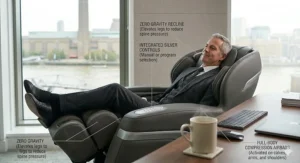
Key specifications: Six vibration massage points, single-zone lumbar heating, 135° recline with integrated retractable footrest, microfiber upholstery, three massage modes, height adjustment 48-56 cm, weight capacity 120 kg. The retractable footrest is the star feature – fully extended, it creates a near-horizontal resting position considerably more comfortable than propping feet on a desk or filing cabinet.
Expert perspective: The science behind power napping is well established: 20-30 minute rest periods can significantly boost afternoon productivity. What’s less discussed is how uncomfortable most office chairs prove for actual sleeping. The Vinsetto’s footrest solves this elegantly – it extends smoothly from beneath the seat, supporting your legs at an optimal angle that reduces lower back pressure and improves circulation. In practice, this means you can achieve genuinely restorative rest rather than merely closing your eyes whilst remaining uncomfortable. The 135° recline angle, combined with proper leg support, approximates a zero-gravity position that NASA research suggests optimises relaxation and recovery.
For UK professionals working from home without dedicated rest spaces, this chair serves double duty: professional executive seating during work hours, comfortable recliner for brief rest periods when needed. Several British reviewers mention using it for late-afternoon meditation sessions, finding the combination of massage, heating, and proper body positioning facilitates effective stress relief. The microfiber upholstery (rather than leather) proves advantageous here – it’s more breathable against skin during rest periods and less likely to develop the creases that leather can show after frequent reclining.
Customer feedback summary: UK buyers highlight the footrest’s smooth operation and genuine comfort during rest periods. Parents working from home particularly appreciate using it for quick breaks between school runs. The primary criticism concerns the footrest’s weight capacity – it’s rated for normal leg weight but shouldn’t be used as a stepping stool or to support additional weight.
Pros:
✅ Retractable footrest enables genuinely comfortable power naps
✅ 135° recline with leg support reduces back pressure effectively
✅ Microfiber upholstery breathes well during extended rest
Cons:
❌ Footrest mechanism adds mechanical complexity and potential failure points
❌ Extended footprint when deployed requires more floor space
Price & verdict: Typically priced around £180-£220 on Amazon.co.uk, this chair commands a premium over basic Vinsetto models specifically for the footrest feature. For professionals who’ve embraced strategic rest periods as productivity tools, the investment proves worthwhile. If you never plan to nap at your desk, simpler models offer better value.
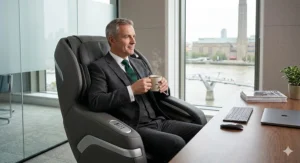
6. HOMCOM Big & Tall Executive Massage Chair – Best for Larger Individuals
The HOMCOM Big & Tall variant addresses a frequently overlooked demographic: professionals who find standard office chairs uncomfortably snug or worryingly close to weight capacity limits.
Key specifications: Six vibration massage points, dual-zone heating (seat and back), 130° recline, reinforced frame construction, extra-wide seat (56 cm versus standard 50-52 cm), height adjustment 47-56 cm, weight capacity 180 kg. That 180 kg capacity provides genuine headroom – you’re not nervously wondering whether every creak signals impending catastrophe.
Expert perspective: What HOMCOM has done cleverly here is enhance the entire structure rather than merely increasing stated weight limits. The chair employs thicker steel framing in the base, reinforced connection points between seat and back, and a heavy-duty gas lift cylinder rated specifically for higher loads. In practice, this means larger users experience proper support throughout the chair, not just theoretically higher capacity that feels precarious in actual use. The wider seat dimension (56 cm) proves crucial – many standard chairs compress larger users against armrests, creating pressure points that negate any massage benefits. This model provides breathing room, allowing you to sit naturally without feeling constrained.
The dual heating zones (seat and back) prove particularly valuable for larger individuals, who often find single-zone lumbar heating insufficient to deliver warmth across their broader back area. From a UK perspective, this chair handles our typical workspace challenges admirably: the reinforced castors roll smoothly across carpet without bogging down (a common issue with heavy-duty chairs on cheaper wheels), and the construction doesn’t flex or wobble despite the robust frame.
One overlooked benefit: the enhanced structure makes this chair more durable for all users, not just those approaching weight limits. If you’re 80 kg but hard on furniture or planning to use this chair for a decade, the Big & Tall construction offers peace of mind.
Customer feedback summary: British buyers emphasise the genuine spaciousness and solid construction. Larger reviewers note it’s the first office chair where they feel comfortably supported rather than perched precariously. Criticisms centre on the chair’s overall bulk and weight (approximately 26 kg), which complicates solo assembly and future repositioning.
Pros:
✅ 180 kg capacity with reinforced construction provides genuine confidence
✅ Extra-wide 56 cm seat eliminates armrest pressure
✅ Dual heating zones effectively warm larger back areas
Cons:
❌ Substantial weight (26 kg) makes assembly and repositioning challenging
❌ Larger footprint demands more floor space
Price & verdict: Generally priced around £190-£240 on Amazon.co.uk, the Big & Tall variant commands approximately £30-40 premium over standard HOMCOM models. For larger individuals, this represents excellent value – finally, a massage chair designed with your proportions in mind rather than hoping you squeeze into standard dimensions.
7. Hbada X7 Smart Executive Chair – Best Ultimate Luxury Experience
The Hbada X7 Smart inhabits rarefied air where office chairs transition into legitimate wellness equipment, offering features that blur the line between office furniture and therapeutic devices.
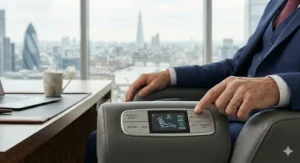
Key specifications: Eight-point massage system with controller, heating and active cooling functions, 160° recline, premium mesh construction, iPod-style digital controller, adjustable lumbar support with memory function, height adjustment 45-55 cm, weight capacity 135 kg. The active cooling function – rare in office chairs at any price – employs actual ventilation rather than merely “breathable” materials.
Expert perspective: What sets the X7 Smart apart is genuine innovation rather than incremental improvement. The active cooling system uses quiet fans to circulate air through the mesh backrest, providing tangible temperature reduction during warm months. For UK professionals working in loft conversions or conservatories that become greenhouses during our increasingly warm summers, this proves transformative – you can remain comfortable during July heatwaves without the massage chair adding to your discomfort. The heating function operates independently, allowing seasonal adjustment. The digital controller (resembling an iPod Classic, complete with click wheel) provides granular control over massage zones, intensity, and temperature. You can programme specific combinations – perhaps gentle massage with moderate cooling for morning work sessions, intense massage with heating for evening relaxation.
However, let’s address the elephant in the room: the £1,100-£1,300 price point. This isn’t a chair you purchase on impulse; it’s an investment requiring justification. The build quality justifies some premium – premium mesh construction, robust mechanisms, thoughtful engineering throughout. But you’re also paying for innovation: active cooling in office chairs remains rare, and the sophisticated controller represents genuine R&D investment.
From a UK buyer’s perspective, the chair handles our climate’s quirks well: the cooling prevents summer discomfort, the heating addresses our cold, damp winter months, and the mesh construction copes with humidity fluctuations that cause leather to crack and PU to deteriorate. British reviewers note some concerns about long-term durability of the electronic systems – more components mean more potential failure points.
Customer feedback summary: UK purchasers emphasise the cooling function’s effectiveness and the overall premium feel. Tech enthusiasts appreciate the sophisticated controls, whilst some question whether the innovation justifies the substantial price premium over £200-300 chairs that deliver 80% of the functionality.
Pros:
✅ Active cooling function genuinely reduces temperature during warm months
✅ Sophisticated digital controller enables precise customisation
✅ 160° recline with premium mesh provides exceptional comfort
Cons:
❌ £1,100-£1,300 price point demands serious justification
❌ Complex electronic systems create potential long-term reliability concerns
Price & verdict: Available around £1,200-£1,300 on Amazon.co.uk, the Hbada X7 Smart represents the pinnacle of office massage chair technology. For executives with generous furniture budgets or those experiencing genuine discomfort during long work sessions, it delivers innovation that cheaper alternatives cannot match. For budget-conscious professionals, excellent options exist at one-quarter the price.
How to Choose the Right Office Massage Chair for Your UK Workspace
Selecting an office massage chair for executives demands more than simply choosing the highest-starred Amazon listing. British buyers face specific considerations – from compact home office dimensions to our peculiar climate – that influence which chair genuinely suits your needs.
Size and spatial constraints matter more than you’d think. Measure your workspace before you’re seduced by marketing photos showing chairs in vast, minimalist offices. A chair that appears modestly sized on screen can overwhelm a 2.5-metre-square spare bedroom masquerading as your home office. The HSE guidance on seating at work emphasises that workspace arrangement must accommodate both the worker and their equipment comfortably. Consider both upright and fully reclined dimensions – that 135° recline might extend 140 cm from the backrest, potentially crashing into filing cabinets or walls. British homes, particularly terraced properties and modern flats, often feature smaller rooms than American or Canadian equivalents. A chair measuring 68 cm wide might fit technically but leave you feeling cramped every time you swivel.
Weight capacity deserves honest assessment, not optimistic guessing. Manufacturers typically rate chairs at absolute maximum safe loads rather than comfortable operating weights. If you’re 115 kg, a chair rated for 120 kg will technically support you but likely feel stressed and exhibit accelerated wear. Build in 15-20% capacity headroom for longevity and confidence. Remember that weight limits assume even distribution – leaning heavily on armrests or reclining aggressively creates forces exceeding your static weight.
Massage point quantity and placement require understanding your pain patterns. Six-point systems typically cover shoulders (×2), lower back (×2), and seat (×2) – adequate for most professionals experiencing standard desk-work tension. Eight-point systems add mid-back or thigh coverage, valuable if you experience specific discomfort in those zones. More massage points don’t automatically equal better relief; precise placement targeting your problem areas proves more valuable than numerous points scattered randomly. Consider where you actually feel tension: pure lower back sufferers needn’t pay premiums for shoulder massage they’ll never use, whilst those battling upper back and neck tension want comprehensive coverage.
Heating function sophistication varies dramatically between models. Basic single-zone lumbar heating operates at one temperature – tolerable in autumn, potentially excessive in summer, barely noticeable mid-winter. Three-level adjustable heating adapts to seasons and personal preference. Dual-zone systems (lumbar and seat) provide enveloping warmth particularly welcome during British winters when home office heating bills encourage economical thermostat settings. The trade-off is power consumption: sophisticated heating systems can draw 60-80W versus 30-40W for basic models, adding approximately £15-25 annually to electricity costs if run several hours daily.
Upholstery material profoundly affects long-term satisfaction. PU leather looks executive and cleans easily but can feel sticky during warm months and eventually cracks with age. Microfiber breathes better, handles temperature fluctuations more gracefully, and ages more gracefully but shows stains more readily. Genuine leather develops beautiful patina over years but commands significant premiums and requires maintenance. For UK buyers, consider your workspace climate control: if you’re working in an un-air-conditioned loft conversion, breathable microfiber proves more comfortable than PU leather during July and August.
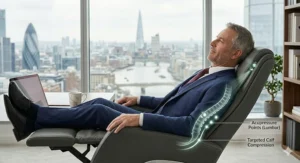
Recline angle and locking positions determine functional versatility. A 120° recline suffices for brief relaxation breaks but limits genuine rest opportunities. 135-145° enables comfortable power naps. 150-160° approaches horizontal positioning, valuable for meditation or serious rest but demands floor space when deployed. Equally important: how many locking positions does the recline offer? Some chairs lock at 90°, 110°, and maximum recline only, forcing you into predetermined positions. Better models feature infinite locking at any angle, allowing you to find your optimal position rather than compromising.
Assembly complexity varies wildly and rarely correlates with price. Some £250 chairs arrive partially assembled, clicking together in 10 minutes with minimal tools. Others demand 45-minute assembly sessions involving dozens of bolts, washers, and spring assemblies that test your patience and back health. Read recent UK reviews specifically mentioning assembly – Americans often have different tolerances for “easy assembly” than British buyers accustomed to flatpack furniture culture. If you live alone or lack assembly assistance, prioritise models with positive assembly feedback rather than assuming higher prices mean simpler construction.
Common Mistakes When Buying Executive Massage Chairs in the UK
Overlooking voltage and plug compatibility remains surprisingly common. Most chairs sold on Amazon.co.uk are UK-compatible (230V, Type G plug), but occasionally European models appear with continental plugs requiring adapters. Verify the listing explicitly states UK plug before purchasing – using adapter blocks with high-wattage massage chairs can create safety hazards.
Ignoring Amazon.co.uk availability versus international sellers causes delivery disappointment. Some listings show products technically “available” but ship from Asia with 3-6 week delivery times and potential customs charges post-Brexit. Filter for UK warehouse stock or Amazon Prime eligibility to ensure swift delivery and straightforward returns under UK consumer protection.
Underestimating the importance of after-sales support proves costly. Massage chairs contain motors, heating elements, and electronic controls – components that occasionally fail. Purchasing from unknown third-party sellers offering suspiciously low prices often means non-existent customer service when issues arise. Established brands like HOMCOM, Vinsetto, and ELFORDSON maintain UK customer service contacts and honour warranties. The £30 saved buying from “TechDealz2026” evaporates when your massage motor fails and nobody responds to emails.
Falling for inflated “original price” marketing distorts value perception. Amazon listings frequently show chairs “reduced” from £499 to £189, implying substantial savings. In reality, £189 might represent consistent market price. Use CamelCamelCamel or similar price tracking tools to verify genuine discounts versus manufactured urgency. British consumer protection requires honest pricing, but enforcement remains inconsistent.
Neglecting to measure doorways, stairwells, and lift access creates delivery day chaos. Executive massage chairs arrive in substantial boxes – often 120 cm × 70 cm × 40 cm. If you live in a third-floor flat with narrow Victorian staircases or a modern building with compact lifts, verify the boxed chair will actually reach your workspace. Delivery drivers won’t haul 30 kg boxes up three flights if they don’t fit through your stairwell bend.
Expecting massage chairs to cure chronic pain conditions without medical consultation invites disappointment. Massage chairs provide symptomatic relief for typical desk-work tension – they’re not medical devices treating diagnosed conditions. If you’re experiencing chronic pain, numbness, or symptoms beyond ordinary muscle tension, consult your GP before self-treating with massage equipment. While these chairs help many UK workers manage everyday discomfort, they complement rather than replace proper medical assessment.
Ignoring the impact of British weather on outdoor delivery and storage proves shortsighted. Most chairs arrive wrapped in protective plastic, but cardboard boxes deteriorate rapidly in rain. If delivery occurs during typical British drizzle and the box sits outside for hours, moisture can penetrate packaging. Arrange delivery for days when someone’s home, or use Amazon Locker services where available. Additionally, if you’re storing a chair seasonally (perhaps moving it to make space), British damp can damage electronic components over months – keep stored chairs in dry environments rather than garden sheds or unheated garages.
Office Massage Chair vs Traditional Executive Chair: Which Delivers Better Value?
This comparison demands honest assessment rather than assumption that “more features equals better.” Traditional executive chairs typically range £80-£300 on Amazon.co.uk, offering ergonomic support, adjustable features, and premium aesthetics. Massage chairs start around £110 but quickly reach £200-350 for quality models. Does the £100-200 premium for massage functionality deliver proportional value?
For pain prevention and relief, massage chairs provide quantifiable advantages. The Health and Safety Executive recognises that work-related musculoskeletal disorders cost British businesses approximately 7.3 million lost working days annually. Massage chairs actively address this through vibration therapy that increases blood flow, reduces muscle tension, and promotes recovery during the workday rather than merely providing passive support. If you currently spend £30-40 monthly on physiotherapy, osteopathy, or deep tissue massage for desk-work-related discomfort, a £200 massage chair achieves payback within 5-7 months. Traditional executive chairs prevent worsening through proper support but offer no active treatment.
However, massage chairs sacrifice some ergonomic sophistication for therapeutic features. Premium traditional executive chairs from Herman Miller, Steelcase, or HÅG incorporate advanced lumbar support systems, synchro-tilt mechanisms, and adjustable armrests engineered through extensive ergonomic research. Massage chairs typically offer simpler ergonomic adjustments, redirecting design focus toward massage and heating systems. For professionals with specific ergonomic requirements – perhaps unusually tall or short stature, particular back conditions, or precise positioning needs – a sophisticated traditional chair might provide better long-term postural support than a feature-rich massage chair with adequate but unremarkable ergonomics.
Build quality and longevity create interesting trade-offs. Premium traditional executive chairs from established manufacturers often carry 5-10 year warranties and genuinely last decades with minimal maintenance. Massage chairs introduce motors, heating elements, and electronic controls – additional components that can fail, typically within 2-5 years of regular use. Consider total cost of ownership: a £300 traditional chair lasting 10 years costs £30 annually; a £250 massage chair lasting 5 years before motor failure costs £50 annually. However, if the massage chair delivers genuine daily relief from tension headaches or back pain, the value calculation shifts dramatically.
For professionals working from home without access to workplace wellness programmes, massage chairs offer unique value. Traditional office environments increasingly provide ergonomic assessments, adjustable desks, and even on-site massage therapy as employee benefits. Remote workers fund their own wellness solutions. A massage chair transforms your home office into a wellness space, providing therapeutic benefits previously requiring dedicated appointments or visits. The convenience factor proves valuable: using your massage chair for 20 minutes mid-afternoon requires no travel, no appointment booking, no additional cost beyond initial purchase.
The optimal solution for many British executives combines both approaches: a high-quality ergonomic chair for core workdays, supplemented by a massage recliner positioned nearby for specific relief sessions. This avoids forcing your massage chair to serve as primary seating 8-10 hours daily, reducing wear on its mechanical components whilst maintaining access to therapeutic benefits when needed. However, this demands space – a luxury not afforded in typical British home offices.
Maximising Your Massage Chair: A Practical Usage Guide for UK Professionals
Purchasing an office massage chair for executives represents merely the beginning; extracting maximum value requires understanding optimal usage patterns, maintenance routines, and integration into your work rhythm.
Strategic timing amplifies therapeutic benefits. Deploy massage functions during natural work breaks rather than arbitrarily or continuously throughout your day. The optimal pattern for most professionals: gentle massage mid-morning (around 11 AM) for 15-20 minutes to address early tension accumulation, lunch break power nap with full massage and heating (20-30 minutes), and intensive evening massage (30-40 minutes) after work completion. Continuous massage throughout work hours creates diminishing returns – your muscles become accustomed to stimulation, reducing effectiveness. Intermittent targeted sessions maintain sensitivity and deliver better relief.
Temperature control demands seasonal adjustment aligned with British weather patterns. January through March: utilise full heating to combat cold, damp conditions that exacerbate muscle tension. April-May and September-October: moderate heating (level 1-2 if available) suits mild but variable temperatures. June-August: minimal or zero heating during our brief but increasingly warm summers, focusing on massage functions alone or utilising cooling features if your chair offers them. November-December: resume moderate heating as temperatures drop and heating bills encourage economical thermostat settings that leave home offices slightly chilly.
Posture optimisation while using massage functions requires attention. Ironically, poor posture during massage sessions can create new tension whilst addressing existing problems. The HSE’s guidance on working with display screen equipment provides excellent baseline principles: position yourself centrally in the seat with weight distributed evenly across both hips. Ensure lumbar support aligns with your lower back curve rather than pushing against mid-back or buttocks. Adjust armrests so your elbows rest comfortably without hunching shoulders upward or allowing arms to dangle. During reclined massage sessions, maintain head support with the integrated headrest rather than allowing your neck to hyperextend backward – this protects cervical vertebrae whilst massage addresses other areas.
Maintenance routines extend chair longevity significantly. Weekly: wipe down upholstery with slightly damp microfiber cloth to remove accumulated dust and skin oils; vacuum crevices where debris collects. Monthly: check all adjustment knobs and mechanisms, tightening any that have loosened through regular use; inspect power cables for fraying or damage, particularly where cables flex repeatedly. Quarterly: apply appropriate upholstery treatment – leather conditioner for genuine leather models, protective spray for microfiber variants, gentle cleaner for PU leather. Annually: lubricate moving parts with silicone spray (not WD-40, which attracts dust); verify all bolts remain snug, particularly those connecting seat to base.
British climate considerations affect long-term chair health. Our damp conditions can encourage mildew growth on upholstery if chairs occupy poorly ventilated spaces. If your home office tends toward dampness (common in older properties, basements, or insufficiently heated spare rooms), consider running a small dehumidifier to maintain 40-60% relative humidity. This protects both your chair’s upholstery and its electronic components from moisture-related deterioration. Additionally, avoid positioning massage chairs near radiators or in direct sunlight through windows – temperature extremes and UV exposure degrade upholstery and can damage electronic controls.
Integration with other workspace wellness practices multiplies benefits. Combine massage chair use with brief standing breaks every hour, simple stretching routines between massage sessions, and proper ergonomic monitor positioning to avoid the massage chair becoming a crutch compensating for otherwise poor workspace setup. The British Safety Council emphasises that preventing musculoskeletal disorders requires a holistic approach including proper equipment, regular movement, and early intervention when symptoms appear.
UK Regulations and Standards for Office Massage Chairs
British workplace regulations approach office seating with specific requirements that affect both employers purchasing massage chairs for staff and individuals selecting chairs for home offices potentially claiming business expenses.
The Workplace (Health, Safety and Welfare) Regulations 1992, specifically Regulation 11, establishes fundamental seating requirements. While massage functions aren’t explicitly addressed (the regulation predates massage chairs entering mainstream office use), the core principle demands that “a suitable seat shall be provided for each person at work in the workplace whose work includes operations of a kind that the work can or must be done sitting.” You can review the complete regulations on the legislation.gov.uk website. Suitability encompasses appropriate dimensions, adequate support, and proper adjustability – standards that quality massage chairs meet or exceed.
Electrical safety standards mandate UKCA marking post-Brexit. Prior to 2021, CE marking indicated European safety compliance. Following Brexit, products sold in Great Britain require UKCA (UK Conformity Assessed) marking, though CE marks remain accepted during transition periods. When purchasing massage chairs on Amazon.co.uk, verify listings explicitly mention UKCA compliance or display the marking in product photos. This certification confirms the chair’s electrical components meet UK safety standards for voltage, insulation, and electromagnetic compatibility. Non-compliant products technically shouldn’t be sold in Britain and may pose safety risks.
BS EN 1335 represents the British Standard for office seating, covering design, dimensions, and safety. While compliance isn’t legally mandatory for all office chairs, adherence to BS EN 1335 demonstrates quality construction and appropriate ergonomic design. Premium massage chair manufacturers often cite this standard in specifications; budget models typically don’t, which doesn’t necessarily indicate unsafety but suggests less rigorous engineering validation. For employers purchasing chairs for staff or individuals claiming business expenses, BS EN 1335 compliance provides documentation supporting the purchase as legitimate business equipment rather than domestic furniture.
Fire safety regulations affect upholstery materials in commercial settings. The Furniture and Furnishings (Fire) (Safety) Regulations 1988 require domestic upholstered furniture sold in Britain to meet specific ignitability standards. Office furniture intended for commercial use faces additional scrutiny under workplace fire regulations. If you’re purchasing a massage chair for a traditional office rather than home use, verify it carries appropriate fire safety labelling. Most chairs on Amazon.co.uk meet domestic standards; commercial applications may require specific certification.
Consumer protection under the Consumer Rights Act 2015 provides strong UK buyer safeguards. Products purchased from Amazon.co.uk must be of satisfactory quality, fit for purpose, and as described. The UK Government’s consumer protection guidance outlines your rights clearly. If your massage chair arrives with non-functioning massage motors or heating elements, you’re entitled to repair, replacement, or refund. Additionally, the Consumer Contracts Regulations grant a 14-day cooling-off period for online purchases, allowing you to return the chair for any reason – though you’ll typically bear return shipping costs unless the product is faulty. These protections prove particularly valuable for massage chairs given their mechanical complexity and potential for defects.
VAT on office furniture requires understanding for business expense claims. Massage chairs sold on Amazon.co.uk include 20% VAT in displayed prices. If you’re self-employed or operate through a limited company, you can potentially reclaim this VAT, making a £240 chair effectively £200. However, claiming requires legitimate business use documentation and proper accounting. The HMRC guidance on business expenses provides detailed information for self-employed individuals.
Long-Term Cost & Maintenance: What UK Owners Actually Spend
The ticket price on Amazon.co.uk represents merely the initial investment; understanding total cost of ownership over typical 3-5 year massage chair lifespans provides realistic budgeting.
Electricity consumption varies substantially by model and usage pattern. Basic vibration-only massage chairs draw approximately 30-40W during operation – comparable to a laptop computer. Models with heating functions consume 60-80W when heat is active, rising to 100-120W for sophisticated dual-heating systems. Chairs with active cooling (like the Hbada X7 Smart) can draw 150W+ during simultaneous massage and cooling operation. In practical British terms, running a 75W chair for two hours daily costs approximately £35-45 annually at current electricity rates (averaging 25-30p per kWh as of April 2026). That’s manageable, but worth noting if you’re fastidious about energy costs.
Replacement parts and repairs create less predictable expenses. Quality massage chairs from established manufacturers should operate 2-3 years before requiring intervention. Common failure points: massage motors (£40-80 replacement plus labour if you’re not mechanically inclined), heating elements (£30-60), gas lift cylinders (£25-45), and castors (£15-30 per set). Electronic controllers rarely fail within typical ownership periods but prove costly (£60-100+) when they do. Budget approximately £40-60 annually for minor repairs and part replacements during years 3-5 of ownership. Some manufacturers offer extended warranties (typically £30-50 annually) that may prove worthwhile if you’re using massage functions extensively daily.
Upholstery maintenance and eventual replacement factor into long-term costs. PU leather typically lasts 3-4 years before showing significant wear, cracking, or peeling, particularly on high-contact areas like armrests and seat edges. Professional reupholstering costs £150-250 for executive chairs – often uneconomical given chair replacement costs. Microfiber generally lasts 4-5 years before staining or fabric deterioration become noticeable. Genuine leather, properly maintained, can look distinguished for 7-10 years but requires annual conditioning (£8-15 for quality leather conditioner). Factor eventual replacement rather than repair into your budget planning.
Comparison against alternative wellness solutions contextualises value. Monthly physiotherapy sessions for work-related back pain typically cost £35-60 per visit in Britain; weekly visits total £140-240 monthly or £1,680-2,880 annually. According to NHS guidance on back pain, many cases of work-related discomfort can be managed through proper posture, regular movement, and supportive seating. Even a premium £300 massage chair achieving 30% of the relief provided by professional treatment delivers remarkable ROI within the first year. Gym memberships specifically for sauna/massage facilities average £40-70 monthly in UK cities – another £480-840 annually. Home massage chairs may not fully replace these services but can significantly reduce their frequency, creating genuine savings whilst providing convenience that dedicated appointments cannot match.
Depreciation and eventual disposal considerations often escape initial budgeting. Massage chairs depreciate rapidly – a £250 chair might fetch £60-80 on Facebook Marketplace after three years, assuming components still function. Unlike premium traditional executive chairs (Herman Miller Aeron models famously retain 40-50% of original value after five years), massage chairs’ mechanical complexity and perceived wear limit resale appeal. Additionally, disposal requires consideration: British councils classify chairs as bulky waste, often charging £15-35 for collection. Factor end-of-life costs into total ownership calculations.
Tax implications for business use can offset costs for eligible individuals. Self-employed professionals can claim massage chairs as allowable business expenses if used primarily for work purposes, reducing taxable income. At 20% basic rate, a £240 chair effectively costs £192 after tax relief; at 40% higher rate, £144. Employed individuals cannot claim direct expenses but may receive tax relief through employer provision or salary sacrifice schemes if their company operates flexible benefits programmes. Consult HMRC’s employment income manual or professional tax advisors regarding your specific circumstances.
Frequently Asked Questions
❓ Are massage chairs suitable for use in UK home offices throughout the year?
❓ How long do massage chair motors typically last with daily UK use?
❓ Can I claim a massage chair as a business expense in the UK?
❓ Do massage chairs comply with UK electrical safety standards post-Brexit?
❓ What weight capacity should I choose for long-term durability?
Conclusion: Investing in Your Executive Wellness
The right massage chair transforms your relationship with desk work from endurance test to sustainable professional practice. For British executives navigating the realities of modern work – whether that’s video calls from your spare bedroom in Birmingham, quarterly reviews from your Canary Wharf office, or managing distributed teams from a cottage in the Cotswolds – these chairs provide genuinely valuable wellness support.
The evidence speaks clearly: work-related musculoskeletal disorders affect hundreds of thousands of UK professionals annually, costing businesses millions in lost productivity and individuals considerable discomfort. Research published by Cardinus on workplace MSDs highlights that these conditions result in around 7.3 million lost working days annually in the UK. Whilst massage chairs aren’t miracle cures, they provide active, convenient relief that traditional seating simply cannot match. The investment proves particularly compelling for remote workers who’ve exchanged workplace wellness programmes for home office independence.
Our analysis reveals distinct value tiers serving different needs and budgets. The HOMCOM 6-Point delivers remarkable functionality around £120-140, proving you needn’t spend extravagantly for genuine benefits. Mid-range options like the Vinsetto Microfiber and ELFORDSON 8-Point (£160-280) provide measurable improvements in comfort, customisation, and build quality that justify their premiums for daily users. Premium offerings like the Hbada X7 Smart deliver innovation and luxury that some professionals will find worthwhile, though excellent value exists at one-quarter the price.
The optimal choice depends on your specific circumstances: workspace dimensions, budget constraints, particular pain patterns, and honest assessment of how extensively you’ll use massage functions. A £250 chair used twice weekly delivers questionable value; that same chair providing daily relief from tension headaches or lower back pain proves transformative.
Browse the options we’ve highlighted, read customer reviews from fellow British buyers, and select a chair that addresses your specific needs rather than simply choosing the highest-rated or most expensive option. Your back, neck, and overall wellbeing will benefit from the investment. Consider it professional equipment as essential as your computer or desk – because maintaining your physical health directly impacts your professional effectiveness.
Recommended for You
- 7 Best Massage Chair for Athletes Recovery UK 2026 Guide
- Zero Gravity vs Regular Massage Chair: 7 UK Winners 2026
- Are Massage Chairs Worth It? 7 Tested Options UK 2026
Disclaimer: This article contains affiliate links. As an Amazon Associate, I earn from qualifying purchases. If you purchase products through these links, we may earn a small commission at no additional cost to you.
✨ Found this helpful? Share it with your mates! 💬🤗
